
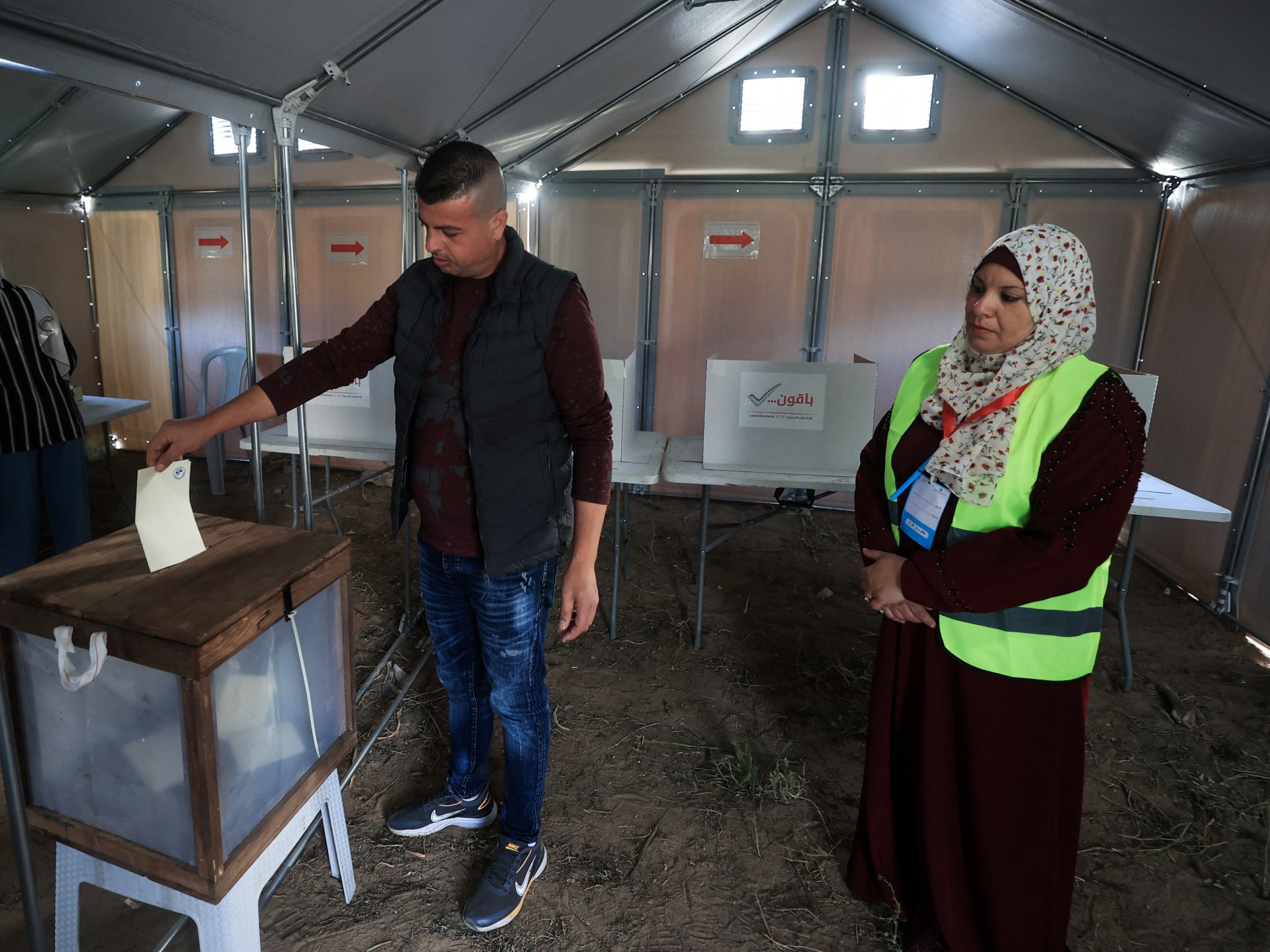

Palestinians in central Gaza and the occupied West Bank have begun voting in municipal elections, the first local vote held since the start of Israel’s genocidal war on Gaza.
Polling stations opened at 7am (04:00 GMT) on Saturday for 70,000 eligible voters in Gaza’s Deir el-Balah area – the first such exercise in the besieged enclave in 20 years.
- list 1 of 4West Bank scepticism as Palestinians doubt local elections will change much
- list 2 of 4‘Solutions, not slogans’: Gaza holds first election in 21 years
- list 3 of 4Elections without sovereignty: What Palestine’s local vote really represent
- list 4 of 4Israel kills at least 12 Palestinians in Gaza amid ‘ceasefire’
end of list
The vote in a single city in Gaza, on the other hand, is largely symbolic, with officials calling it a “pilot”.
Nearly 1.5 million registered voters in the occupied West Bank are also voting to determine the makeup of the local councils overseeing water, roads and electricity.

The elections come as the Palestinian Authority (PA) seeks to project reform and legitimacy amid growing public frustration over corruption, political stagnation and the absence of national elections since 2006.
Most electoral lists are backed by President Mahmoud Abbas’s Fatah movement or independent candidates, with no official participation from Hamas, which controls parts of Gaza.
With much of Gaza decimated by more than two years of war, the Ramallah-based Central Elections Commission chose to hold its first vote in Deir el-Balah. It had to improvise because it was unable to conduct traditional voter registration.
“The main idea is to link the West Bank and Gaza politically as one system,” its spokesperson, Fareed Taamallah, said.
Advertisement
The commission has not coordinated directly with either Israel or Hamas ahead of the Deir el-Balah vote and has been unable to send materials like ballot papers, ballot boxes or ink into Gaza, he added.
Though Palestinian voter turnout has gradually decreased, it has been relatively high in past local elections by regional standards, according to commission figures, averaging between 50 and 60 percent.
Gaza’s first election in 20 years
Hamas won parliamentary elections in 2006 and seized control of Gaza from the Fatah-led PA a year later.
It did not put forth candidates for Saturday, but polling from the Palestinian Center for Policy and Survey Research indicates it remains the most popular Palestinian faction in both Gaza and the occupied West Bank.
Ramiz Alakbarov, the United Nations deputy special coordinator for the Middle East peace process, called the elections “an important opportunity for Palestinians to exercise their democratic rights during an exceptionally challenging period”.
Hamas controls half of Gaza, which Israeli forces partially withdrew from last year, including Deir el-Balah, but the coastal enclave is preparing to transition to a new governance structure under US President Donald Trump’s 20-point plan.
The plan established a Board of Peace composed of international envoys and a committee of unelected Palestinians, intended to operate under it.
Progress towards further phases, including disarming Hamas, reconstruction and a transfer of power, has stalled.

Electoral reform
Palestinian President Mahmoud Abbas, 90, signed a decree last year to overhaul the electoral system in line with some demands from Western donors.
The reforms allow voting for individuals rather than party lists (slates), lowering the eligibility age to run and raising quotas for female candidates.
In January, another Abbas decree required candidates to accept the programme of the Palestine Liberation Organization, the group that leads the PA. The programme calls for the recognition of Israel and renouncing armed struggle, in effect, sidelining Hamas and other factions.
The slates in major West Bank cities are dominated by Fatah, the faction that leads the PA, and independents, some with ties to other factions. It marks the first time in six local elections that no other faction has officially put forward its own slates.

In the occupied West Bank, the PA exercises limited autonomy, and local councils oversee services from rubbish collection to building permits.
Advertisement
Votes are being held in villages in Area C, which covers about 60 percent of the West Bank and remains under direct Israeli control. Full administrative control would have been handed to the PA according to the 1995 Oslo Accords.
Votes will also be held in municipalities that Israel’s military has occupied since it launched a ground invasion in the northern West Bank last year.
Campaign posters have been plastered across cities, though many – including Ramallah and Nablus – will not hold elections because too few candidates or slates registered.
The PA’s power has withered amid years without peace negotiations with Israel and the expansion of illegal Israeli settlements in the occupied West Bank.
Related News
Flu vaccine no longer mandatory for soldiers, says US military chief
Peru’s ballot count drags on amid frustration with presidential election
Iran citizen held in France over pro-Palestine comments returns home