

Armenian Prime Minister Nikol Pashinyan has rejected a call from Moscow to hold an immediate referendum on leaving the Russian-led Eurasian Economic Union (EAEU) to join the European Union.
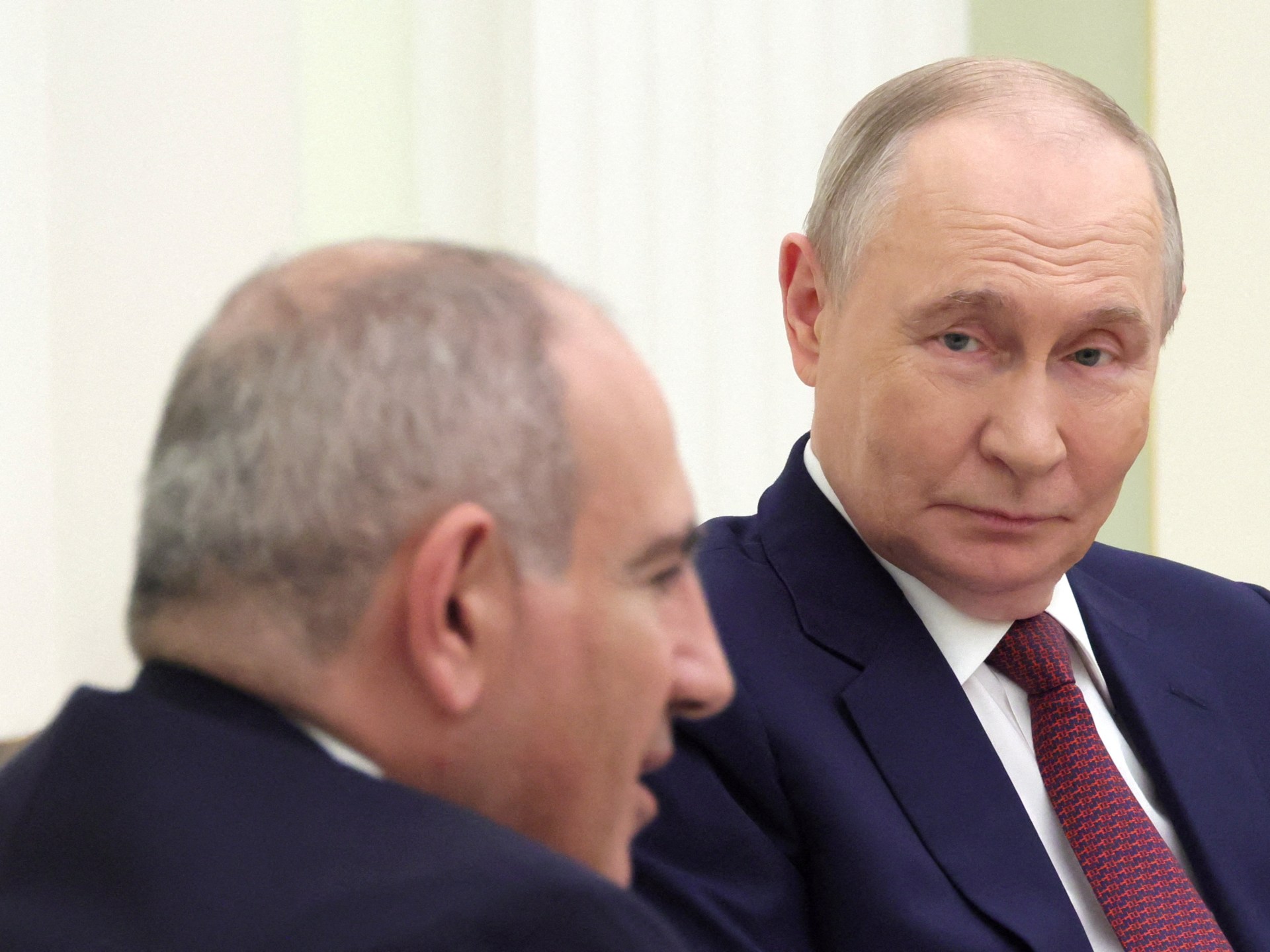
The refusal from Pashinyan came on Monday as Russian President Vladimir Putin called, ostensibly to wish him a happy birthday. The “unreasonable” demand, as the Armenian leader termed it, came amid a rapid escalation of economic and diplomatic pressure from the Kremlin as its traditional ally increasingly looks to the West.
- list 1 of 3Armenia hosts major EU summits in pivot away from Russia
- list 2 of 3Armenia signs strategic partnership deal with US as election approaches
- list 3 of 3Macron sings as Armenia’s leader drums in unusual moment at state dinner
end of list
Tensions boiled over at the EAEU summit in Kazakhstan on May 29, as Putin and fellow bloc members Belarus, Kazakhstan and Kyrgyzstan issued a joint statement urging Armenia to hold a referendum on joining the EU “as soon as possible”.
Membership of both the EU and EAEU is impossible, the Russian leader insists.
Putin also appeared to make a barely-veiled threat, warning Armenia against pursuing its Western ambitions, and noting that the “Ukrainian scenario” had begun with Kyiv’s EU aspirations.
In a video address broadcast on social media, Pashinyan stated that the government in the capital Yerevan would continue working within the EAEU until a choice between the two blocs “becomes unavoidable”, noting that any referendum before Armenia formally applies for EU candidate status remains purely theoretical.
“Putting a theoretical choice to a referendum is, of course, neither very sensible nor justified,” Pashinyan said, describing ties with Russia as being in a “transformation phase”.

Both the Kremlin and Yerevan said that Putin had called Pashinyan to discuss the outcome of the summit, and to offer him birthday wishes.
Advertisement
However, Russia has been raising the pressure on Armenia significantly ahead of ahead of parliamentary elections in the Caucasian country on June 7.
Over the weekend, Moscow recalled its ambassador to Armenia for consultations.
On Monday, Russia’s agricultural watchdog suspended fish and seafood imports from Armenia, citing health violations.
The embargo hits a vital sector that sends 30 percent of its exports to Russia, and follows trade bans on Armenian produce, flowers, mineral water and alcohol – a common tactic employed by Moscow displeased by former colonies.
The European Union accused Moscow on Monday of attempting to cripple Armenia’s economy to influence the upcoming election outcome.
Long allied with Russia, the former Soviet republic has been diversifying its partnerships since its neighbour failed to intervene during Azerbaijan’s 2023 military offensive in Nagorno-Karabakh, which saw Armenia lose control of the territory over which the pair had argued for decades.
That process has accelerated since Moscow invaded neighbouring Ukraine in February 2022.
Yerevan has significantly deepened its European ties, hosting its first official EU summit last month alongside a wider European gathering attended by Ukrainian President Volodymyr Zelenskyy.
Armenia also hosted French President Emmanuel Macron for a high-profile state visit, which provoked sharp criticism from the Kremlin after a video emerged of Macron singing while Pashinyan played the drums.
Related News
Iran reasserts control over Hormuz Strait as deal with US remains elusive
‘Want equal respect’: Pakistan’s females galloping to glory in tent pegging
Ukraine drones strike Russian oil facility, as Kyiv and Moscow trade blows