
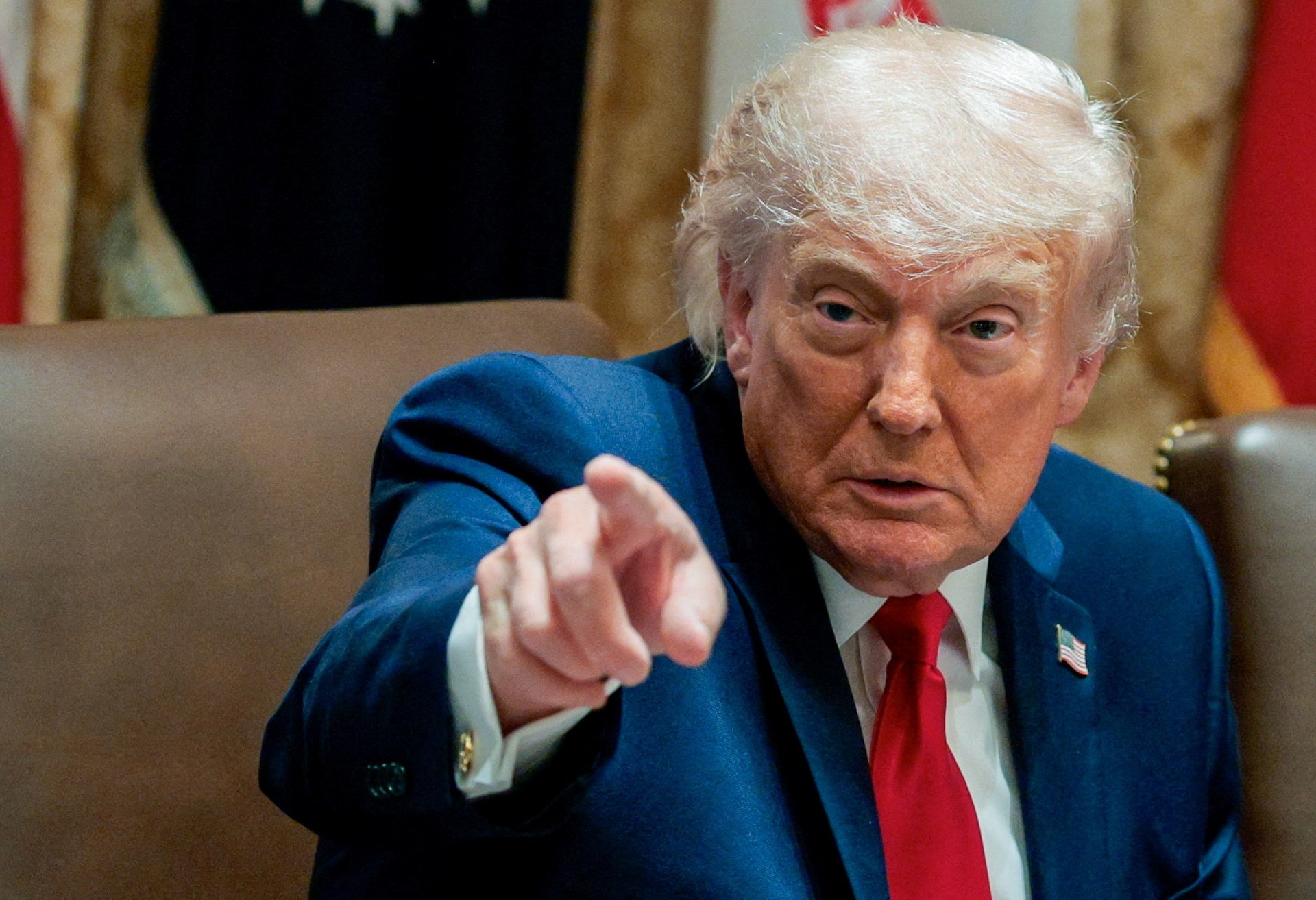

United States President Donald Trump will reportedly drop his $1.8bn “anti-weaponisation” fund amid congressional backlash, including from fellow Republicans.
On Monday, US media indicated the fund would be paused, though the White House has yet to publicly confirm the reports.
- list 1 of 4Could Democrats be shut out of the California governor’s race?
- list 2 of 4US measure to deepen Israel military cooperation faces bipartisan pushback
- list 3 of 4Newark mayor imposes curfew at Delaney Hall immigration detention centre
- list 4 of 4Former election clerk Tina Peters released after Trump pressure campaign
end of list
Axios was the first to break the news, citing an unnamed senior official. “It’s dead for now,” the official told the news outlet.
The “anti-weaponisation” fund was announced last month as part of a settlement between Trump and the Internal Revenue Service (IRS), part of his executive branch.
According to documents released by the Department of Justice, the $1.8bn was slated to serve as payment for victims of “lawfare” and government “weaponisation”.
Trump himself has repeatedly painted himself as such a victim, framing himself and his allies as victims of unfair government prosecution.
Monday’s announcement came after Trump met with House Speaker Mike Johnson over Republican concerns about the “anti-weaponisation” fund.
Senate Majority Leader Mike Thune has likewise called for the fund to be dropped, as he seeks to rally Republicans to pass a $72bn immigration enforcement funding bill.
Still, Democrats on the Senate floor argued that the reported pause did not go far enough.
“The press reports that Trump says he will table his $2bn MAGA slush fund,” Senate Minority Leader Chuck Schumer said, using the acronym for Trump’s “Make America Great Again” movement.
“But a promise from Trump is worthless. If Trump and Republicans are truly abandoning this corrupt scheme, they should have zero problem banning it in law.”
Advertisement
He pledged to advance legislation to “ensure no president can ever do this again”.
Inside the controversy
Plans for the $1.8bn “anti-weaponisation” fund were revealed on May 18, shortly after Trump agreed to drop his case against the IRS.
Trump had filed the lawsuit in January, alleging that the IRS was responsible for the leak of his tax returns, information from which was published in The New York Times and ProPublica, starting in 2020.
The Republican leader sought $10bn in damages, though critics argued that the lawsuit faced an uphill battle.
There were questions about whether it fell within the statute of limitations and whether the IRS could be held responsible for the actions of an outside contractor, Charlies Littlejohn, who was convicted of leaking the documents.
The lawsuit and the subsequent settlement also raised outcry over apparent conflicts of interest, since Trump was in charge of the IRS and the Department of Justice, which represented the tax agency in court hearings.
After announcing the lawsuit’s settlement in May, the Department of Justice revealed its plans to set up the fund.
An additional settlement document also was made public, saying Trump and his family would have lifelong immunity from any IRS audits.
While the Department of Justice had yet to outline who would be eligible for the “anti-weaponisation” fund, acting Attorney General Todd Blanche has declined to rule out Trump supporters involved in the attack on the US Capitol on January 6, 2021.
Legal challenges
The “anti-weaponisation” fund has since been criticised as a piggy bank for payouts to Trump allies, and it has faced both legal and congressional pushback.
At least three separate lawsuits have been filed to stop the “anti-weaponisation” fund, including one filed by police officers injured in the January 6 attack.
Last week, a federal judge temporarily blocked the creation of the fund while the court reviewed the case.
The plaintiffs in that lawsuit were represented by the nonprofit Democracy Forward, and they included Andrew Floyd, a former federal prosecutor involved in January 6 cases.
The third lawsuit was led by the government watchdog Citizens for Responsibility and Ethics in Washington (CREW).
All three legal complaints challenged the Trump administration’s legal authority to establish the fund, pointing to the president’s conflicts of interest.
Separately, the federal judge in Florida that was slated to hear Trump’s $10bn IRS complaint has reopened the case, citing details of the settlement that only became public after the case was dropped.
Advertisement
In response to reports that the “anti-weaponisation” fund had been paused, CREW issued a statement that it “never should’ve been proposed in the first place”.
“Trump’s reported temporary abandonment is not enough, and it does not resolve the legal issues raised in CREW’s case or others seeking to block the fund,” Nikhel Sus, CREW’s chief counsel, told Al Jazeera.
“We will continue pressing forward our case until the illegal fund is shuttered permanently.”
Al Jazeera reached out for comment to the White House, which responded by pointing to a post from the Department of Justice on social media, saying it would comply with the court ruling to pause the fund.
“This fund was open to anybody who was so weaponised, targeted, or persecuted, whether they were Democrat, Republican, Conservative, Independent, or otherwise,” the Justice Department said in the post.
Related News

Iran war live: US bombs Qeshm, Goruk; Kuwait reports missile, drone attacks
Taiwan monitors ‘unprovoked’ Chinese combat patrol near island
Iran war day 80: Trump issues warning; Tehran ready to confront aggression