
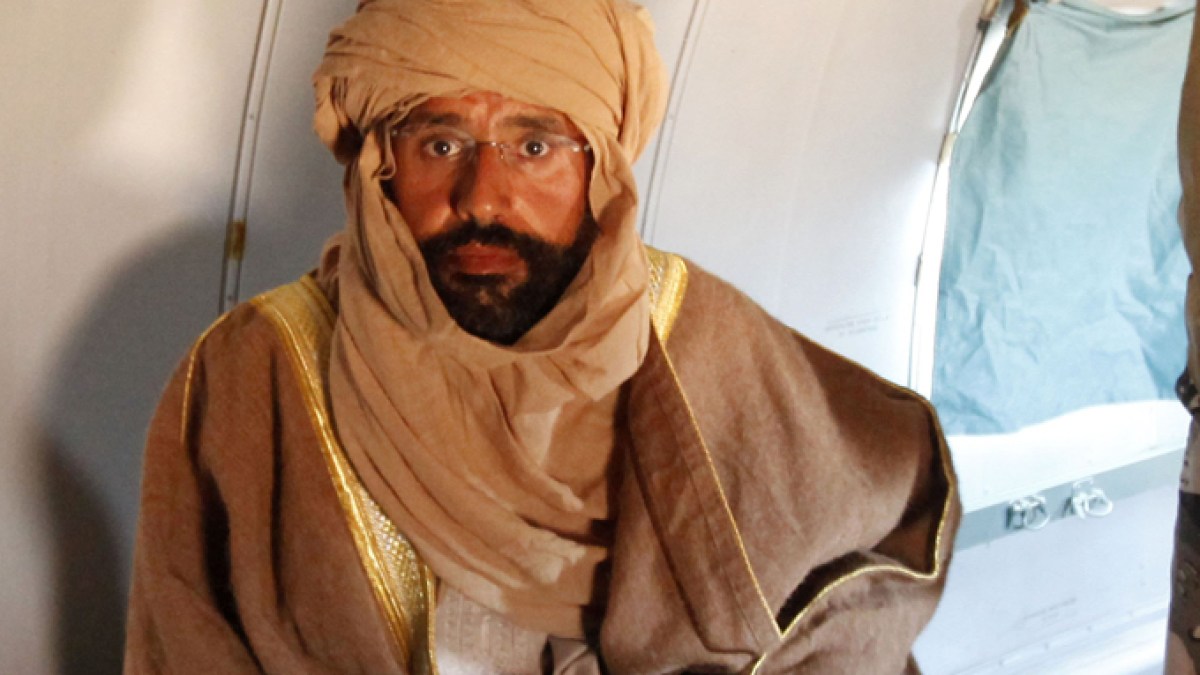

Saif al-Islam Gaddafi, the most prominent son of slain Libyan leader Muammar Gaddafi has himself been killed in the country’s western city of Zintan.
Saif al-Islam, who was 53 when he was killed, was Gaddafi’s second son, and had been based in Zintan since 2011 – first in prison, and then, after 2017, as a free man plotting a return to politics.
- list 1 of 3Saif al-Islam Gaddafi, son of former leader, killed in Libya
- list 2 of 3What would be the impact of a US attack on Iran?
- list 3 of 3Moscow confirms Russian forces helped repel ISIL attack on Niger airport
end of list
But figures close to him, including his political adviser Abdullah Othman and his lawyer Khaled el-Zaydi confirmed his death on Tuesday, although the exact circumstances are still unclear.
Saif al-Islam had been seen by many before the 2011 uprising as his father’s heir apparent and the second-most powerful man in Libya.
He remained prominent throughout the violence that gripped Libya in the wake of the Arab Spring. There were numerous allegations against him of torture and extreme violence against opponents of his father’s rule. By February 2011, he was on a United Nations sanctions list and was banned from travelling.

In June 2011, he announced that his father was willing to hold elections and to step down if he did not win them. However, NATO rejected the offer and the bombardment of Libya continued.
As an internationally prominent negotiator and influencer, Saif al-Islam could claim a number of victories and prominent roles.
By the end of June 2011, the International Criminal Court (ICC) issued an arrest warrant against him, but he remained at large until after the death of his father Muammar and his brother Mutassim in Sirte, on October 20, 2011.
Prison
Following long negotiations with the ICC, which had been calling for his extradition, Libyan officials were granted authority to try Saif al-Islam in Libya for war crimes committed during the 2011 uprising.
Advertisement
At the time, Saif al-Islam’s defence lawyers feared that a trial in Libya would not be motivated by justice, but would be motivated by a desire for revenge. The UN had estimated that up to 15,000 people were killed in the conflict, while Libya’s National Transitional Council placed the figure as high as 30,000.
In 2014, Saif al-Islam appeared via video link in the Tripoli courtroom where his trial was held, as he was incarcerated in Zintan at the time. In July 2015, the Tripoli court sentenced him to death in absentia.
However, in 2017 he was released by the Abu Bakr al-Siddiq Battalion – a militia that controls Zintan – as part of an amnesty issued by Libya’s eastern authorities, which are not recognised internationally.
But he did not reemerge publically for years, and continued to be wanted by the ICC. In July 2021 he gave a rare interview to the New York Times, in which he accused authorities in Libya of being “afraid of … elections”.
Explaining his underground persona at the time, he said that he had “been away from the Libyan people for 10 years.
“You need to come back slowly, slowly. Like a striptease,” he added.
He went on to make his first public appearance in years in November 2021 in the city of Sebha, where he filed to run for the Libyan presidency, in an attempt to resurrect the ambitions of his father’s former supporters.
Initially banned from taking part, he was later reinstated, but the election did not take place as a result of Libya’s tumultuous political situation, with two rival administrations vying for power.
‘Progressive’ face
A Western-educated and well-spoken man, Saif al-Islam presented a progressive face to the oppressive Libyan regime and was extremely visible and active in the drive to repair Libya’s relations with the West between the year 2000 and the start of the 2011 uprising.
He received a PhD from the London School of Economics (LSE) in 2008. His dissertation dealt with the role of civil society in reforming global governance and was prominent in his calls for political reform.
LSE was later condemned for having sought a relationship with the Libyan regime, namely for accepting Saif al-Islam as a student, who had signed an agreement for a $2.4m gift from the Gaddafi International Charity and Development Foundation on the day of his doctorate ceremony.
As an internationally prominent negotiator and influencer, Saif al-Islam could claim a number of victories and prominent roles. He played a pivotal role in the nuclear negotiations with Western powers including the United States and the UK.
Advertisement
He was also prominent when negotiating compensation for families of victims of the Lockerbie bombing, the Berlin nightclub attack, and the UTA Flight 772, which detonated over the Sahara desert.
And he mediated the release of six medics – five of whom were Bulgarian – who were accused of infecting children with HIV in Libya in the late 1990s. The medics were imprisoned for eight years in 1999 and, upon their release, announced that they had been tortured while in detention.
He had a number of other proposals including “Isratine”, a proposal for a permanent resolution of the Palestinian-Israeli conflict through a secular one-state solution. He also hosted peace talks between the Philippines government and leaders of the Moro Islamic Liberation Front, which resulted in a peace agreement that was signed in 2001.
Related News
Trump says US will end support for Iraq if al-Maliki reinstated as PM
Are Trump officials driving Alberta’s separatist movement in Canada?
Israel cleared to buy $6.6bn in US attack helicopters, assault vehicles