
When Police Pursuits Must End: Law, Proportionality and Public Safety in the Caribbean
 08 April 2026

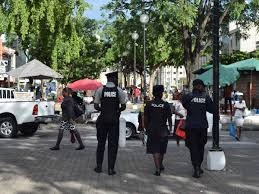
News Americas, NEW YORK, NY, Weds. April 8, 2026: The greatest risk in a police pursuit is not speed. It is the absence of restraint in the presence of power. Across the jurisdictions of the Organization of Eastern Caribbean States, the Caribbean Community, and the wider Commonwealth Caribbean, courts have converged on a principle that is as exacting as it is necessary. A pursuit is judged not by how forcefully it begins, but by how carefully it is sustained. The law does not measure motion. It measures judgment.
This principle can be expressed with precision. Disciplined proportionality defines the point at which the duty to enforce yields to the duty to preserve life. Police officers owe a duty of care that remains intact even in moments of urgency. The standard applied is that of the reasonable officer, informed by training, foresight, and the realities of risk. A pursuit that is justified at its inception may become indefensible in its continuation. When the risk to life outweighs the objective of apprehension, the law requires restraint. That requirement is not aspirational. It is binding.
The analysis then turns to causation, where legal reasoning meets real time decision making. Every pursuit is a sequence of choices, each one altering the level of risk. The question is whether those choices merely accompanied the event or actively shaped its outcome. Where the manner of pursuit transforms foreseeable danger into probable harm, liability follows. Responsibility does not end with the individual officer. It extends to the State through vicarious liability, affirming that public authority must remain accountable for the risks it creates. Power, in this sense, carries consequence.
The law also recognizes that responsibility may be shared. A motorcyclist who refuses to stop or engages in reckless conduct contributes to the outcome that follows. The doctrine of contributory negligence ensures that such conduct is neither ignored nor overstated. Liability is adjusted with care, reflecting a balanced assessment of fault. This is not a compromise between competing interests. It is a disciplined method of ensuring that accountability remains both fair and precise.
This framework matters because it governs the boundary between enforcement and endangerment in everyday life. For the average citizen, it defines the conditions under which public authority must yield to the preservation of life. For policymakers, it shapes the design of pursuit protocols and institutional safeguards. For legal practitioners, it demands reasoning that is both rigorous and exact. These cases are measured in seconds, yet their consequences endure for decades. In the end, the legitimacy of power is not proven by how far it can go. It is proven by where it stops.
Related News

Kristi Noem Visits Guyana And Costa Rica Amid Regional Focus

Guyana News: Corey Lewandowski And Kristi Noem In Focus

War With Iran: The Three Fronts Of Modern Warfare Explained