

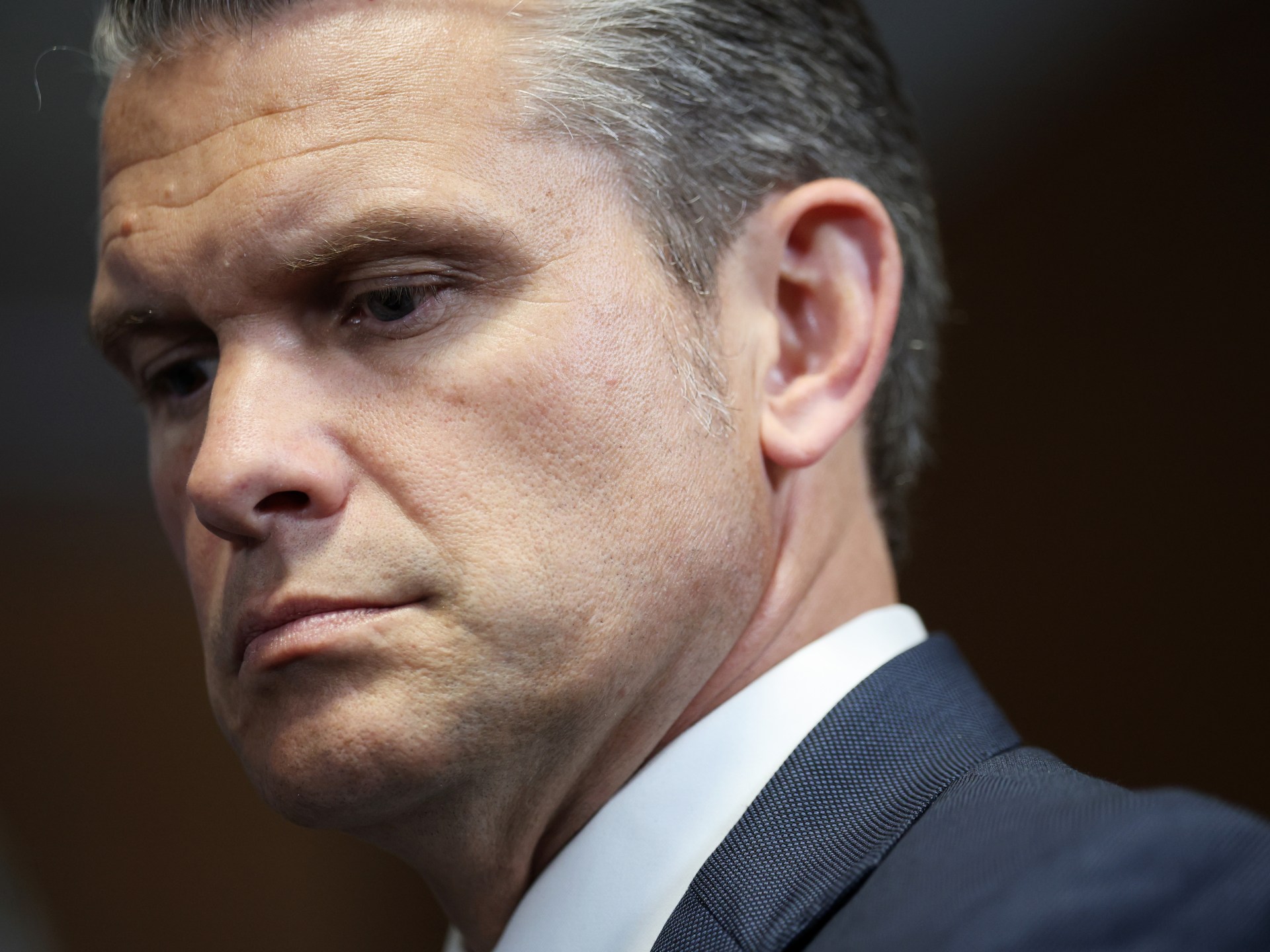

Earlier this week, Daniel Driscoll, the secretary of the United States Army, resigned from his post after he reportedly tried to directly appeal to US President Donald Trump about how changes in the military’s leadership were having an impact on the institution’s readiness for war.
Driscoll, a law school colleague of US Vice President JD Vance, was appointed last February to his position, the highest civilian role in the Army below the secretary of defense, Pete Hegseth. He was particularly involved, experts say, in planning how to transform the Army so it could take part in modern wars that seemed to increasingly rely less on ground forces and more on assets like drones and missiles.
- list 1 of 3Pete Hegseth says US military to start testosterone screening for over 30s
- list 2 of 3Hegseth called a ‘failure’ over Iran as he reveals $37b cost of war
- list 3 of 3US Army Secretary Daniel Driscoll submits resignation, media reports say
end of list
His resignation is the latest in a list of top officials who have been fired or asked to resign under Hegseth, including three- and four-star generals and members of the Joint Chiefs of Staff, a group of top-ranking military officers who meet to directly advise the US president. Among them have been Black and female leaders, demographics the Trump administration has said were unfairly promoted in recent times because of “diversity, equity, and inclusion” initiatives he is now seeking to undo.
Technically, officials like Driscoll serve at the pleasure of the president, said Kelly Grieco, senior fellow at the Stimson Center think tank. So Hegseth, having been appointed by Trump, has the power to remove them. But for civilian leaders, as well as the rest of the military who are not told exactly why these personnel changes happen, “the sheer number of firings, and promotions that have been blocked, raises the question of whether there is a hollowing out of the senior levels of the military.”
Advertisement
Ending ‘wokeness’
Hegseth was an infantry officer in the Army National Guard who went on to become a television personality on the conservative US news channel Fox News before being tapped for the military portfolio in Trump’s cabinet. Hegseth had been particularly outspoken about modern changes in the military that he claimed had weakened it, including policies that led to the inclusion and promotion of women and LGBTQ personnel. These are other minority groups, Hegseth has said, have been promoted in the military based on their demographics and not based on their performance, as they should have been judged.
“Hegseth came into the Pentagon with a specific set of priorities,” said Jennifer Kavanagh, a senior fellow at Defense Priorities, “including a focus on increasing what he calls ‘lethality’ and getting rid of what he calls ‘woke’ ideology, which he and Trump think are running rampant through the Pentagon.”
Under Hegseth, the Trump administration began using the “Department of War” instead of the “Department of Defense”, and the military has toned down, and in some cases erased, memorials and other public acknowledgments of minorities and women who were pioneers in the institution. Earlier this year, Hegseth announced the military would start annual testosterone screening for its soldiers who are aged 30 and over, as part of an initiative to ensure they “have the biological foundation required to sustain the fight”.
Fired, or forced to retire early
The result, experts say, has been the unravelling of a merit-based system of promotions that defines a military with about a trillion-dollar budget and more than 1.3 million active duty personnel.
“It is far past time for President Trump to recognize the lasting harm that Pete Hegseth is inflicting on the Department of Defense,” Senator Jack Reed, a former Army officer himself, said in a statement in response to news of Driscoll’s resignation this week. “Secretary Hegseth is cultivating a culture where dissent is punished and competence is secondary to personal allegiance.”

Members of the Joint Chiefs of Staff who have represented the Army, Navy, and Air Force have all been fired, resigned, or replaced under Hegseth.
General Charles Q Brown, Jr., a Black fighter pilot who served as the Air Force’s chief of staff and later became the chairman of the Joint Chiefs, was fired last February and replaced with a white man. Admiral Lisa Franchetti, a white woman who also served on the Joint Chiefs of Staff as chief of naval operations, was also fired that month, replaced by a white man. General Randy A George, chief of staff of the Army, was fired in April of this year. General David Allvin, the Air Force chief of staff, retired early last year.
Advertisement
Hegseth has also removed or forced out top civilians working under him. Navy Secretary John Phelan resigned in April, and Driscoll’s last day was Wednesday.
Heads of intelligence services too have left. Lieutenant-General Jeffrey Kruse, head of the Defense Intelligence Agency, was fired last year after his agency reported US air strikes on Iran’s nuclear facilities had not been effective.
Other high-ranking personnel who have left under Hegseth include: General Chris Donahue, US Army commander Europe and Africa; General David Hodne, US Army commander of transformation and training command; General James Mingus, US Army vice chief of staff; Lieutenant-General Joseph McGee, director for strategy, plans and policy at the Joint Chiefs of Staff; Vice Admiral Shoshana Chatfield, US Navy representative to NATO; Rear Admiral Milton Sands, commander of Naval Special Warfare Command.
The sidelining of top-ranking women and minorities, experts say, will make others below them question whether they should be devoting decades more of their lives to an institution that could get rid of them because of their identity.
“If you’re in the military and you’re watching these changes, even if you’re not at the senior levels, you would have to be wondering what message it is sending to the rank and file?” Grieco said.
Overruling advice
There are pressing operational consequences, as well, for all this churn at the Pentagon, experts say.
There are longer-term strategic considerations of losing leadership, said Kavanagh.
The war in Iran has shown how crucial fleets of drones and missiles will be in any future conflict, she said, and top leaders like Driscoll understood the need to pivot their forces in a new direction, a task that becomes much more difficult if the person in charge of this kind of long-term thinking is constantly being swapped out with someone else.
“This is what the chiefs of staff, the secretaries of services, are supposed to do,” Kavanagh said. “They are not dealing with operational warfighting; they are not dealing with what’s going on in Iran every day, for example. They are dealing with big-picture issues of force modernisation, and every time there’s a new leader, they might come in with a new vision.”
Related News
Iran war looms over Trump at Republican midterm convention in Dallas

‘Things happen’: How Vance’s comment on Iran wedding strike fits US pattern
World reacts to AfD victory in east Germany state election
