
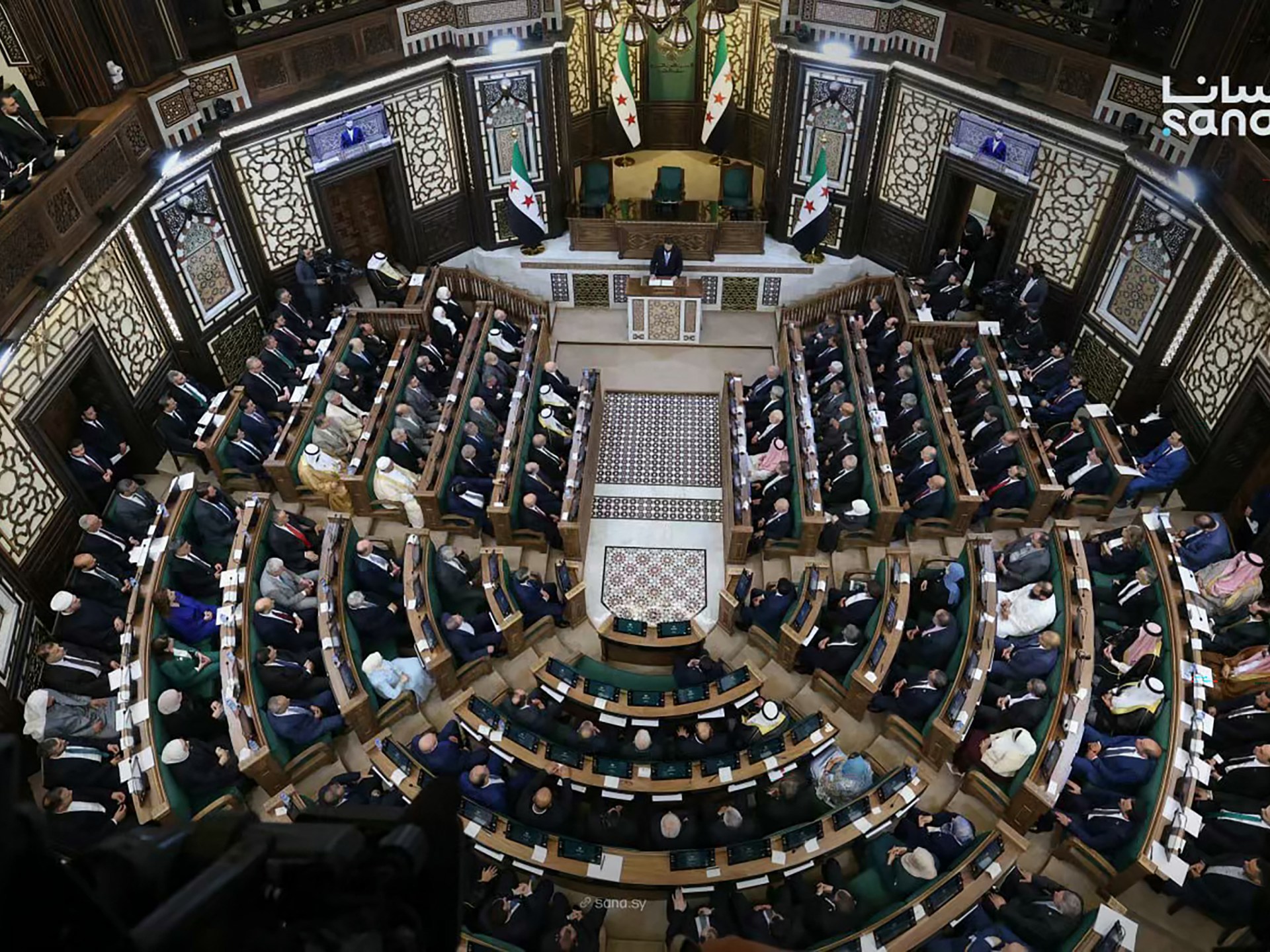

Syria’s president has called on lawmakers to put “national interest above all” as the newly appointed transitional parliament convenes for its inaugural session.
Members of the parliament took the constitutional oath in Damascus on Sunday, more than 18 months after longtime authoritarian ruler Bashar al-Assad was toppled by rebels led by Ahmed al-Sharaa, who is now Syria’s president.
- list 1 of 3Syria says one killed, 36 wounded after Damascus blasts during Macron visit
- list 2 of 3Syria in tough balancing act as it tightens security after Damascus blasts
- list 3 of 3Chemical weapons watchdog restores Syria’s voting rights, citing progress
end of list
“I urge you to make this assembly a model of responsibility and competence, and to help foster a culture of dialogue, the rule of law and respect for institutions,” al-Sharaa said.
The main role of the parliament, called the People’s Assembly, will be to draft a new constitution and lay the foundations for democracy after decades of oppressive rule under the al-Assad family that culminated in a 14-year civil war that killed more than half a million people.
The 43-year-old al-Sharaa has pledged to usher in a new era for Syria, which remains in a dire economic state after years of conflict and political isolation. The country’s challenges have been compounded by periods of political and sectarian tension following al-Assad’s overthrow.
Al-Sharaa stressed that improving the economy, strengthening public services and attracting international investment were key priorities for parliament.
“Syria is writing a glorious history that reflects its heroism, and we face the responsibility of building both the nation and the individual,” he said.
The chamber has 210 seats. Two-thirds of lawmakers were chosen last year by regional electoral colleges, while al-Sharaa appointed the remaining 70 members of parliament at the beginning of the month.
Advertisement
Officials say nationwide elections were not feasible because of the complex logistical challenges created by years of conflict, including inaccurate population records.
Claudio Cordone, the deputy United Nations special envoy for Syria, called the parliament’s first session “a key milestone in the country’s political transition”, adding that the international community “will follow its work closely and stand ready to support” it.
Related News
Pakistan searches for Boeing cargo plane missing over Arabian Sea
Colombia earthquake: Hospitals adapt to save lives amid widespread damage
Saudi-led coalition pledges ‘unprecedented’ force against Houthi threats