

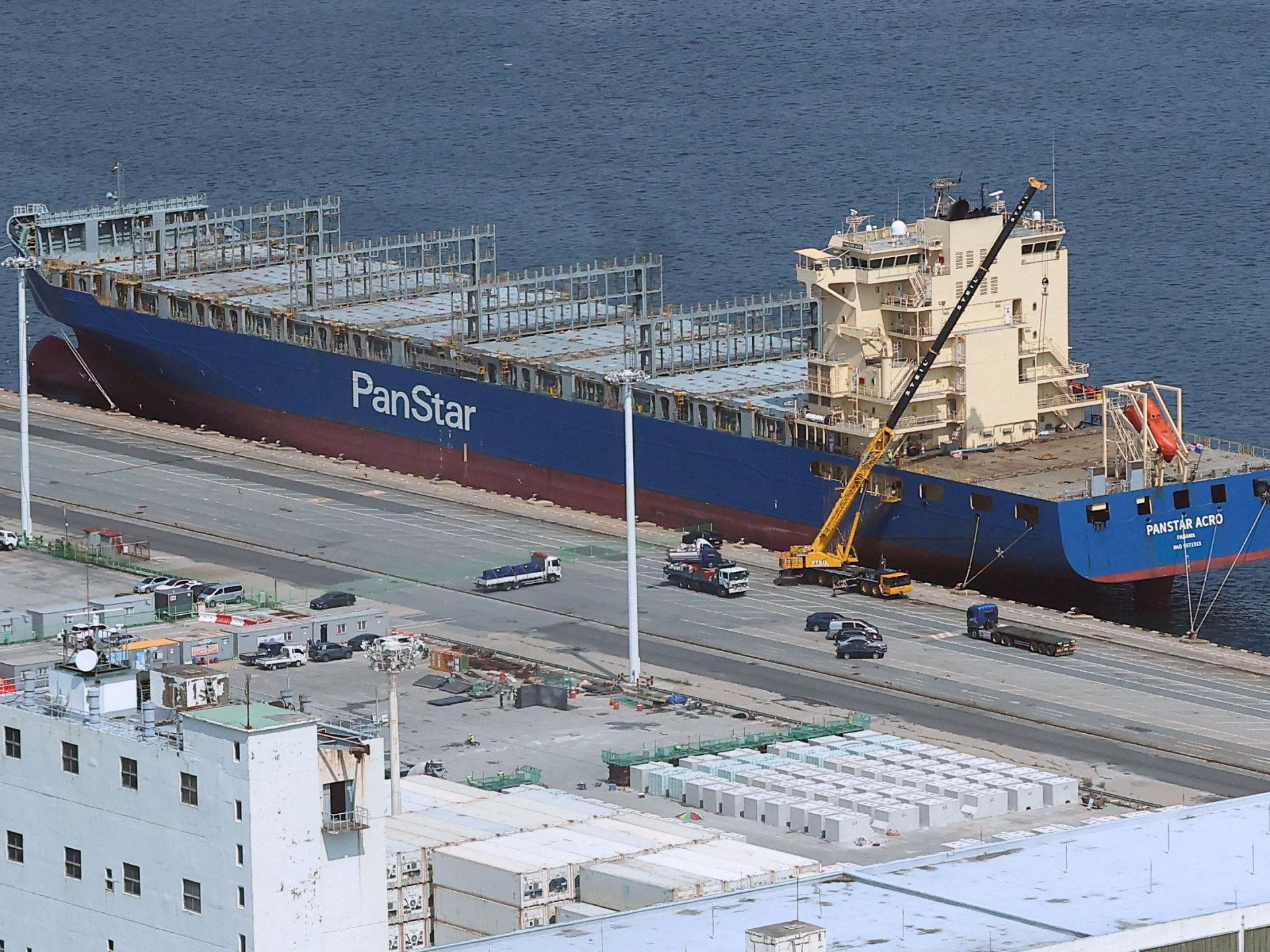

A South Korean container ship is sailing to Europe via the Arctic, in the nation’s first commercial voyage on the route to test its viability as the war in the Middle East rattles global shipping.
The PanStar Acro set sail from Busan New Port on Saturday. “We would like to inform you that the vessel for the Arctic route trial voyage departed” at 9:30pm (12:30 GMT), Seoul’s Ministry of Oceans and Fisheries said in a statement to the AFP news agency.
- list 1 of 4South Korea footballers urge safety after extreme heat statistics
- list 2 of 4Putin warns of tit-for-tat seizures of European vessels
- list 3 of 4Activists’ bid to sue Russia over climate change gets off to shaky start
- list 4 of 4Can China’s new Arctic sea route to Europe replace Middle East chokepoints?
end of list
The PanStar Acro will sail north, the Reuters news agency reported, hugging eastern Russia’s Kamchatka Peninsula, then cross the Bering Sea, and take the Northern Sea Route, stopping in Felixstowe in the UK, Rotterdam in the Netherlands, and Poland’s Gdansk before returning.
The 2,758 TEU (twenty-foot equivalent unit) container ship operated by South Korea’s PanStar has secured 837 TEU of cargo, including car parts, chemical products and about 100 empty containers on the government-backed voyage.
The journey is expected to take 40 to 45 days, according to the Oceans Ministry.
President Lee Jae Myung has made Arctic shipping a priority for South Korea, with the hope of turning the southeastern port of Busan into a global maritime hub and position the Arctic as a regular trade route by 2030.
But this new route has been criticised for several different reasons. Environmental groups have warned the route could accelerate polar ice melt, meaning the increase in shipping could worsen global warming.

The project also risks increasing friction with Western allies hoping to keep Russia isolated in its war with Ukraine. Seoul has consulted with Moscow about the journey, Reuters reported, including whether the ship needed help to tackle any problems, such as getting stuck in ice.
Advertisement
Last year, 103 transits through the route were made by 88 vessels, up from 97 in 2024 and 43 in 2022, chiefly from nations such as Russia and China, according to Norway’s Centre for High North Logistics.
But with the Iran war affecting global shipping, governments and shipping firms are scrambling to seek different routes, with the Arctic route increasingly viewed as a viable alternative due to technological advances and environmental degradation.
South Korea’s Vice Oceans Minister Nam Jae-hon said the Arctic route was “bound to become an alternative” to Middle Eastern shipping lanes.
The usual maritime route between Asia and Europe runs through the Suez Canal, but travelling through the Arctic can cut the journey by approximately 7,000 kilometres (4,300 miles) and about 10 days, according to the Korea Institute for International Economic Policy.
However, major carriers including CMA CGM, MSC and Hapag-Lloyd have pledged to avoid Arctic shipping routes due to pressure from environmental groups. The Arctic sea route is believed to be accessible only during the time of year when the ice is melted enough to allow transits without icebreakers.
“The Northern Sea Route has become increasingly viable as the Arctic warms about four times faster than the global average, leading to a sharp decline in sea ice,” South Korean environmental group Paran Ocean Citizen Science Center said in a statement last year. “But making the route commercially viable would require further warming, putting the policy at odds with efforts to combat climate change.”
Related News

Iran’s government spars with state TV as mediators push talks with US

Thousands gather in Srebrenica to mark 31 years since genocide

South Korea has hottest day on record amid extreme weather globally