
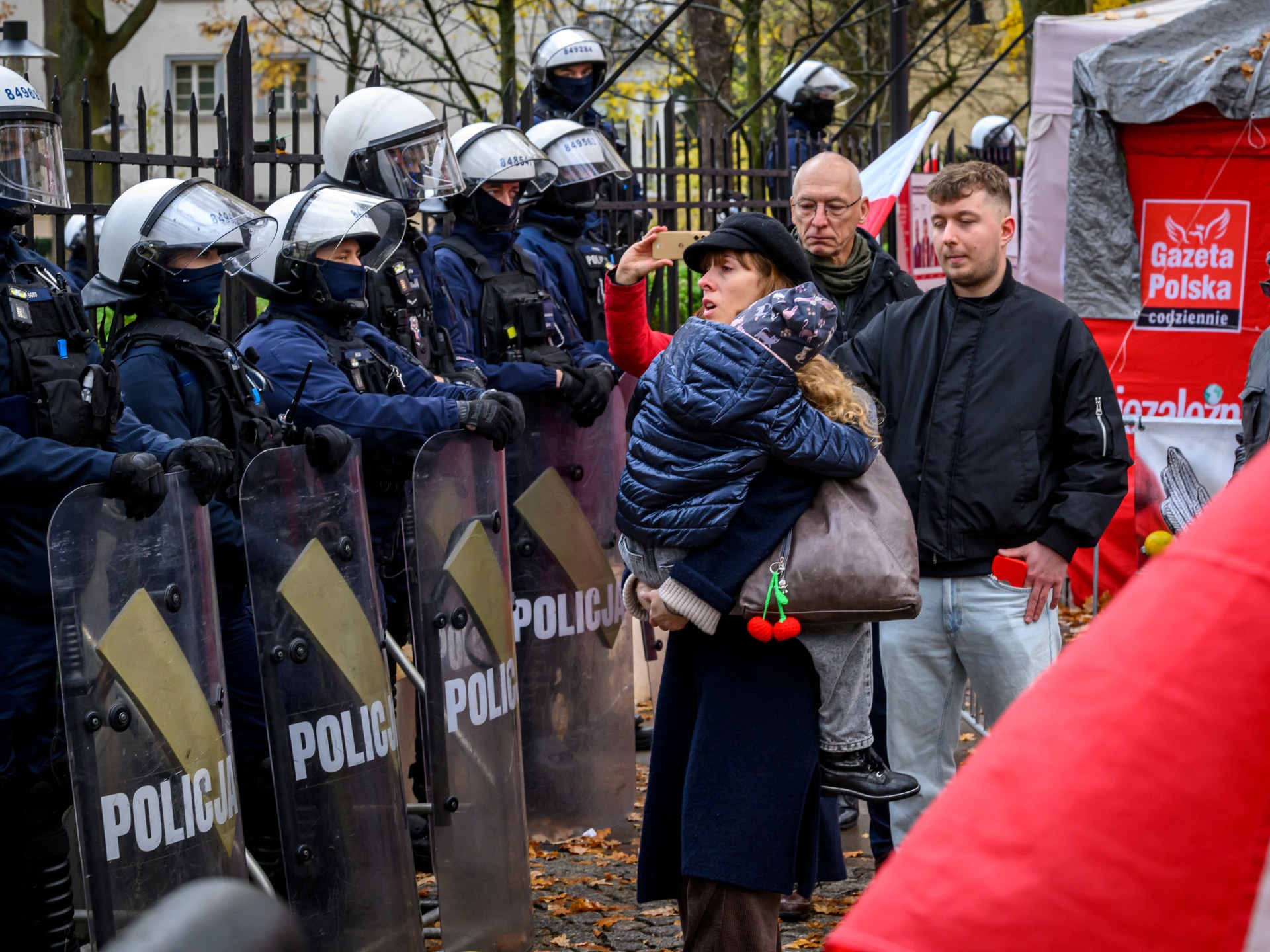

Riot police have been deployed outside Poland’s Constitutional Tribunal as a dispute over who should serve on the court escalates into a confrontation between Prime Minister Donald Tusk’s government and the nationalist opposition.
Hundreds of protesters gathered outside the Warsaw building on Friday night after judges elected by the current parliamentary majority announced the suspension of the tribunal’s president, Bogdan Swieczkowski, and his deputy, Bartlomiej Sochanski.
- list 1 of 4Flávio Bolsonaro vows to continue father’s political fight in Brazil
- list 2 of 4Lebanon charges 13 over confiscated Hezbollah explosives
- list 3 of 4Rival US and Russian resolutions on Western Sahara fail at UN
- list 4 of 4Wounded Arsenal seek redemption in Anfield test against Liverpool
end of list
The move drew condemnation from the far-right opposition Law and Justice party, known as PiS, and prompted President Karol Nawrocki, a PiS ally, to abandon a trip to Senegal, turning his plane around to return to Poland on Friday. Police said three people were arrested after trying to enter the court complex.
Tusk says decisive action is necessary to restore the rule of law after years of political interference in the Constitutional Tribunal under PiS. Here is what we know.
Why are Poland’s leaders fighting over the Constitutional Tribunal?
The Constitutional Tribunal decides whether laws comply with Poland’s constitution. Its rulings can prevent legislation from taking effect, making its independence and who sits on its bench politically significant.
This latest dispute can be traced back to 2015, during the transfer of power from a centrist government led by Tusk’s Civic Platform party to the far-right PiS.
The outgoing parliament elected five judges, although Poland’s Constitutional Tribunal subsequently found that only three of those appointments had a valid legal basis. The incoming PiS majority then elected replacements, including for the three seats already lawfully filled. Then-President Andrzej Duda refused to swear in the three validly elected judges.
Advertisement
During its eight years in government, PiS introduced broader judicial changes that critics said brought the courts under greater political influence. PiS is currently the main opposition in Poland.
“It was a power play to control who serves as a justice, in what positions, and how the court system operates in Poland,” Wojciech Przybylski, editor-in-chief of Visegrad Insight, told Al Jazeera.
“The former PiS government wanted a court system and tribunal that would allow it to pass laws that supported their ideological perspective. It also wanted control of a Constitutional Tribunal that would support its claim of sovereignty over the EU.”
Aleksandra Kustra-Rogatka, an associate professor at Nicolaus Copernicus University in Torun, told Al Jazeera that “after Przylebska became president of the CC, the rule of law crisis worsened. Controversial laws reformed the judicial system, and the court became seen as a rubber-stamp body and an active political player supporting illiberal policies.”
The European Court of Human Rights, which is separate from the EU, had already ruled in 2021 that an improperly appointed judge’s participation deprived a company of its right to a tribunal established by law. Then, in December 2025, the EU’s highest court ruled that the tribunal had not met the requirements of an independent court. It also found that tribunal judgements challenging the authority of EU law breached Poland’s obligations as a member state.
Tusk returned to office as prime minister in December 2023 promising to restore judicial independence, and his government has refused to recognise the tribunal’s legitimacy in its existing form and has been attempting to disregard its rulings.
Kustra-Rogatka added that “many supporters of the centrist governing camp have grown disappointed by the lack of progress in restoring the rule of law since 2023, partly constrained by the prospect of losing the 2025 presidential election”.
This year, the parliament elected eight judges to the 15-member tribunal. President Nawrocki, a supporter of Donald Trump, was elected last year and with the power to veto legislation, administered the oath to three judges but withheld it from five, who instead took their oaths without his presence. The tribunal’s president, Bogdan Swieczkowski, refused to allow those five to begin adjudicating.
What triggered the latest confrontation?
On Friday, Judge Anna Korwin-Piotrowska announced one-month suspensions of court president Swieczkowski and his deputy, Sochanski, and said she was assuming responsibility for running the tribunal.
Advertisement
But questions have arisen over whether Korwin-Piotrowska, who is one of the court’s 15 justices alongside Swieczkowski and Sochanski, has the authority to do this. Her claim rests on her length of judicial service overall, rather than having served longest on the tribunal.
In separate measures, Justice Minister Waldemar Zurek, who also serves as prosecutor general, took steps that could lead to criminal proceedings against the suspended president, Swieczkowski, and his deputy, Sochanski. Far-right critics say these measures are politically motivated and intended to apply pressure on the already suspended justices.
PiS supporters, including senior party figures, gathered outside to oppose the suspensions on Friday. Police said their deployment followed information from Korwin-Piotrowska about possible threats to judges and staff and risks to public order. They said officers were securing the grounds and had not entered the tribunal building.
Nawrocki turned back to Poland midair while flying to Senegal and arrived at the tribunal during the night. By Saturday morning, he had called urgent consultations with parliamentary representatives, describing events as a forcible takeover of a constitutional institution.
Tusk defended the effort to restore the rule of law, saying that reversing the legacy of PiS required difficult action.
What could happen next?
The confrontation raises two overlapping questions: who is entitled to sit on the tribunal, and whether the measures used to change its leadership are lawful.
Marcin Matczak, a prominent Polish lawyer, told Al Jazeera that the far-right opposition was defending its “remaining institutional stronghold”, while the centrist government wants to “restore balance to the Constitutional Tribunal”.
But restoring independence also requires scrutiny of the current government’s choices. In September, its parliamentary majority elected Maciej Berek, previously a minister in Tusk’s cabinet, to the tribunal. Some coalition members opposed the appointment, saying it contradicted promises to depoliticise the judiciary.
With parliamentary elections due next year, Matczak said Tusk might be taking a harder line to mobilise supporters frustrated by the slow pace of reform. “But that is a risky strategy: it may energise his political base while alienating more moderate voters,” he said.
A more immediate flashpoint could be a tribunal judges’ meeting that Matczak said had been called for November 3. Attempts to lift immunity could deepen the confrontation if the assembly’s composition or ability to reach the required quorum is challenged.
Matczak also warned that the scenes could establish a precedent for future governments. “A future government could invoke these events to argue that sending the police into the Constitutional Tribunal is an acceptable way to resolve a legal dispute,” he said.
“Whatever the immediate political gains, the long-term institutional consequences could be deeply damaging.”
Related News

Saudi Arabia cancels 2026 ‘Davos in the Desert’ amid Houthi attacks
Former Catholic bishop sentenced for abusing indigenous men in Australia
‘Deliberate’ car ramming of Australian MP an isolated incident, police say