
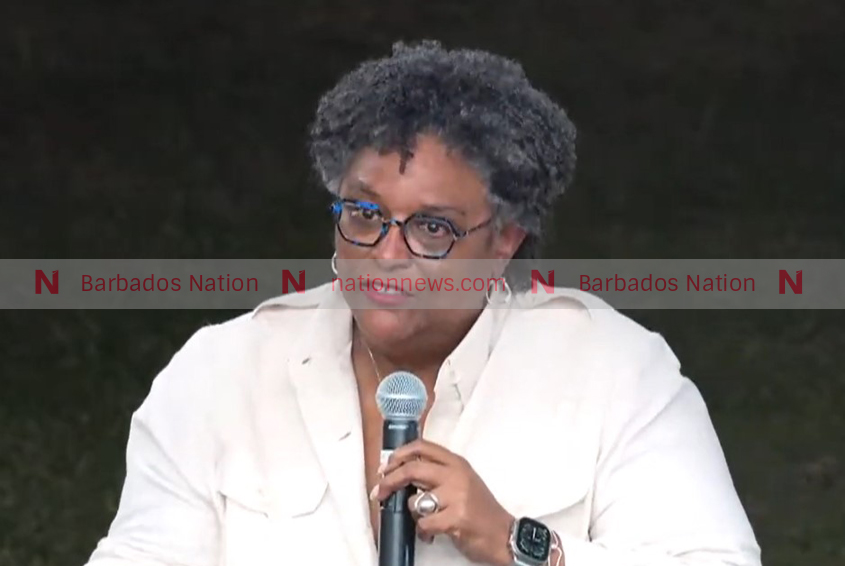

Prime Minister Mia Amor Mottley yesterday announced she will appoint a special committee of historians and economists to build a Barbadosspecific case for reparations, telling delegates at the third CARICOM Reparations Conference that the region’s moral argument must now be matched by hard evidence, even as she insisted the political will to act remains the ultimate test.
Speaking at the Wyndham Sam Lord’s Castle Resort in St Philip, on the opening day of the conference, Mottley said the committee would be tasked with quantifying the specific historical and economic harms Barbados had experienced from the transatlantic slave trade, moving beyond broad moral appeals.
“I will be appointing a technical committee of historians and economists to do the research so that our business-specific case can quantify the kinds of things that we have seen and experienced in this region,” she said, adding that other CARICOM member states should do the same.
The prime minister, drawing on her own background as a lawyer, said the credibility of the region’s case depends on the strength of its documentation.
“If your evidence is not strong, then you cause a disorder or a referral to the opposition,” she told delegates, arguing the Caribbean must shift from being “advocates for the movement” to becoming “advocates for the case.”
She said the principle “where there is a will, there is a way” applies as much to the work ahead in Barbados as it does to the wider global movement, describing sustained political will, not further delay, as the real obstacle to justice.
Mottley pointed to Barbados’ legislative history as proof that reparatory action is possible recalling that the Barbados parliament passed the 1661 Slave Code, which she said became “the blueprint for how other countries and colonies framed their understanding of what black people were”, as chattel, but later found the will to repeal the 1830 Consolidated Slave Act after the Colonial Office deemed it “so offensive” that it forced the law’s withdrawal in 1831.
Right to purchase
She also cited the 1980 Tenantries Freehold Purchase Act, which gave families who had lived for generations on plantation lands the right to purchase that land, as the country’s “first national act of reparations”. Mottley framed access to land, rather than education, as the more urgent unfinished struggle in Barbados’ post-slavery history, noting the country had already built 200 primary schools by 1900.
The forthcoming committee, she suggested, would build on that by producing the kind of rigorous, quantified case needed to press claims internationally. She drew a comparison to Holocaust reparations to illustrate what she sees as a double standard: “Since 1952, the Germans have paid $95 billion to the Jewish community as a result of a Holocaust of six years,” she said, stressing that no one seeks to diminish that history, but that a system of enslavement lasting 211 years, by her accounting, from Barbados’ 1627 settlement, had produced no comparable reckoning.
Mottley also linked the domestic committee’s work to her broader critique of global financial hypocrisy, arguing that wealthy nations lecture indebted countries on fiscal discipline while engaging in massive money-printing themselves calling it “the germ of hypocrisy”.
Beyond the committee, Mottley proposed a global petition campaign running five to six months to build public pressure alongside government diplomacy, building on a UN resolution she said had already won backing from 123 countries. She credited former US President Barack Obama for his continued engagement with the cause.
She closed by urging that indigenous peoples be included in the reparatory justice conversation, citing the Garifuna’s expulsion from St. Vincent and the dispossession of indigenous communities in Guyana, Suriname and Belize.
“There is never going to be a right time to have this discussion,” Mottley said. “We are not boulders, we are not monsters, we do not bear arms, we have come to have a conversation.” (BA)