
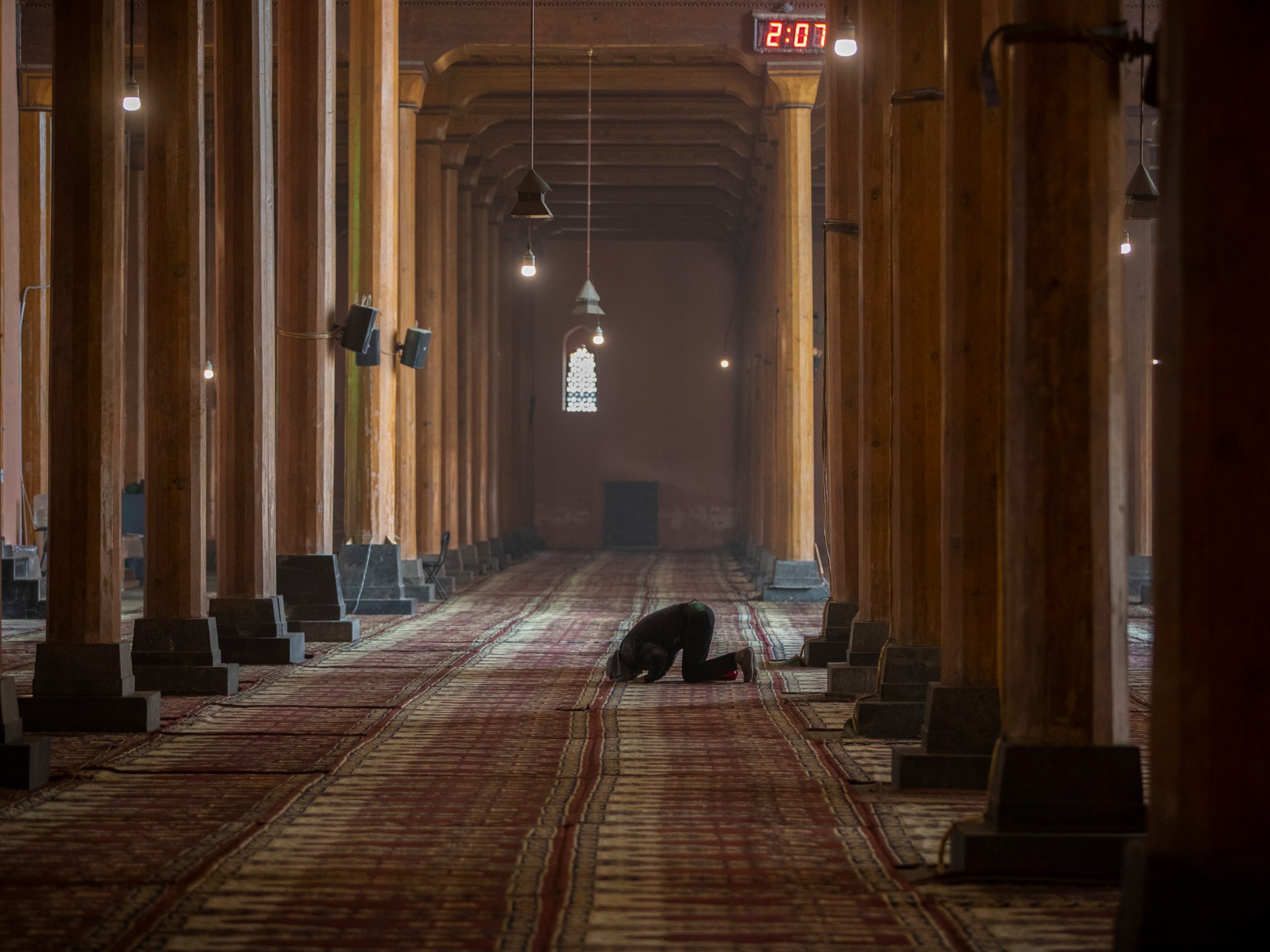

An important Islamic seminary in Kashmir has been declared unlawful under anti-terror laws, prompting backlash from prominent religious and political leaders in the Indian-administered territory.
Kashmir Divisional Commissioner Anshul Garg issued the order based on a police dossier that alleged “sustained and covert links” between the seminary and the banned political party Jamaat-e-Islami (JeI), local media reported.
- list 1 of 4At least 21 killed as bus crashes into Kashmir gorge
- list 2 of 4‘Cocktail of Hindutva and welfarism’: How Modi’s BJP is wooing Assam voters
- list 3 of 4Why many Kashmiris are donating gold, breaking piggy banks for Iran
- list 4 of 4India to Iran: How two wars shaped rise of Pakistan’s Asim Munir
end of list
The seminary, Jamia Siraj-ul-Uloom, is one of the largest in southern Kashmir and is recognised by the Jammu and Kashmir Board of School Education.
The dossier stated that members of Jamia Siraj-ul-Uloom’s management and faculty were linked to JeI. It also cited other allegations related to land use and financial transparency.
The move was handed down under the Unlawful Activities Prevention Act (UAPA), a much-criticised law that allows authorities to designate someone a “terrorist” without evidence.
Seminary chairman Mohammad Shafi Lone has reportedly rejected the allegations.
“We are a law-abiding institute and have nothing to do with the banned Jamaat-e-Islami,” the Hindustan Times reported him as saying. “This order has created panic among parents and students enrolled here.”
Leaders in Muslim-majority Kashmir criticised the move as part of an ongoing campaign of overreach by New Delhi.
“Declaring Jamia Siraj-ul-Uloom ‘unlawful’ under UAPA is the latest act in a calculated dismantling of Kashmir’s civic life,” wrote Aga Syed Ruhullah Mehdi, a member of Jammu and Kashmir parliament, on X. “The pattern is unmistakable. Trusts, mosques, libraries and now seminaries serving underprivileged children, every social and nongovernmental institution that holds Kashmiri society together is being strangled.”
Advertisement
The school has more than 800 students and has “produced doctors, scholars and professionals from homes that could never afford private education”, he added.
Mehbooba Mufti, a former chief minister in Jammu and Kashmir, called the decision a “flagrant injustice to the poor underprivileged sections of society.”
“Banning these altruistic institutions without any solid evidence of antinational activity shows a deep-seated prejudice,” she said.
Kashmir’s top Muslim cleric, Mirwaiz Umar Farooq, listed recent alleged incidents against residents, including the seizure of property and arrests under the Public Safety Act.
“Can the … administration tell people of Kashmir clearly how long they will continue this policy of harassment and disempowerment?” he asked. “And can the elected [government] tell us how long they will let this happen?”
Indian-administered Kashmir is a “union territory”, meaning that it is administered by the federal government in New Delhi.
Although Article 370 of the Indian Constitution previously granted Kashmir partial autonomy over education, employment and land ownership, Prime Minister Narendra Modi’s government did away with the law in 2019 and divided the region into two federally-controlled territories: Jammu and Kashmir, and Ladakh.
Since then, Kashmiri leaders have pushed back against what they describe as a curtailing of religious and other freedoms.
Police began profiling Kashmir mosques earlier this year, prompting a wave of fear over increased surveillance by the federal government.
Meanwhile, Jamia Masjid in Srinagar, the region’s most prominent mosque, was forced to shut for almost two years following the 2019 transition and still faces frequent closures, along with limits on the number of people allowed to gather for prayers.
Kashmir voters elected local officials in 2024, in the first elections in a decade. However, most powers remain with the New Delhi-appointed lieutenant governor, including control over police, public order and the transfer and posting of officials.
Related News
Hezbollah leader urges Lebanon’s government to pull out of Israel talks
Who is Roelf Meyer, South Africa’s new ambassador to the US?
Two CIA agents reportedly killed in car crash in Mexican state of Chihuahua