
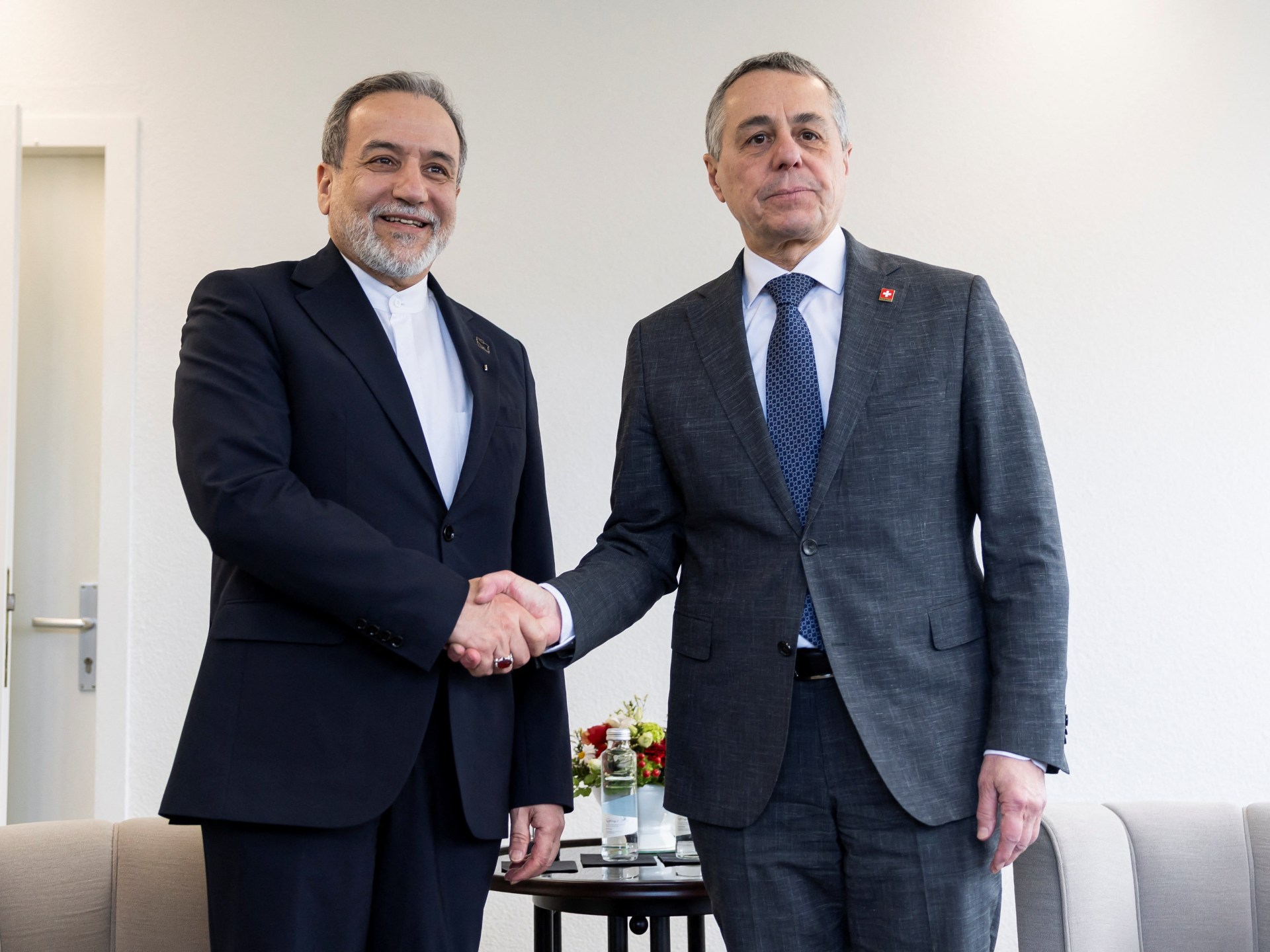

Iranian Foreign Minister Abbas Araghchi has said that “good progress” has been made in indirect nuclear talks with the United States, but US Vice President JD Vance said Tehran was not yet ready to acknowledge all of Washington’s red lines.
The talks, mediated by Oman in the Swiss city of Geneva on Tuesday, were aimed at averting the possibility of US military intervention to curb Iran’s nuclear programme, weeks after a deadly Iranian crackdown on antigovernment protests.
- list 1 of 4US and Iran reach ‘guiding principles’ in Geneva nuclear talks
- list 2 of 4Iran’s Khamenei maintains tough rhetoric with US despite nuclear talks
- list 3 of 4Iran’s Khamenei says US will not be able to destroy government
- list 4 of 4Trump urges Iran to make nuclear deal saying he’ll be ‘indirectly’ involved
end of list
“Ultimately, we were able to reach broad agreement on a set of guiding principles, based on which we will move forward and begin working on the text of a potential agreement,” Araghchi told state television after Tuesday’s talks.
“Good progress” has been made compared to the previous round in Oman earlier this month, he said, adding: “We now have a clear path ahead, which I think is positive.”
Araghchi said that once both sides had come up with draft texts for an agreement, “the drafts would be exchanged and a date for a third round [of talks] would be set”.
In Washington, DC, Vance also appeared to indicate that the US preferred diplomacy but painted a more mixed picture.
“In some ways, it went well; they agreed to meet afterwards,” Vance said in a Fox News interview.
“But in other ways, it was very clear that the president has set some red lines that the Iranians are not yet willing to actually acknowledge and work through,” Vance told “The Story with Martha MacCallum” programme.
“We’re going to keep on working it. But of course, the president reserves the ability to say when he thinks that diplomacy has reached its natural end,” Vance said.
Iran for years has been seeking relief from sweeping sanctions imposed by the US, including a Washington-imposed ban on other countries buying its oil.
Advertisement
Tehran has said it wants the talks to focus on its uranium enrichment programme, insisting that any deal must deliver tangible economic benefit, while maintaining its sovereignty and national security.
Washington has demanded that Iran forgo uranium enrichment on its soil and has sought to expand the scope of talks to non-nuclear issues, such as Tehran’s missile stockpile.
Iran has said it will not accept zero uranium enrichment and that its missile capabilities are off the table.
The talks come amid high tensions in the Gulf, with the US deploying two aircraft carriers to the region. The first – the USS Abraham Lincoln, with nearly 80 aircraft – was positioned about 700 kilometres (435 miles) from the Iranian coast as of Sunday, satellite images showed.
Its location puts at least a dozen US F‑35s and F‑18 fighter jets within striking distance. A second carrier was dispatched over the weekend.
Iran’s Supreme Leader Ayatollah Khamenei warned on Tuesday that the country had the ability to sink a US warship. “A warship is certainly a dangerous weapon, but even more dangerous is the weapon capable of sinking it,” he said.
Iran has also sought to display its military might, with its Islamic Revolutionary Guard Corps (IRGC) beginning a series of war games on Monday in the Strait of Hormuz to prepare for “potential security and military threats”.
Iran has repeatedly threatened to close the waterway, a vital oil export route from Gulf Arab states, in retaliation against any attack. The move would choke a fifth of global oil flows and send crude prices sharply higher.
Tehran has also threatened to strike US military bases in the region in the event of an attack, prompting concerns of a wider war.
A previous attempt at diplomacy collapsed last year when Israel launched surprise strikes on Iran in June, beginning a 12-day war that Washington briefly joined to bomb three nuclear sites at Natanz, Fordow and Isfahan.
Ali Vaez, the Crisis Group’s Iran Project director, told Al Jazeera he believed there is a lot of space for agreement on the nuclear front.
“Simply because Iran’s nuclear programme has been degraded on the ground. And so some of the cost of the compromise has already sunk in. And it should be easier for the Iranians to accept zero enrichment for a period of time because they have not spun a single centrifuge since the 12-day war back in June,” he said.
“But when it gets to non-nuclear questions, like regional activities or their missile programme, I think at best the Iranians will be willing to do superficial concessions, not the kind of grand bargain capitulation that the US expect,” he said.
Advertisement
Iran’s President Masoud Pezeshkian meanwhile reiterated in an interview published on Tuesday that Tehran was “absolutely not seeking nuclear weapons”.
“If anyone wants to verify this, we are open to such verification to take place,” he said.
“However, we do not accept that we should be prevented from using nuclear science and knowledge to address our illnesses and to advance our industry and agriculture,” he added.
Related News
Washington Post CEO resigns after sweeping layoffs
US seizes Venezuela-linked oil tanker in Indian Ocean
Indian national admits role in plot to assassinate US Sikh leader