
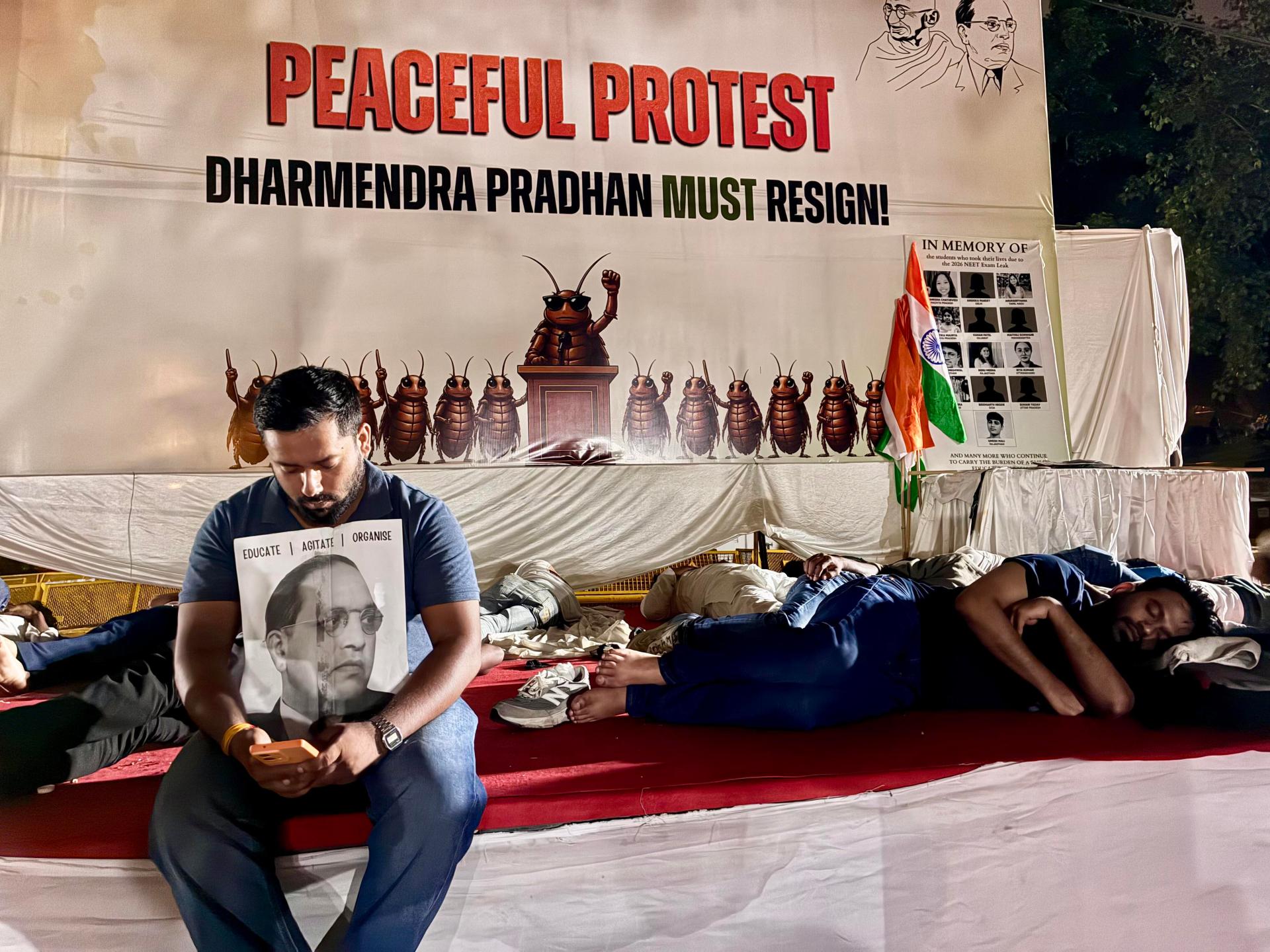

New Delhi, India — Supporters of the Cockroach Janta Party, a Gen Z political movement born out of a joke and despair, have camped in the Indian capital to demand the resignation of the education minister, defying police orders.
The June summer heat is sweltering in New Delhi, where dozens of protesters slept overnight on roads and pavements, with more people joining on the second day amid a heavy police presence.
Abhijeet Dipke – the viral movement’s leader, who recently graduated from Boston University in the United States – returned to India earlier this month to escalate the protests from online to the streets, addressing the simmering anger among Indian youth.
More than half of India’s 1.4 billion population is under 25. Frequent leaks of exam papers and discrepancies in exam scores have caused widespread outrage among young people already stressed by the pressures of studying and seeking jobs.
Dipke’s Cockroach Janta Party (Cockroach People’s Party, or CJP) has been channeling that anger and frustration, demanding that the federal education minister, Dharmendra Pradhan, resign.
Until recently, it was all jokes and digs on social media. In May, the Indian chief justice’s comments equating the youth with cockroaches drew widespread ire. Dipke casually wrote on X at the time: “What if all cockroaches came together?”
Soon, it went viral — and Dipke set up an official website, and its Instagram followers breached the 22 million mark, double that of India’s ruling party in power for the last 12 years.

Since staging the party’s first protest in New Delhi on June 6, Dipke has taken the demonstration to several Indian cities, including Mumbai, Bengaluru, and Nagpur, drawing hundreds of supporters.
Advertisement
Past midnight at New Delhi’s Jantar Mantar, a designated protest site in the capital, 18-year-old Sachin Kumar was lying on the road, sharing wired earphones with a friend he made there, Shubhankar.
Kumar studied hard for a year and last month took India’s top medical entrance examination, which was subsequently cancelled after it appeared that the question paper had been leaked.
“It broke my resolve. Students slip into depression, and no one cares,” he told Al Jazeera, adding that he hasn’t picked up his books since then.
On Sunday, nearly 1.7 million students retook the exams, but Kumar stayed back at the protest site.
India has temporarily banned the Telegram messaging app in an effort to curb the leaks – a move decried by critics of the government as a “Band-Aid solution”.
In the days between the two exam dates, more than a dozen students across India died by suicide, fuelling calls for the education minister to resign.
“I have no faith in the fairness of this exam anymore, or any other competitive exam for that matter,” Kumar said. “Everything in India has been compromised by the incompetent ministers who believe power is their inheritance.”
It was the first protest that both Kumar and Shubhankar ever attended. Both were sleeping on roads, against their parents’ wishes, and do not plan to return home soon.
For millions of youth like them, Prime Minister Narendra Modi’s Hindu nationalist rule is the only political era they have experienced first-hand, since he swept to power in 2014.
Since Saturday evening, the Delhi police have tried several pressure tactics to move the protesters away from the barricaded site, including briefly cutting off water and food access.
Past midnight, some of those remaining danced to hip-hop tunes, while others sat in circles discussing politics.
Dipke and his supporters insist they will not leave the site until Pradhan resigns. That, if it happens at all, would be a first in Modi’s 12 years in power.
Dipke is sure the resignation is imminent. “If the government thinks they can exhaust us, they are mistaken,” he told Al Jazeera. “We will remain here.”
Related News
Thousands attend anti-racism rallies following unrest in Belfast

Italy recovers 10 bodies as boat with nearly 60 on board capsizes off Malta
Trump insists Italy’s Meloni sought photos with him to boost popularity