
‘Indentured servants’: US green card move will hit thousands of IT workers
 09 October 2026
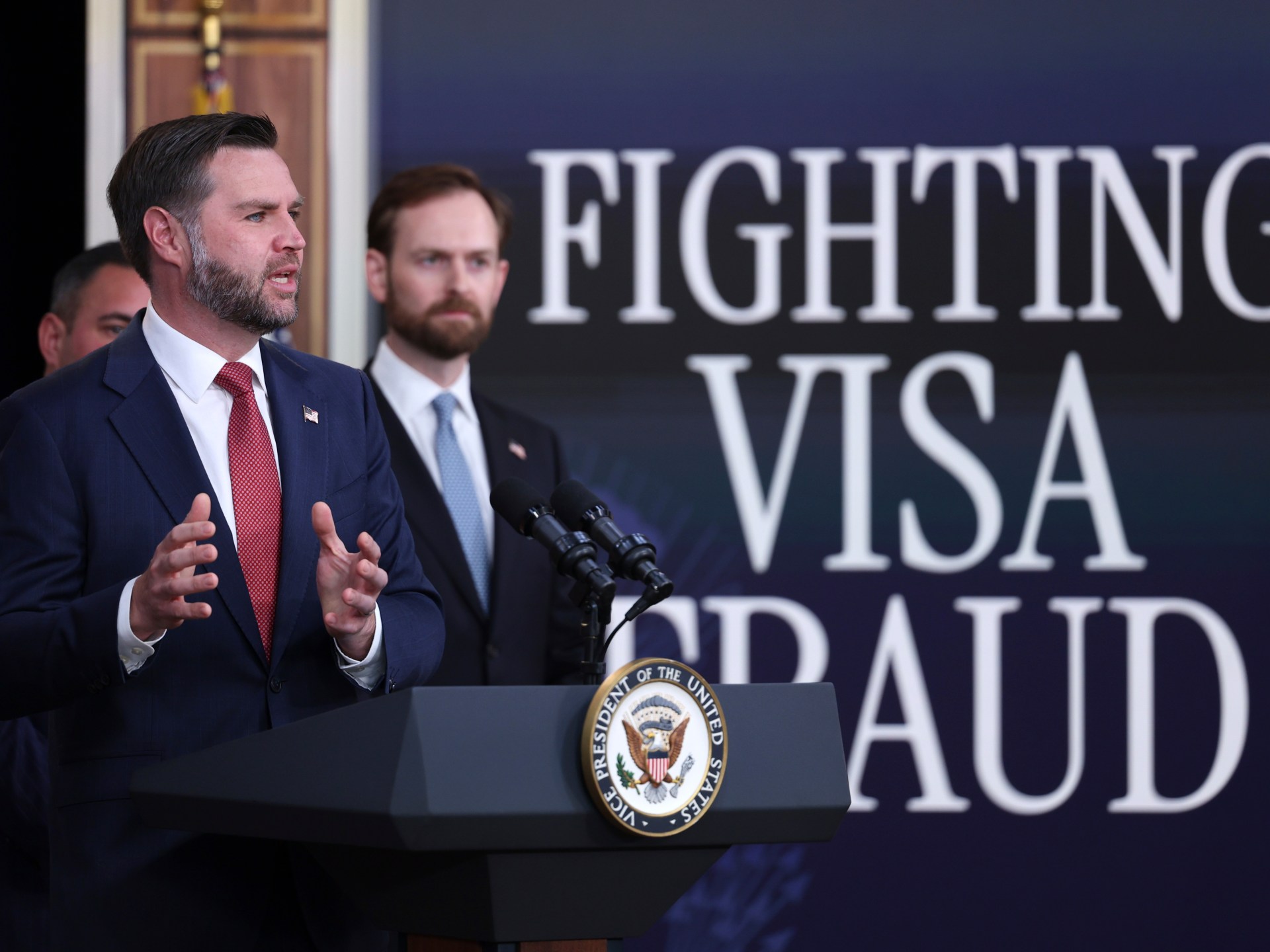

The United States government has moved to exclude some of the world’s top tech companies from a programme that allows them to sponsor skilled foreign workers for permanent residency.
Vice President JD Vance said the action was a response to companies abusing the system to hire lower-paid foreign workers at the expense of US workers.
- list 1 of 3Trump’s approval hits new low among Hispanic voters ahead of midterms
- list 2 of 3US Supreme Court agrees to take up Trump’s ICE detention policy
- list 3 of 3Trump launches midterms campaign blitz amid record low approval ratings
end of list
It comes as US President Donald Trump’s administration continues efforts to clamp down on immigration – both legal and undocumented – and make it harder for immigrants to get residency or citizenship.
But the latest move also potentially impacts thousands of foreign workers, many of whom have spent years waiting for a backlog in applications to clear.
Here’s what to know about the latest policy:
How does the current system work?
The suspension concerns the Permanent Labour Certification (PERM) programme, which enables a US-based employer to sponsor a foreign worker’s green card — as the permanent residency is commonly known. To qualify, the employer is supposed to demonstrate that there are insufficient US workers for a needed job role and that bringing a foreign worker will not impact the pay or conditions of US workers in the industry.
PERM is a key step in the green card process for many skilled foreign workers. Major tech companies often hire workers on temporary visas, such as the H-1B, before they transition to permanent residency through the PERM process.
What have Vance and others said?
Vance on Thursday accused major companies of fraudulently using the current visa regime to displace US employees and bring in lower-paid foreign workers who amount to “indentured servants”.
Advertisement
“The programme has become rife with fraud,” said Vance at a White House news conference. He claimed that many workers who start off on temporary H-1B visas and later apply for permanent residency under the PERM programme are “being mistreated by their employers” and “used to undercut the wages of American workers”.
“You’ve got to hire great American workers,” the US vice president said. “You cannot lay off American workers and then replace them with foreign indentured servants.”
Labour Secretary Keith Sonderling used similar language, saying the US would “shut down the pipeline of systemic fraud that has flooded our country”.
“The fraud doesn’t end with getting the job,” said Sonderling. “That job becomes a pathway for foreign workers and their families to stay in America permanently and eventually (become) US citizens.”
“And who pays for it all? The American worker,” he said.

Which companies are impacted?
Vance singled out Microsoft as a major offender and said it would be suspended from the PERM programme.
Other companies whose PERM applications will no longer be processed include US software firm Adobe and some of the world’s top IT firms, including Cognizant, Infosys, Tata Consultancy Services (TCS), Wipro, HCL Technologies and Capgemini. Of these, Capgemini is French, Microsoft and Adobe are American, and the rest — Cognizant, Infosys, TCS, Wipro and HCL — are all Indian.
“We will not accept any new or process any pending permanent labour certification applications involving these companies,” said Sonderling.
Vance said the suspensions would continue “as long as it needs to”.
Other companies that rely heavily on H-1B visas such as Meta, Amazon or Alphabet’s Google will not be affected.
Have tech firms been abusing US immigration rules?
Critics of the H-1B visa and PERM green card process argue that some employers use the system not to fill legitimate skills shortages, but to reduce labour costs, gain leverage over workers and make it harder for US employees to compete for jobs. They say companies do this by hiring foreign workers at lower wages and manipulating recruitment conditions to keep out qualified US workers.
Vance said Microsoft last year let go 6,000 US workers, while also securing 6,300 H-1B visas and almost 3,000 green cards.
“If you do the math, for every worker that Microsoft laid off, they replaced that worker with one and a half foreign indentured servants,” said Vance.
Advertisement
Sonderling said companies being suspended from PERM had received more than 230,000 H-1B visas and over 100,000 permanent labour certifications since 2009.
“That’s hundreds of thousands of jobs that were taken from American workers,” Sonderling said.
The H1-B visa system has also emerged as a lightning rod for many of the most vocal backers of Trump’s Make America Great Again (MAGA) movement, some of whom have married criticism of the programme with anti-immigrant stereotypes — particularly against Indians — to demand that the scheme be scrapped.
Microsoft disputed the implication that its visa filings represented new hires replacing US workers. In a statement, the company said that 80 percent of the roughly 6,000 H1-B visa applications it issued last year were “to extend or change the status of existing Microsoft employees”, not for new employees, and that the other filings were for “individuals already legally in the United States”.
The company also said that it only files applications for people who “meet the rigorous standards of this visa category” and that such employees are paid equally to any others who do similar work.
What does this mean for foreign workers?
The suspension could make it harder for foreign workers in the tech industry to obtain permanent residency in the US. Many of those affected are likely to be Indian nationals, who account for a large share of the country’s skilled foreign workforce in the technology sector.
Each year, there are only 85,000 slots for new H-1B visas (not including filings for renewals), but hundreds of thousands of applications. Many H-1B visa holders work in technology-related jobs: 62 percent of the beneficiaries in the 2025 fiscal year worked in computer-related occupations.
Indian nationals account for roughly 70 percent of existing H-1B visa holders.
The Trump administration has already tried to crack down on the H1-B scheme, and in August proposed a new $103,000 fee for H1-B applications, after an earlier pitch for a similar fee was struck down by a federal court. The fee, the government argues, would help provide revenue that could be used to service the vast US immigration system, while reducing the incentive for companies to attempt to misuse H1-B visas.
But the new move to restrict the pathway to a green card for foreign workers already in the US, legally, could impact not just those who might have dreamed of working or living in the US — but thousands already in the country.
The US typically issues around 140,000 employment-based green cards every year. But it also has a strict country-based cap — applicants from any one country cannot receive more than seven percent of green cards issued in a year.
Yet, because the employment-based green card application system is largely used to convert many H1-B visa holders into permanent residents, applicants for permanent residency are disproportionately Indian.
The result: Nearly one million Indians legally in the US on work visas are currently stuck in the employment-based green card backlog. They represent 79 percent of the total green card backlog of around 1.25 million people.
Advertisement
Even before the latest move, Indian green card applicants in certain employment categories would have needed to wait for decades, according to a 2025 analysis for the Congressional Research Service.
Sonderling’s statement that the US will no longer process “any pending permanent labour certification applications” from the blacklisted companies has raised fears that tens of thousands of foreign workers in the country legally — most of them Indian — who have waited for years might suddenly no longer be eligible. For others, the wait could get even longer.
Has India responded?
Yes. India’s Ministry of External Affairs issued a statement saying the US’s suspension does not “advance the shared ambitions of both countries”.
The ministry said that “talent mobility adds value” to both the Indian and US economies, including providing US companies “with cutting-edge talent, innovation, research, productivity, competitiveness and job creation”.
The ministry also criticised comments by Vance comparing foreign workers to indentured servants as “unwarranted” and “deeply offensive”, saying his words recalled “painful historical and colonial legacy connotations”.
Colonial powers — the British, Dutch and French — took more than 1.6 million Indian workers as indentured labourers to work on plantations and build railways in their other colonies: in Malaysia, Mauritius, South Africa, Kenya, Uganda, Fiji, Suriname, Guyana and other Caribbean countries.
India’s foreign ministry said Vance’s descriptions also “ignore the fact that Indian professionals in the United States are highly educated and skilled contributors to its economy and innovation ecosystem”.
Related News

Tehran and Muscat delay talks, citing regional consensus need
Netanyahu praises stabbed Indian pilot for saving lives on Flydubai flight

UN extends Darfur arms embargo, blocks broader Sudan sanctions proposal