

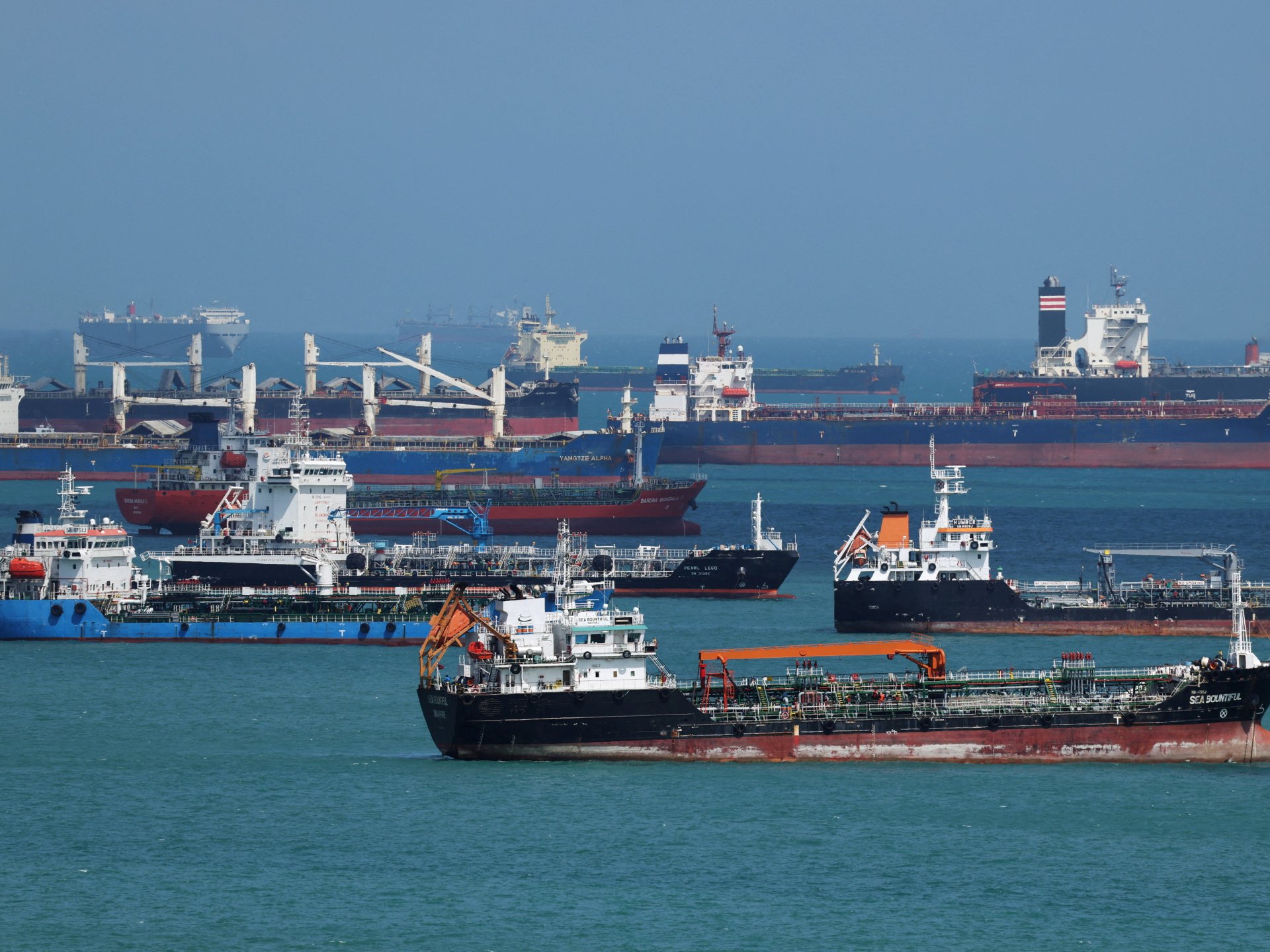

On Saturday last week, the Iranian oil tanker Humanity sailed through the Straits of Malacca and Singapore before veering northeast towards the coast of Malaysia, where it suddenly turned off its automatic identification system (AIS).
Satellite tracking data showed the 330-metre (1,083ft) crude oil tanker had arrived at the Eastern Outer Port Limits (EOPL) of Malaysia, a 1,200-square-kilometre (463-square-mile) expanse of water in the South China Sea about 70km (43 miles) off the shore.
- list 1 of 4Will Germany bring back mandatory military conscription next year?
- list 2 of 4Iran and Oman swap proposals to manage Strait of Hormuz: What we know
- list 3 of 4Cricket: Seales stars with ball as West Indies beat Pakistan in first Test
- list 4 of 4US and Saudi Arabia strike ‘Iran-aligned’ groups in Iraq
end of list
Maritime security experts say the Humanity likely went “dark” as it was preparing to offload its cargo of Iranian oil in a ship-to-ship transfer to a waiting middleman. They say the cargo’s ultimate destination is likely China, which historically buys about 90 percent of Iran’s crude oil exports, according to the US-China Economic and Security Review Commission.
For decades, the EOPL has served as an unofficial marketplace for sanctioned Iranian, Russian and Venezuelan oil, analysts say. Now, satellite data shows that EOPL activity has continued throughout the five-month-long United States-Israel war on Iran and despite a US naval blockade of Iranian ports that ran from April 13 to June 18 and resumed on July 14.
Ray Powell, director of SeaLight, a maritime security monitoring project affiliated with Stanford University, told Al Jazeera he has observed 62 ships broadcasting false or decommissioned ship identities since the start of the year while moving between the Gulf, the EOPL, Hong Kong and then onto northern China.
Advertisement
These ships are part of a network of middlemen who facilitate the sale of Iranian oil to China’s independent “teapot” oil refineries, according to Erica Downs, a senior research scholar at the Center on Global Energy Policy at Columbia University.
“Crude oil bound for China from Iran involves ship-to-ship transfers in international waters, which can happen multiple times before reaching China, to disguise the crude’s origins,” she said.
Unlike China’s huge state-owned enterprises such as CNPC, Sinopec, and CNOOC, these small refineries are less exposed to the US financial system, which makes them more willing to buy discounted but sanctioned Iranian oil, she told Al Jazeera.
Calm waters
The anchorage area off Malaysia’s EOPL area is “just as busy as it has ever been,” said Charlie Brown, a maritime security expert and director of Southeast Asia Regional Programs at the Yokosuka Council on Asia-Pacific Studies (YCAPS).
“Before the war and [throughout] all the different phases of the conflict, there’ve been ships out there anchoring and conducting all kinds of different things like ship-to-ship operations.”
Spanning roughly the size of Hong Kong, the EOPL offers the advantage of calm waters that are close enough to reach suppliers in Singapore and Malaysia but far enough to make the area a historically grey legal one.
The EOPL is outside Malaysia’s territorial waters but within its Exclusive Economic Zone (EEZ), a designation that addresses issues like fishing rights and natural resource exploitation rather than sanctions compliance at sea. Malaysia’s Maritime Enforcement Agency has said in the past that the area is challenging to patrol due to its remoteness and “jurisdictional gaps”.
However, Kuala Lumpur has moved to strengthen its legal toolkit. In June, Malaysia amended its Exclusive Economic Zone Act to crack down on illegal anchoring, resupplying or “bunkering”, and ship-to-ship cargo transfers conducted in its EEZ without government approval.
Malaysia’s Ministry of Foreign Affairs did not respond to Al Jazeera’s request for comment.
Still, on any given day, as many as 200 ships may be anchored in the area, according to Brown – half of them likely having ties to Iran.
Satellite data reviewed by Al Jazeera on Thursday showed that over the past month, 18 Iranian-flagged oil tankers, including the Humanity, arrived in the EOPL before going “dark”. Another Iranian oil tanker, the Dore, could be seen sailing through the Strait of Malacca towards the Middle East on Thursday and may have recently departed the area.
Advertisement
Also present in the EOPL on Thursday were at least 50 US or EU sanctioned ships broadcasting an AIS signal, including three Iranian-flagged cargo and container ships. More “dark” ships are likely in the area, according to experts.
The long arm of US law
The sale of Iranian oil being transferred between ships there is facilitated by China’s Cross-Border Interbank Payment System, which also allows oil payments to be made in renminbi outside the US-monitored SWIFT network, according to Geopolitical Intelligence Services, a global forecasting consultancy based in Europe.
China does not officially acknowledge purchases of Iranian oil, and a spokesperson at the Chinese embassy in Washington, DC told Al Jazeera they were unfamiliar with the transit of Iranian oil through the EOPL to China.
China’s Ministry of Foreign Affairs has repeatedly said in the past that it opposes “illegal unilateral sanctions” imposed by the US and its use of “long-arm jurisdiction” that lacks a basis in international law.
However, Chinese customs data offer some clues about the origin and movement of cargoes through the EOPL, according to Downs of Columbia University.
“Last year, Iran exported about 1.4 million barrels per day to China, yet Chinese customs reported no oil imports from Iran. At the same time, Chinese customs data shows that China’s imports from Malaysia at times greatly exceed Malaysia’s oil production, which indicates that a portion of the crude originated somewhere else,” she said.
Beijing, for its part, has moved to protect its domestic refineries from the US legal system.
After the US Department of the Treasury sanctioned five “teapot” refineries in late April over their purchases of Iranian oil, China’s Ministry of Commerce “blocked” the order, arguing that the sanctions were “in violation of international law and the basic norms governing international relations” and lacked “UN authorisation and basis in international law”.
Beijing has yet to respond to new sanctions imposed this week by the US Treasury on six oil tankers that, it says, transported Iranian oil to China and five companies registered in China and Hong Kong it claims are associated with Iran’s “shadow fleet”.
While the purchase of Iranian crude oil by Chinese refineries has fallen by about 40 percent since the war began, according to US Treasury Secretary Scott Bessent, experts say networks like the EOPL have kept the rest of the oil sales flowing.
“Sanctions never stopped any of this. The market mechanism, the payment mechanism, evolved because of the sanctions, but it never stopped anything,” said Brown from YCAPS. “The only thing that physically stopped oil from going from Iran to China is the blockade.”
Related News
Saudi condemns Houthi blockade: How will the rest of the world be impacted?
US judge voids Trump’s IRS settlement, alleges self-dealing

Argentina’s Milei seeks to deport foreigners that spread ‘hate’ of country