
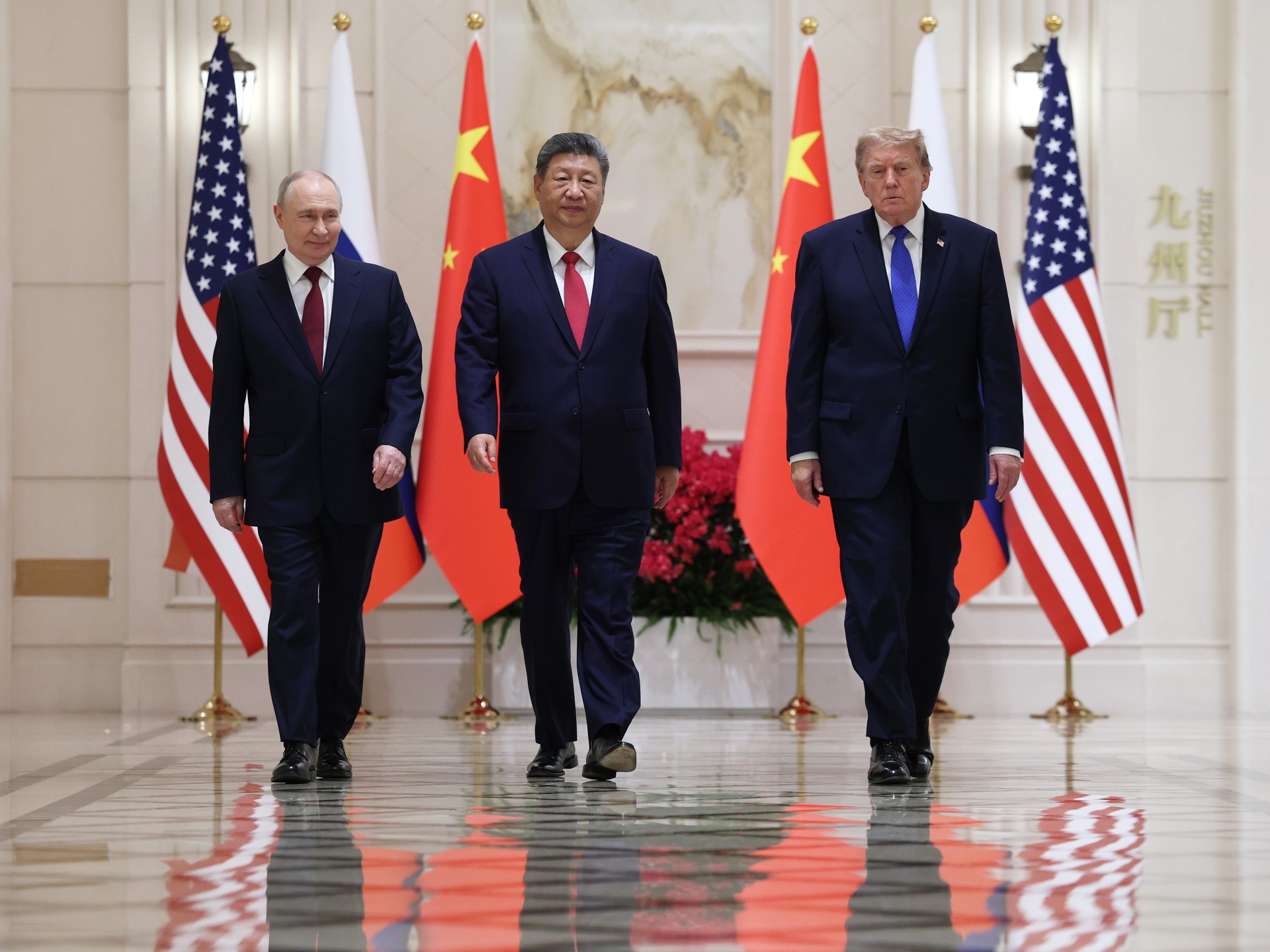

The presidents of the United States, China and Russia have declared a shared intent to stabilise energy flows, prevent nuclear proliferation and find mechanisms to work more closely together, at an unprecedented summit in Shenzhen, China on Thursday.
The meeting, held on the sidelines of the annual Asia-Pacific Economic Cooperation (APEC) conclave, was the highlight of three days of intense diplomacy in the region, where leaders from multiple countries — including US President Donald Trump — had previously gathered in Manila for other summits.
Chinese President Xi Jinping chaired the summit with Trump and Russian President Vladimir Putin, after a series of bilateral meetings among the leaders.
At the end of a more than one-hour-long meeting, they released what they described as a “peace declaration”. They met at a time when multiple wars — including the US war on Iran and Russia’s war on Ukraine — have taken a heavy toll on economies and people around the world.
Here are some key takeaways from their summit:

Landmark meeting, ‘peace declaration’
Trump said that the meeting was between “three of the world’s largest nations,” mentioning that the trio of countries also hold the planet’s three biggest nuclear arsenals. “We’re making history,” the US leader said in his opening remarks, referring to their trilateral summit.
Advertisement
The US president added that “too often past leaders avoided talking to leaders they had disagreements with,” however, Trump noted, “No peace [was] ever forged by declining opportunities.”
All three leaders reiterated that it was up to them to protect the world.
China’s Xi said the countries should shed a “Cold War mentality” and become friends — something reiterated by Russia’s Putin, in his own words, adding that the three countries can strengthen global stability if they cooperate constructively.
After the meeting, the trio released a joint “peace declaration”.
Stable energy flows
Under the China-US-Russia “peace declaration”, the three countries have reaffirmed the importance of stable energy flows, Chinese state media reported.
Global energy supplies have been on edge since the US attacked Iran in February this year, and Tehran closed down the Strait of Hormuz, a critical waterway through which a fifth of the world’s oil supplies previously transited. Ukrainian attacks on Russian energy facilities have further compounded global energy woes.
But there appears to be no end to both wars — either by the US or Russia — and it remains unclear how the promise of stable energy flows will be realised given the different priorities of the three nations.
In fact, there was no reference to the war on Iran at the summit — other than Trump reiterating that Tehran cannot have a nuclear weapon. And a Kremlin spokesperson said that Ukraine was not even the “central topic” at the trilateral meeting, though it was a central part of Putin’s bilateral talks with Trump earlier. Trump also called on Xi to help out in resolving the war on Ukraine.

Nuclear talks
In a major statement before the trilateral meeting started, China’s Xi said, “Nuclear weapons should be comprehensively banned and thoroughly destroyed, building a nuclear-free world.
“Nuclear war cannot be won and must not be fought; every effort must be made to prevent it,” he added.
The thrust of that statement was also later adopted in the post-meeting joint declaration, with three countries pledging to hold a dialogue on reducing nuclear risks and preventing proliferation. The leaders also committed to maintaining strategic stability and international security at their trilateral meeting.
Advertisement
In his opening remarks at the meeting, the US president said that the “three countries are uniquely positioned to discuss nuclear weapons” — given they hold the biggest arsenals.
Trump also said Xi agreed with him that the Strait of Hormuz needs to stay open and that Iran must not be allowed to have nuclear weapons. Tehran has repeatedly said that its nuclear mission is for civilian purposes and that it holds no desire to build weapons.
The start of a G3?
As the US, Russia, and China sat down for the trilateral meeting to discuss a variety of issues, European leaders gathered nervously in Berlin, analysts say, at a meeting of the so-called Coalition of the Willing, a group of European countries coordinating help and support for Ukraine.
The leaders of these three countries appeared to take it upon themselves to solve the conflicts and issues plaguing global economies.
Next month, President Trump is hosting the G20 Summit in Miami, Florida, and China’s Xi Jinping is almost certain to attend. But Russia too is a member of the G20.
President Putin has skipped recent summits of the grouping because of an International Criminal Court warrant against him for the Ukraine war, and because European members of the G20 have been clear that they do not want to share a room with him.
Trump, however, has invited Putin to attend the Miami G20. The US is not a part of the ICC, so it is under no obligation to arrest the Russian president.
“The discussion at the trilateral summit was very frank and helped the leaders to better understand one another,” Putin said after the meeting.
Is this the start of a G3? We shall know in the coming weeks.

Critique of the ICC
Among the many points in the “peace declaration” agreed upon by Trump, Xi, and Putin in Shenzhen was a pointed critique of the International Criminal Court.
The three leaders demanded that the ICC and “similar institutions” not “abuse their positions”.
What is it about the ICC that upsets all three powers — none of whom are members of the court?
- United States: The US has long had an adversarial relationship with the ICC, but those ties have grown especially tense in recent years after the court began investigating allegations of abuse by US soldiers in Afghanistan. The court’s warrant for the arrest of Israeli PM Benjamin Netanyahu on charges of having committed war crimes in Gaza caused a further rupture, and the US has now publicly, as part of official policy, made the dismemberment of the ICC a goal. It has imposed sanctions against the institutions and its officials.
- Russia: Like the US, Russia has never trusted the ICC. But after the ICC issued an arrest warrant against President Putin on charges related to the Russian war on Ukraine, Moscow has become even more fiercely opposed to the UN court and its way of functioning.
- China: There have been times in previous years when China — while never endorsing the court — has been lukewarm to it. But the spate of arrest warrants against leaders of sovereign nations, including Philippines ex-President Rodrigo Duterte, turned Beijing into a strident critic. The ICC has also received petitions from activists accusing China of committing genocide against the Uighur community in Xinjiang — an allegation Beijing rejects.
Advertisement
Related News
Rocket launcher deal illustrates deepening Russia-Iran relations
UN top court convicts Myanmar of ‘genocidal intent’ against Rohingya
UK approves development of Jackdaw gasfield in North Sea