
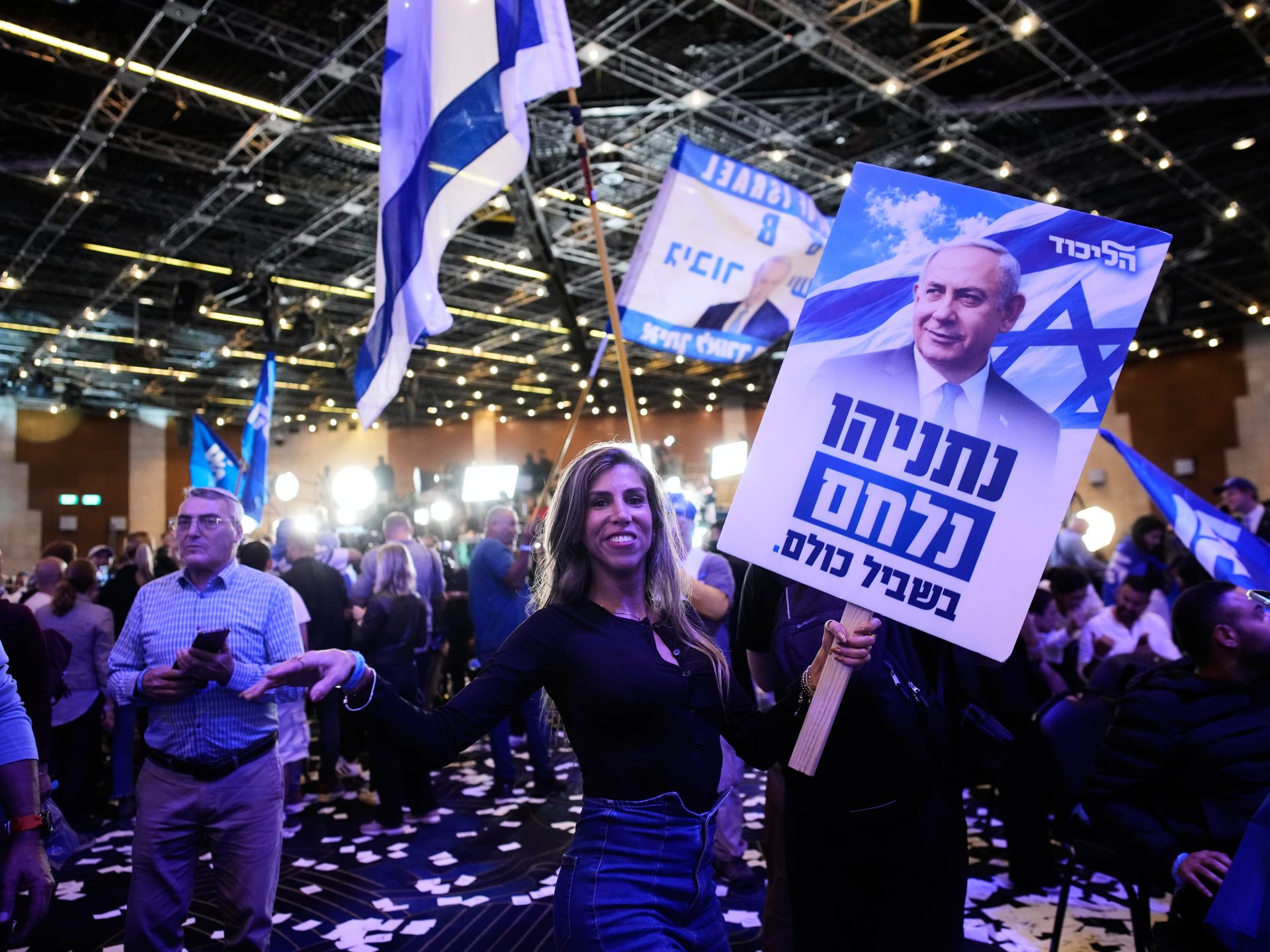

Exit polls from Israel’s election show a neck-and-neck race between Prime Minister Benjamin Netanyahu and his main rival, Gadi Eisenkot, with neither likely to secure a clear path to a governing majority.
Tuesday’s vote was largely seen as a referendum on Netanyahu’s leadership and response to the Hamas-led attacks of October 7, 2023, and the subsequent genocidal war on Gaza.
- list 1 of 3Lebanon’s lost olive season: harvesting olives under drones and warplanes
- list 2 of 3Arab towns in Israel celebrate historic Knesset gains with fireworks
- list 3 of 3Smotrich dances in Israel despite far-right decline
end of list
It also came as Israel’s pogroms in the occupied West Bank have escalated, and amid mounting tensions with several of its neighbours, many of whom it has attacked in the past three years.
Here are five key takeaways from the Israeli elections so far:
Late-night exit polls from Israel’s Channel 12 broadcaster projected the Netanyahu bloc would win 52 seats in the 120-seat Knesset, or Israeli parliament. Netanyahu was edging out the opposition bloc led by former Israeli military chief of staff Gadi Eisenkot’s Yashar party, which was projected to win 49 seats.
Israel’s Channel 13 earlier indicated the two blocs were tied, with each winning 51 seats.
Polling indicated that Netanyahu’s Likud party – which leads his wider bloc – could emerge as the single largest party with an estimated 27 seats to 21 for Eisenkot’s Yashar party, according to updated projections from Channels 12 and 13 – giving Likud a clear lead over all others in the parliament.
Arab parties were projected to win 19 seats collectively, building on their 2022 performance.
Israelis vote for parties, which then form alliances to create a governing coalition with a prime minister at the helm. No single party has ever won a 61-seat majority.
Advertisement
Released by the major Israeli television networks, exit polls are unofficial indicators of the vote. Preliminary official results are expected on Wednesday, and may vary from the exit polls.
Leaders react, predict end to Netanyahu’s reign
Opposition bloc leader Eisenkot, who was mounting a challenge to Netanyahu, said the Israeli public had voted for change and against the incumbent prime minister.
Addressing supporters at his Yashar party headquarters, Eisenkot said “this will be a new start. A real new start on a new path. The old era is over, and Israel is starting a new era.”

But the Israeli prime minister told supporters that his Likud party is dominant and called for the formation of a “national right-wing government”.
“What we’ve seen is that the Likud party is the largest party – nobody can compete with us,” he said. “The second thing that is clear as well is that the right bloc has a majority. And it is a decisive majority.”
He also accused Israeli television channels of trying to discourage his supporters from voting by projecting stronger results for opposition parties.
Israeli far-right Finance Minister Bezalel Smotrich told supporters that his party was projected to win seven seats, vowing to continue expansion of Jewish settlements in the occupied West Bank.
The far-right National Security Minister Itamar Ben-Gvir praised his Otzma Yehudit party’s election performance in a speech to supporters at its headquarters.
“We are very proud of our journey”, Ben-Gvir said. “This party was not even existing on the political landscape.”
Democrats leader Yair Golan said on X that Israeli voters had “fired the Netanyahu government” and pledged to work with political partners to form a new administration.
Ra’am leader Mansour Abbas said he hopes the final election results will let the opposition bloc and his party hold the 61 seats needed to form a government. The party was projected to win around seven seats.
Record turnout among voters
The Central Elections Committee reported that 77.7 percent of eligible voters participated in Israel’s election, the highest turnout since 1999. Turnout was up 7.1 percentage points from 2022, when Netanyahu, who has served as prime minister off and on since 1996, returned to office.
Israel’s military said turnout among soldiers had climbed beyond 68 percent by 5pm local time (15:00 GMT). More than 60,000 Israelis also returned home from abroad to take part in the vote.
Advertisement
Polling stations closed at 10pm local time (20:00 GMT), but the committee, the country’s official elections body, said anyone waiting in line at that time would be allowed to vote.
Arab parties accuse Netanyahu of inciting hatred to scare voters
Prominent politicians from Arab-led lists accused Netanyahu of inciting hatred against Palestinian citizens in Israel in an attempt to boost his electoral prospects.
Yousef Jabareen, leader of the Joint List, said in a video statement shared on social media on Tuesday that Netanyahu knew that “we can put an end to his bloody reign”.
Mansour Abbas, leader of the United Arab List, denounced Netanyahu’s comments as a “scare tactic to mobilise right-wing voters and drive them to the polls”.
In a series of posts on X on Tuesday, Netanyahu attacked Arab voters, describing them as “Muslim Brotherhood supporters” and accusing them of “raiding the polling stations and stealing the elections”.
In a separate post, he urged right-wing Israelis to “go out and vote for Likud”, referring to his political party and describing the situation as a “matter of life and death for us”.
What could happen next
After the vote is finalised, the parties will immediately begin negotiations to try to reach the 61-seat majority.
The bloc with the most votes will have different options to assemble support from smaller parties, including forming a minority government or working with another political leader to alternate as prime minister under a power-sharing arrangement.
Once the final count is in, President Isaac Herzog will speak with party leaders about who they want as prime minister, then tap the candidate he believes has the best chance of forming a government.
The person nominated then has up to 42 days to form a government.
If no government emerges, Netanyahu and his current cabinet will remain as a caretaker government.
If negotiations fail and no coalition can form a government, new elections will be called.
The final vote tally is expected by Friday, and official election results are formally published a week after the election, on November 4.
Related News
Iraq begins high-stakes security balancing act as US troops withdraw
Trump says he plans to campaign for 32 days before midterm elections
Iran war live: Kremlin says Trump welcomed Russia’s effort in Iran deal