
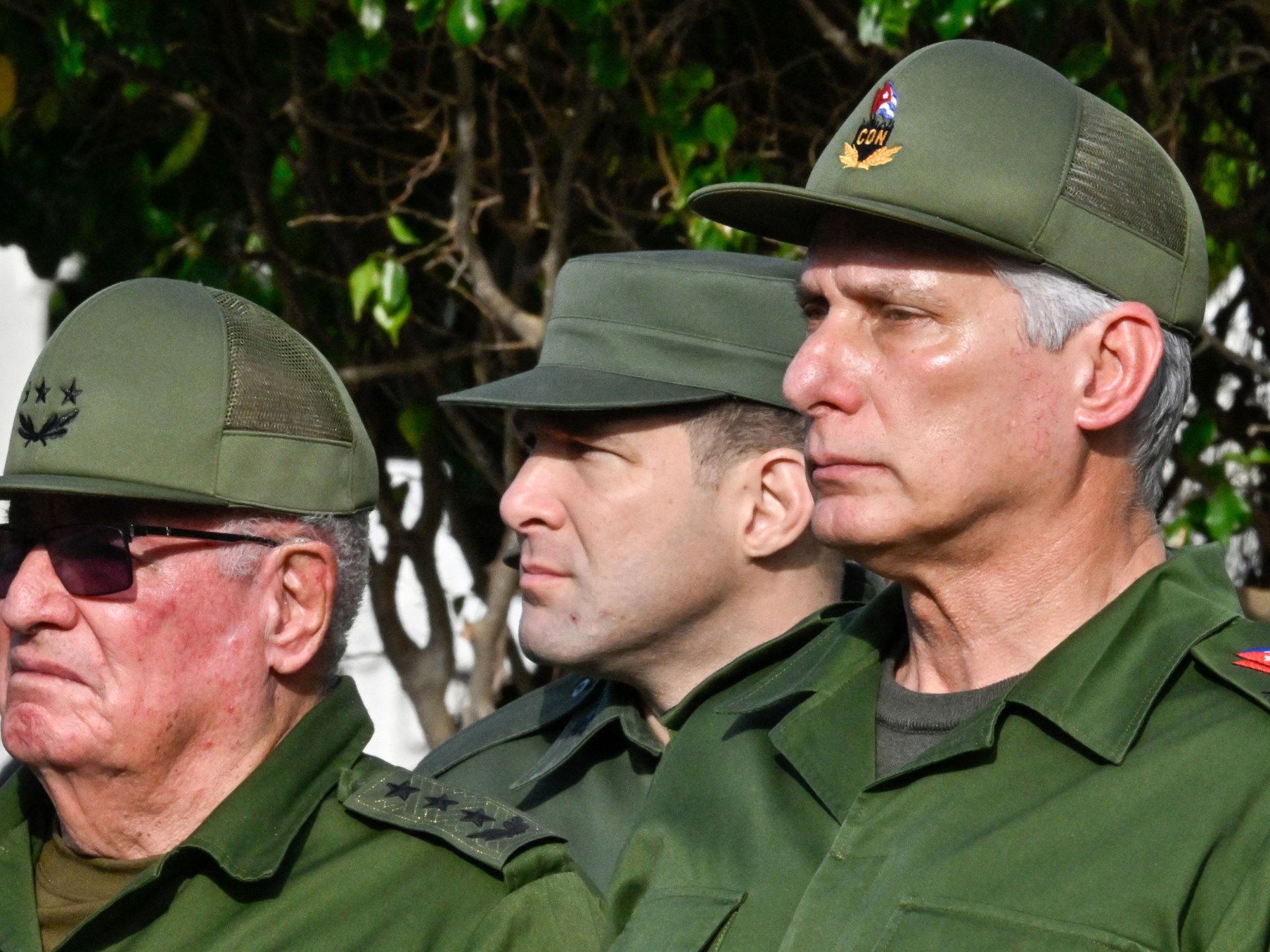

Cuba’s President Miguel Diaz-Canel has said that the island nation does not seek confrontation, but warned that United States military action against it would result in a “bloodbath”.
The president said in a social media post on Monday that Cuba is not a threat and does not have “aggressive intentions” against any country, but has the “absolute legitimate right” to defend itself if the US follows through on mounting military threats.
- list 1 of 3‘Absolutely no fuel’: Cuba hit by blackouts, protests amid power outages
- list 2 of 3Havana slams new Trump sanctions as ‘collective punishment’ of Cuban people
- list 3 of 3US issues new Cuba sanctions as UN experts warn of ‘energy starvation’
end of list
“The threats of military aggression against Cuba from the world’s greatest power are well-known,” Diaz-Canel said, in reference to the US. “The threat itself already constitutes an international crime. If it were to materialise, it would trigger a bloodbath with incalculable consequences, plus the destructive impact on regional peace and stability.”
The remarks from the Cuban president come one day after a report in the news outlet Axios, citing classified information shared with it, claiming that Cuba has amassed more than 300 drones and could launch an attack on US military forces or the US state of Florida.
The report, met with strong scepticism, comes amid months of threats from the administration of US President Donald Trump that suggest the US could topple the Cuban government through military force and an energy blockade that has squeezed the country’s already fragile economy and triggered nationwide blackouts.
The energy blockade has heaped further strain on the island’s population, which has long struggled with political repression from the Cuban government and economic restrictions imposed by the US.
Advertisement
On Monday, the Trump administration continued to ramp up its pressure campaign against the Cuban government, announcing sanctions on the island’s directorate of intelligence.
But the island has been under a wholesale US trade embargo since the 1960s, and it is unclear what the additional sanctions will accomplish.
Reactions in Cuba to the most recent US pressure campaign have ranged from defiance to exhaustion and protests.
“I know Cuba is a strong country. Cubans are very brave, and they are not going to find us unprepared,” 57-year-old Sandra Roseaux told the news service Reuters.
“If they come, they will have to fight, because Cuba will respond. My country, hungry or however it may be, will respond. It is better that they do not come because there will be a fight.”
Related News
UK identifies new suspected hantavirus case on remote island
Tackling methane emissions key for climate change and energy security: IEA
How to escape Russia’s army: Soldiers serving in Ukraine seek a way out