

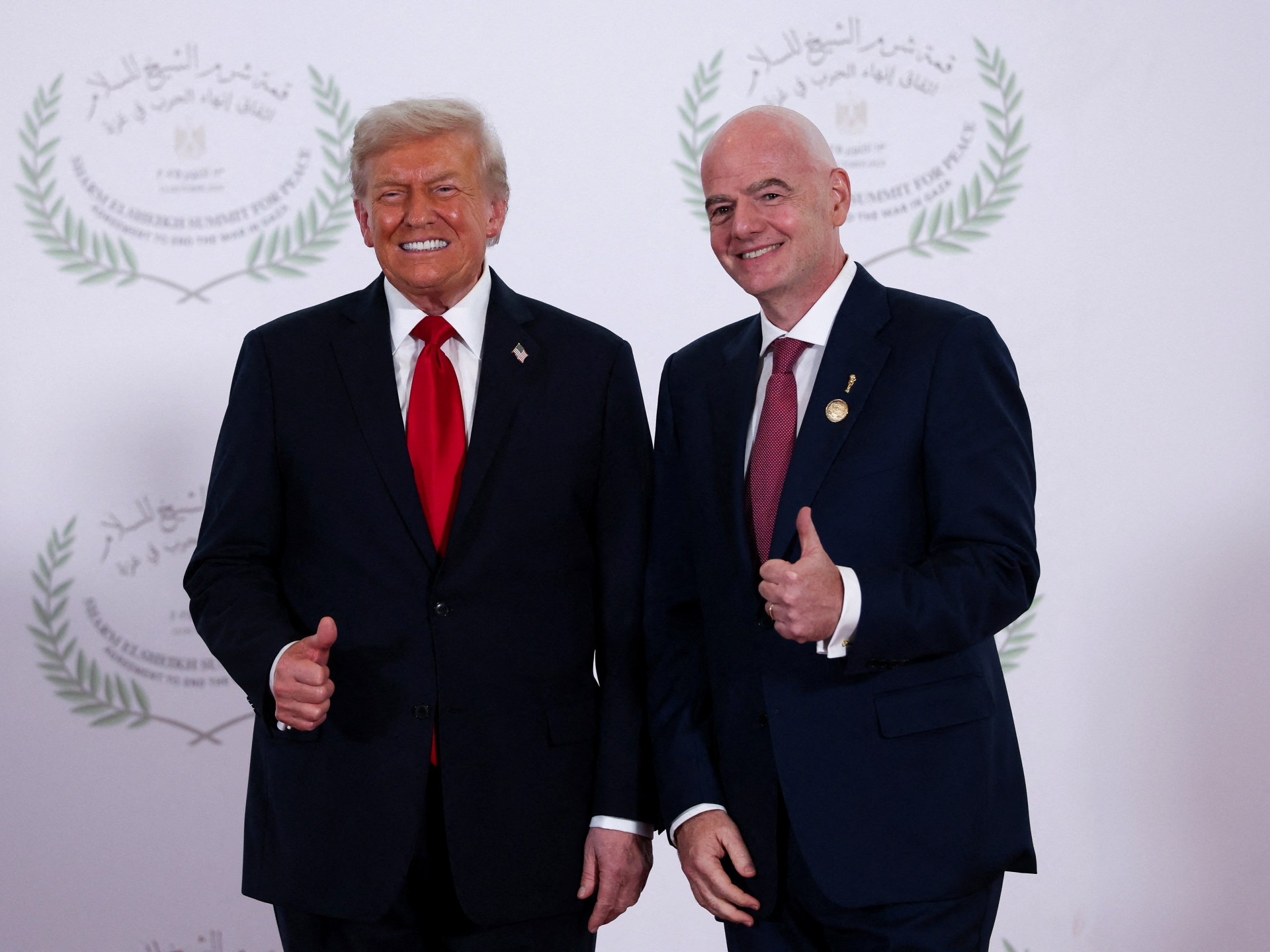

The United States’ World Cup campaign is mired in controversy after FIFA seemingly broke its own rules to allow star striker Folarin Balogun to face Belgium in Monday’s last 16 clash, despite picking up a red card in Wednesday’s Round of 32 win over Bosnia and Herzegovina.
World football’s governing body announced it had suspended the automatic one-match ban after President Donald Trump phoned FIFA chief Gianni Infantino to urge him to review the case. Infantino reportedly bypassed his own 37-member council to unilaterally create and award Trump the inaugural FIFA Peace Prize during the World Cup draw.
- list 1 of 4Why FIFA’s Balogun red card suspension after Trump call is so controversial
- list 2 of 4Can ‘Trump’ card Balogun guide USA to quarterfinals? Belgium test awaits
- list 3 of 4The World Cup must pay its carbon bill
- list 4 of 4World Cup: Mohamed Salah and the ghosts of Egypt’s ‘golden generation’
end of list
Balogun, who plays for Monaco in France, has scored three goals and is his country’s leading scorer at this World Cup.
The decision prompted criticism from Belgium’s football association as well as Europe’s top football body UEFA, which argued that setting aside a suspension after direct political intervention undermined the integrity of the tournament and set a dangerous precedent.
But this is far from the first time FIFA has found itself at the centre of a World Cup storm.
From political interference to corruption scandals, football’s governing body has a long record of controversy at its own showpiece event.
Here is a look back at some of the most notable:
1930: The whistle that came too soon
FIFA’s very first World Cup had barely begun before it ran into hot water.
Argentina led France 1-0 through an 81st-minute Luis Monti free kick in a group game in Montevideo, Uruguay, when Brazilian referee Gilberto de Almeida Rego blew for full-time in the 84th minute – six minutes early – just as French winger Marcel Langiller broke clear with only the goalkeeper to beat.
Advertisement
The French players protested furiously and mounted police rode onto the pitch to restore order.
After consulting his linesman, Rego accepted his error and the players were recalled to complete the remaining minutes.
A rattled France failed to score and Argentina’s 1-0 win stood.
The World Cup was just two days old at the time.
1962: Garrincha, the red card and two presidents
Long before Folarin Balogun, there was Garrincha.
Brazil’s mercurial winger – carrying the team in the injured Pele’s absence – scored twice in a 4-2 semifinal win over hosts Chile in 1962, only to be sent off late on for kicking an opponent in retaliation after being hacked throughout the game.
Red cards then carried no automatic ban; FIFA’s disciplinary committee ruled on a case-by-case basis, and the other player dismissed in the same match was suspended.
But after Chilean President Jorge Alessandri backed a petition for Garrincha to play, and Peru’s President Manuel Prado reportedly phoned the referee to soften his testimony, the committee let him off with a warning.
Garrincha played in the final, Brazil beat Czechoslovakia 3-1 and the trophy was retained.
Until this week, it stood as the only time a red-carded player played in his team’s next World Cup match.

1973: FIFA, Pinochet and the match with no opponent
Weeks after General Augusto Pinochet’s coup toppled Chile’s socialist government of Salvador Allende in September 1973, Chile were due to host the Soviet Union in a World Cup qualifying playoff at Santiago’s Estadio Nacional – a stadium the military government was using as a detention centre, where thousands of political prisoners were held, tortured and killed.
The Soviets told FIFA they could not play in the blood-stained stadium and requested a different venue.
FIFA instead sent inspectors, who declared the ground fit for football; prisoners were reportedly hidden inside the complex during the visit.
The USSR refused to travel.
On November 21, 1973, Chile kicked off against nobody, walked the ball into an empty net for a symbolic 1-0 before the referee abandoned the match and FIFA registered it as a 2-0 win for Chile.
Chile qualified for the 1974 World Cup but went out in the group stage.
1978: A dressing room visit and accusations of collusion
Argentina hosted the 1978 World Cup during the military rule of General Jorge Videla, which tortured and killed thousands, some within earshot of the Estadio Monumental, the largest stadium in Latin America.
Advertisement
It wanted a home triumph to bolster its legitimacy, and FIFA’s format obliged.
With final group games then played at different times, Argentina kicked off against Peru knowing that Brazil’s earlier win meant they needed a victory by four clear goals to reach the final. FIFA had rejected Brazil’s request for simultaneous kick-offs.
Before the game, Videla visited the Peruvian dressing room.
Argentina won 6-0, and allegations have been made ever since: reported grain shipments to Peru, unfrozen Peruvian assets and a former Peruvian senator’s claim that the fix was sealed with a deal to imprison thirteen Peruvian dissidents.
Nothing has ever been proven and players from both sides deny collusion.
Argentina beat the Netherlands in the final to win its first World Cup.
1982: The disgrace of Gijon
Sometimes FIFA’s failure is doing nothing at all.
On 25 June 1982, West Germany and Austria faced off in Gijon in Spain, knowing – because Algeria had played a day earlier – that only one outcome would send both European sides through, eliminating Algeria: a West German win by a margin of less than three goals.
Horst Hrubesch scored for West Germany after 10 minutes, and then, for 80 more, almost nothing happened: the ball was passed harmlessly around as both teams protected the result.
The fans in the stadium saw through it.
They chanted “fuera, fuera” (out, out), Algerian supporters waved banknotes at the players, a German commentator stopped speaking in protest, his Austrian counterpart told viewers to switch off – and local newspaper El Comercio published its match report in the crime section.
Algeria lodged a formal complaint.
FIFA ruled that no rules had been broken and took no action, admitting the flaw only implicitly: from 1986 onward, they fixed the issue that had also plagued the previous tournament by having final group games kick off simultaneously.
2006: One card too many
In the decisive Group F clash between Croatia and Australia in Stuttgart, Germany, English official Graham Poll booked Croatia’s Josip Simunic in the 61st minute for a foul on Harry Kewell – but mistakenly recorded the caution against Australia’s Craig Moore.
Simunic, born and raised in Australia, spoke with a broad Australian accent, which Poll later suggested may have caused the mix-up.
So when Simunic committed another bookable foul late on, Poll showed a second yellow with no red.
Only after the final whistle, when the defender angrily confronted him, did Poll produce a third yellow – and finally the red card.
The match ended 2-2 and Australia went through.
FIFA conceded the error, Poll was sent home before the knockout rounds, and one of England’s most experienced referees retired from international football.

Related News
New front in US-Iran war escalates as Houthis fire at Saudi oil facilities
At least 11 killed in Ukrainian and Russian strikes as holiday camp hit
Two civilians killed in Houthi strike on Marib, says Yemen’s government