

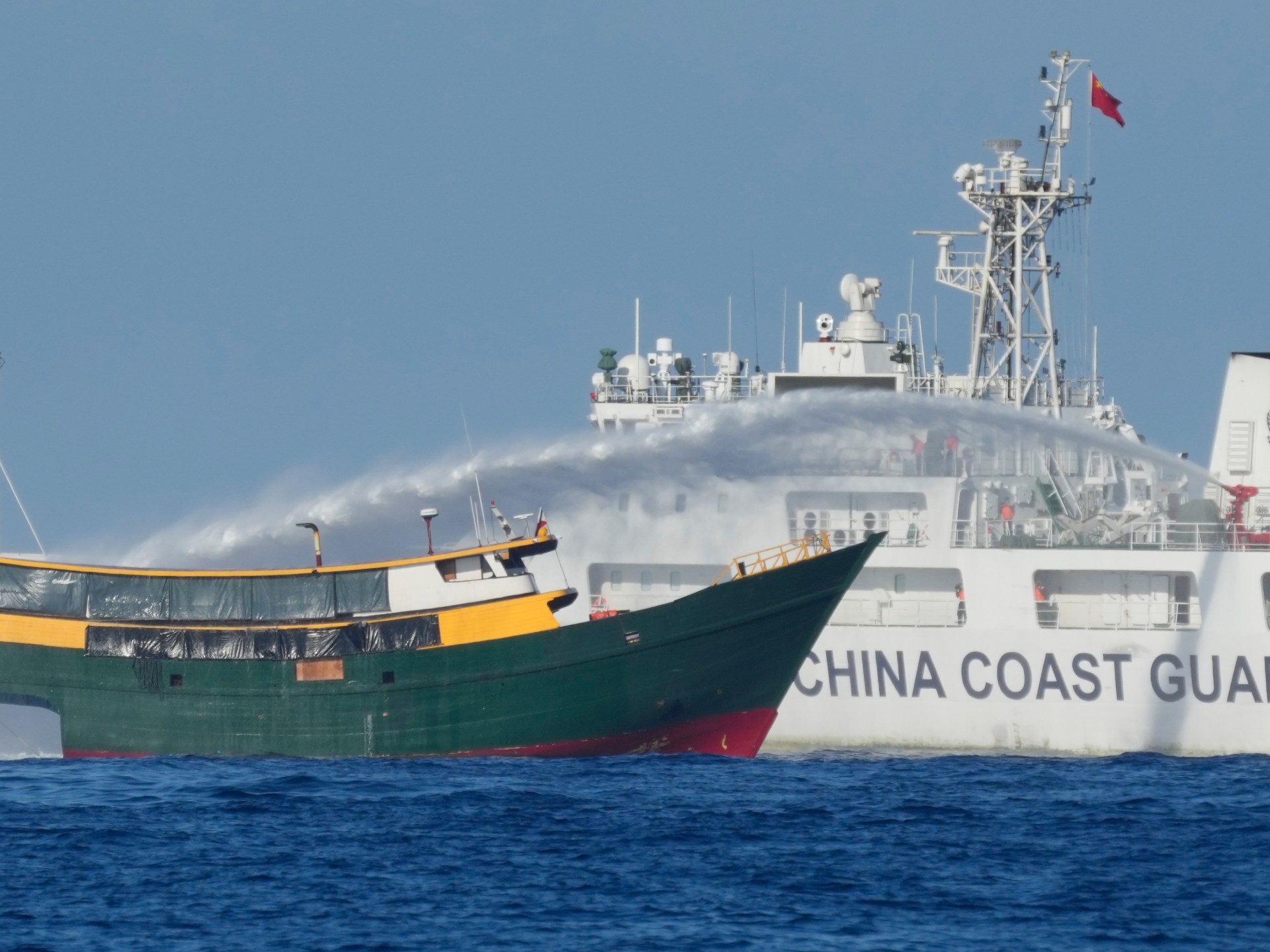

China and the Association of Southeast Asian Nations (ASEAN) have failed to conclude long-running negotiations on a code of conduct for the South China Sea during meetings in Manila, despite tentative agreement on about 80 percent of a draft, the Philippines’ foreign minister said.
“There is no conclusion yet,” Theresa Lazaro told reporters at the ASEAN summit on Sunday, adding that several key issues remain unresolved, including whether the code would be legally binding.
- list 1 of 4Hegseth heads to Manila to shore up US ties with Asia-Pacific partners
- list 2 of 4Myanmar’s coup leader-turned-president wins back neighbours despite war
- list 3 of 4Myanmar’s detained ex-leader Suu Kyi receives package from King Charles III
- list 4 of 4Nearly 1,500 migrants arrive in Myanmar from Malaysia despite UN warnings
end of list
“The ASEAN countries plus China have also different views on how things are,” she added.
ASEAN and Beijing have been working on a code of conduct in the South China Sea, where they have overlapping claims, for more than two decades. The Philippines, as the current chair of the 11-nation association, had pledged to speed up the process and reach a deal by the end of this year.
Lazaro said she still hoped the code could be concluded under Singapore’s auspices, as the city-state takes over as chair next year.
Southeast Asian nations want the code to reflect international law, which some of them accuse China of ignoring. Beijing insists its actions have been lawful and professional.
China has laid claim to most of the South China Sea, clashing with the exclusive economic zones of Brunei, Indonesia, Malaysia, the Philippines and Vietnam, making a functional code essential to keeping tensions from escalating and managing maritime encounters.
An international arbitration tribunal ruled in 2016 that China’s sweeping claims have no basis under international law, a decision Beijing rejects.
Advertisement
China and the Philippines, in particular, have faced off in a series of maritime confrontations in recent years.
The Philippines accuses Chinese ships of repeated aggressive actions inside its exclusive economic zone, including dangerous manoeuvres, firing water cannons and disrupting resupply missions. China accuses the Philippines of intruding on its territory.
Tensions escalated after Philippine President Ferdinand Marcos Jr took office in 2022. Months of harsh words between the two countries over the sea preceded this weekend’s meetings.
Separately, ASEAN extended a ban on Myanmar’s leader attending the bloc’s annual summits, saying the country failed to comply with a 2021 peace plan.
ASEAN leaders also decried Myanmar’s military and armed groups for continuing to attack civilians in the country’s long-running civil war.

Under the ban, Myanmar can be represented only by lower-level career diplomats, including at the summit in Manila. Myanmar was due to hold ASEAN’s rotating chair this year, but because of the civil strife, the role passed to the Philippines.
The stern rebuke followed a review of progress on the Five-Point Consensus for Myanmar, approved by ASEAN in April 2021 in a bid to ease the violence that erupted after Myanmar’s military seized power from the democratically elected government of Nobel laureate Aung San Suu Kyi in February that year.
The military coup triggered widespread pro-democracy protests that were brutally quashed, leading to armed resistance and a civil war that has spread over much of the country.
In Manila, ASEAN leaders expressed “deep concern” over insufficient progress in implementing the plan and urged all parties to “stop targeted attacks against civilians and civilian infrastructure”.
There are “still certain bombings and displacement of Myanmar people, so step-by-step, we give it to them, how they’re going to tackle this issue, and we’ll monitor that,” said Lazaro, who is also ASEAN’s current special envoy to Myanmar.
Myanmar leader Min Aung Hlaing, the former chief of the military, has made official visits to several ASEAN member states since assuming the presidency after elections in December and January, widely seen as having been rigged.
ASEAN has not discouraged those visits, but its leaders have emphasised that the peace plan remains “the main reference for addressing the political crisis in Myanmar”.
Advertisement
Related News
Israel’s Herzog accepts vote results, opens talks on forming a government

WHO approves trials for two new Ebola vaccines

NASA’s Voyager 1 to hit new space distance record of one light-day