Gaza’s infrastructure collapse leaves residents defenceless against floods
 11 November 2026
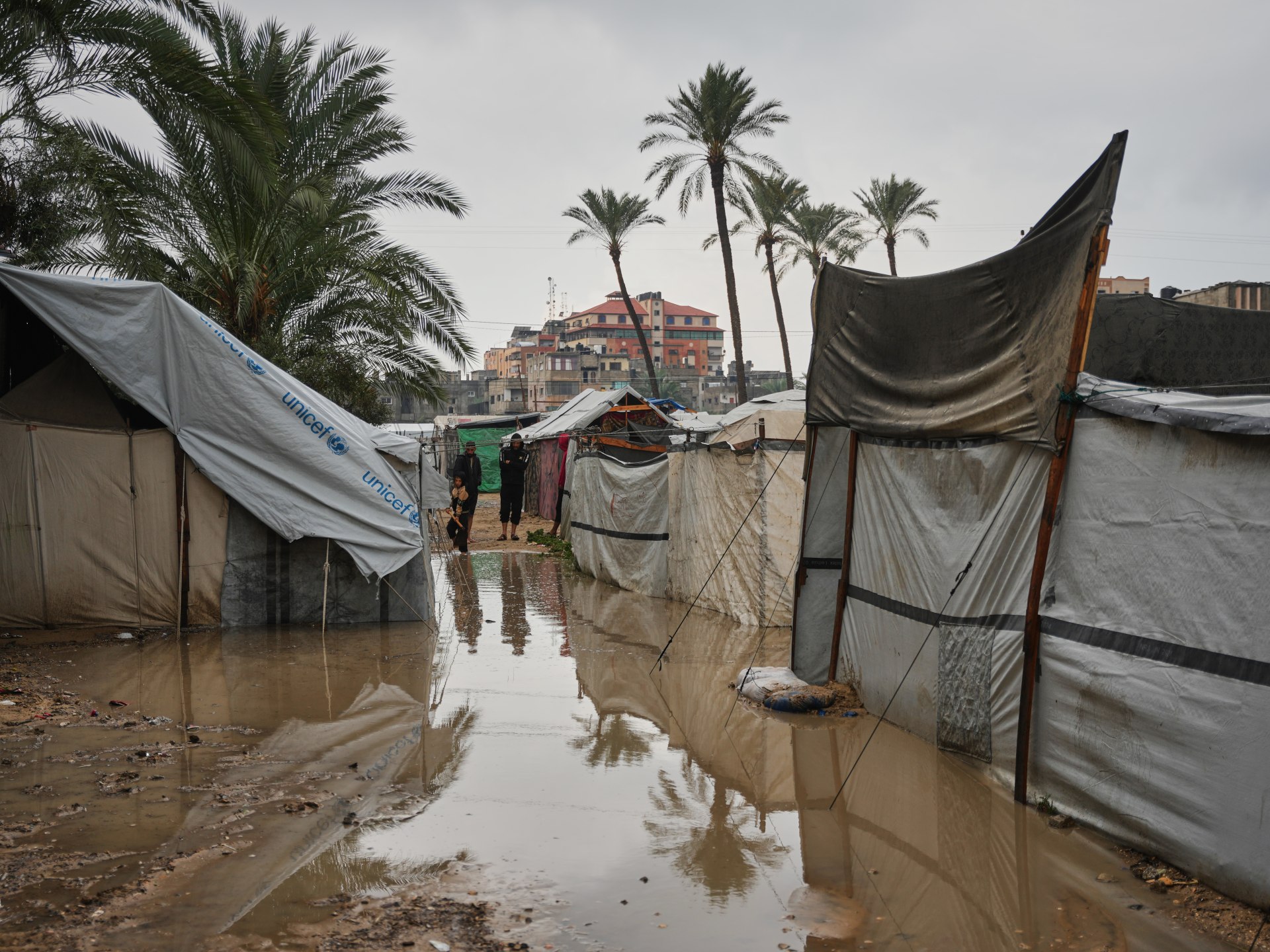

Damage from Israel’s genocidal war on Gaza has worsened floods caused by heavy rain, which have submerged large areas of the enclave, local officials say.
A deep weather depression has exposed how the catastrophic deterioration of the Strip’s stormwater and sewage networks is causing thousands of tents to be flooded.
- list 1 of 3‘Tents don’t protect us’: Rains flood displaced Palestinians in Gaza
- list 2 of 3Gaza authorities slam global ‘inaction’ after mudslide kills five people
- list 3 of 3How is Gaza coping with another severe winter?
end of list
Gaza’s infrastructure has been severely damaged by waves of air raids and shelling since the start of the war in October 2023.
Ramadan Rabaa, a Palestinian shop owner, saw floodwaters sweep through his premises in western Gaza City, destroying large quantities of goods and inflicting heavy financial losses on his and his neighbours’ businesses.
When municipal crews arrived at the scene, they could do little to help due to a severe shortage of equipment and machinery.

Rabaa believes that if municipal authorities had sufficient resources, such as water suction trucks, pumps, and bulldozers, his losses could have been minimised, potentially saving his shop along with other businesses, homes and tents that have been inundated.
The rain has submerged or damaged 70,000 tents, affecting approximately 350,000 people, according to Gaza’s Government Media Office. In some displacement camps, water levels reached nearly 1.5 metres.
The impact of the weather is compounded by wartime destruction, with the media office reporting that more than 700km of Gaza’s sewage network has been destroyed.
Advertisement
Within 12 hours of the storm, Gaza’s Civil Defence received more than 2,000 distress calls but could only respond to 218, because of fuel shortages and equipment breakdowns.
Due to the ongoing siege on Gaza and destruction caused by Israel’s war, Gaza City’s municipality currently relies on only one bulldozer, which often breaks down, and two water suction trucks. Most water and sewage pumps are out of service.
“The municipality lost about 85 percent of its fleet of vehicles and heavy equipment during the war, after the Israeli occupation destroyed more than 135 vehicles, mechanisms, and equipment, leaving it with only 15 percent of the total previous fleet,” Husni Muhanna, a spokesman for Gaza City municipality, told Al Jazeera.
“The remaining mechanisms are old and worn out, suffer frequent breakdowns, and require continuous maintenance to keep them operational and provide the minimum level of services to residents and the displaced, so the municipality is forced to seek help from whatever resources are available in the private sector.”
The destruction extends to the drainage networks.
“The occupation destroyed six sewage pumps out of eight in Gaza City, and the municipality has so far been unable to restart more than two pumps, leading to a decline in drainage capacity to about 20 percent at best,” Muhanna said.
This situation has been worsened by the destruction of the stormwater drainage network. Gaza City has lost about 2,800 of the 4,800 drains that existed before the war, heightening the risk of flooding during heavy rain.
Muhanna warned that the challenges in Gaza City are beyond the capacity of municipal crews, with about a million citizens and displaced people concentrated in an area covering less than one third of the city, while 85 percent of infrastructure is damaged.
To address the situation, the municipality and local institutions have prepared an emergency winter plan requiring $1.3m worth of materials and field equipment. But it depends entirely on the flow of funding and supplies, which is being hampered by Israeli restrictions on Gaza.
Jibril Kashko, a businessman from a family specialising in heavy equipment, told Al Jazeera that Gaza City Municipality requested his help during the recent storm, but was limited in the assistance he could provide due to broken equipment and a lack of operational resources.
“What owners of heavy equipment in Gaza face goes beyond usual breakdowns, as they have become unable to obtain the simplest operating supplies, from spare parts, oil and grease, to batteries,” Kashko said.
Advertisement
Ismail al-Thawabta, director general of the Government Media Office, said the enclave requires between 300,000 and 350,000 tents and reinforced plastic tarps, as well as caravans, to replace damaged shelters. Mobile homes which were supposed to enter Gaza as part of the October 2025 ceasefire agreement have been held up on the border.
Gaza also needs 1,000-1,500 water pumps, 300-500 heavy machines such as bulldozers and excavators, and generators to power essential services.
Al-Thawabta said that repeated displacement and the destruction of most homes in Gaza have left large numbers of residents lacking essential supplies to cope with the winter months.
He said 2.2 million winter clothing bags, 5 million heavy blankets, 2 million water and moisture-insulating sponge mattresses, and about 400,000 heaters are needed to help Palestinians in Gaza cope with the bad weather. But the aid entering Gaza remains at a fraction of what the enclave’s 2.3 million population needs, due to the Israeli restrictions.
Related News

Balad leader blasts ‘racist’ exclusion of Arab parties in Israel
Rubio says Trump administration did not help Bolsonaro flee Brazil to US
Trump administration renews bid to block Alaska election results