From railway tragedy to gov’t change: Serbia’s two-year fight for justice
 01 November 2026

Sunday marks two years since 16 people were killed when a train station canopy collapsed in the Serbian city of Novi Sad.
The accident prompted student-led protests which swiftly evolved into a wider political campaign that brought the Student List opposition movement to power last week.
Here is a timeline of events from the tragedy in Novi Sad on November 1, 2024, to the elections that led to a change of government in Serbia.
November 1, 2024 – The collapse of a concrete canopy on the renovated Novi Sad railway station building kills 14 people at the scene, with three others taken to hospital in critical condition. Two of them later die of their injuries in November 2024 and March 2025, bringing the total number of victims to 16. The tragedy leads to public outrage, raising questions about the quality of the work, lack of transparency in the spending of public money and endemic corruption.
November 5, 2024 – Just four days after the accident, thousands of protesters gather in Novi Sad to demand accountability for those responsible. The protests escalate into clashes with police, with dozens of protesters arrested and City Hall damaged. Observers point to the swift judicial response to the protesters, while the investigation into the accident itself remains stalled.
November 19, 2024 – Opposition MPs, councillors and citizens block the entrance to the court and prosecutor’s office building in Novi Sad for three consecutive days, demanding the release of those arrested and an accelerated investigation into those responsible for the collapse of the canopy. The blockade is marked by daily confrontations with police in riot gear.
Advertisement
November 21, 2024 – After three weeks of public pressure, the higher public prosecutor’s office in Novi Sad announces that 11 people have been arrested in connection with the deaths at the railway station, including former Construction Minister Goran Vesic and other officials.
November 22-25, 2024 – Students and professors come under attack during a memorial service for the victims of the canopy collapse in front of the faculty of dramatic arts of the University of Arts in Belgrade. The incident marks a turning point, prompting students to launch a university sit-in to demand the prosecution of the attackers, the publication of documentation on the railway station’s reconstruction and the release of all detained protesters.
December 11, 2024 – Under strong pressure from months of protests and university blockades, authorities publish part of the documentation on the reconstruction of the railway station. Eight binders containing 195 documents are presented, but students and others dismiss the move as insufficient, demanding full transparency and criminal accountability for the contractors and supervisory institutions.
December 30, 2024 – Prosecutors in Novi Sad officially file an indictment against 13 people on suspicion of committing serious crimes against public security, improper execution of construction works and abuse of office. But higher courts overturn detention orders for Vesic and Serbia Railways Infrastructure’s acting General Director Jelena Tanaskovic, putting them under house arrest. The transparency of the proceedings is further called into question by a dispute over the jurisdiction of the prosecution offices and the transfer of case files.
January 15, 2025 – In addition to the proceedings in Novi Sad for the canopy collapse, the public prosecutor’s office for organised crime in Belgrade officially launches a separate investigation into potential financial fraud, corruption and money laundering during the reconstruction of the railway station. It involves Vesic, former Trade Minister Tomislav Momirovic and 12 other individuals, including managers of construction and supervision companies.
January 28, 2025 – Public outcry erupts after governing party activists attack and cause serious bodily harm to students of the Academy of Arts in Novi Sad. Serbian Prime Minister Milos Vucevic submits his resignation in the government’s biggest political concession to date. However, protests and blockades continue.
March 11, 2025 – Thirteen activists and students are arrested in Novi Sad on the eve of planned large protests in Belgrade, charged with undermining the constitutional order and violent behaviour. The arrests prompt a strong reaction from civil society organisations and citizens, who denounce them as politically motivated and organise protests and road blockades in Novi Sad.
Advertisement
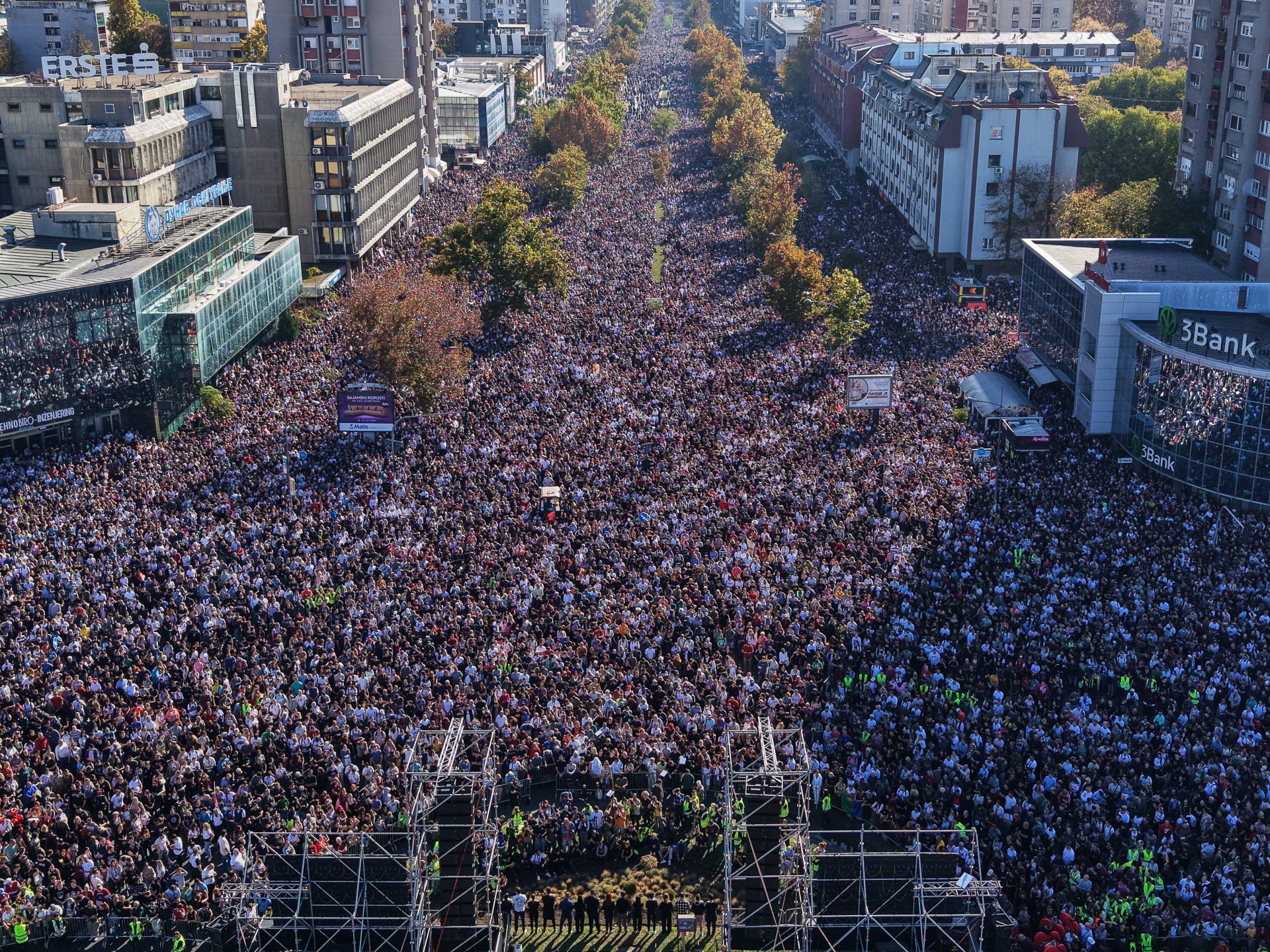
March 15, 2025 – Hundreds of thousands of people demonstrate in Belgrade.
May 28, 2025 – After months of student-led protests and blockades, Novi Sad’s High Court decides to replace prison detention with house arrest for some of the imprisoned activists and students.
June 25, 2025 – With the prosecutor refusing to withdraw the charges of undermining the constitutional order and security services continuing to exert pressure, some of the accused activists leave Serbia for European Union countries, where they continue to draw attention to the situation.
September 9, 2026 – The informal student-led movement morphs into a political force following the announcement of snap parliamentary elections for October. The Student List-Students Win grouping is formed, bringing together students, professors and legal experts.
September 27, 2026 – Longtime leader Aleksandar Vucic resigns as president of Serbia to lead the Serbian Progressive Party-led electoral list. On his last day as president, he pardons all prosecuted students and activists, ending the proceedings for “undermining the constitutional order” and allowing the safe return of activists from exile. The move is widely seen as an attempt to ease social tensions ahead of the election campaign.
October 25, 2025 – Vucic concedes defeat to the Student List in the elections, which saw voter turnout reach its highest level in more than 30 years. Accountability for the Novi Sad railway station tragedy remains a central issue following the announcement of the results.
Related News
Russian attack on Ukraine’s Kramatorsk kills at least 12 people
Hegseth says firing squad execution of Fort Hood shooter will be ‘public’
Qatar, France call for opening of Hormuz and Gaza ceasefire implementation