

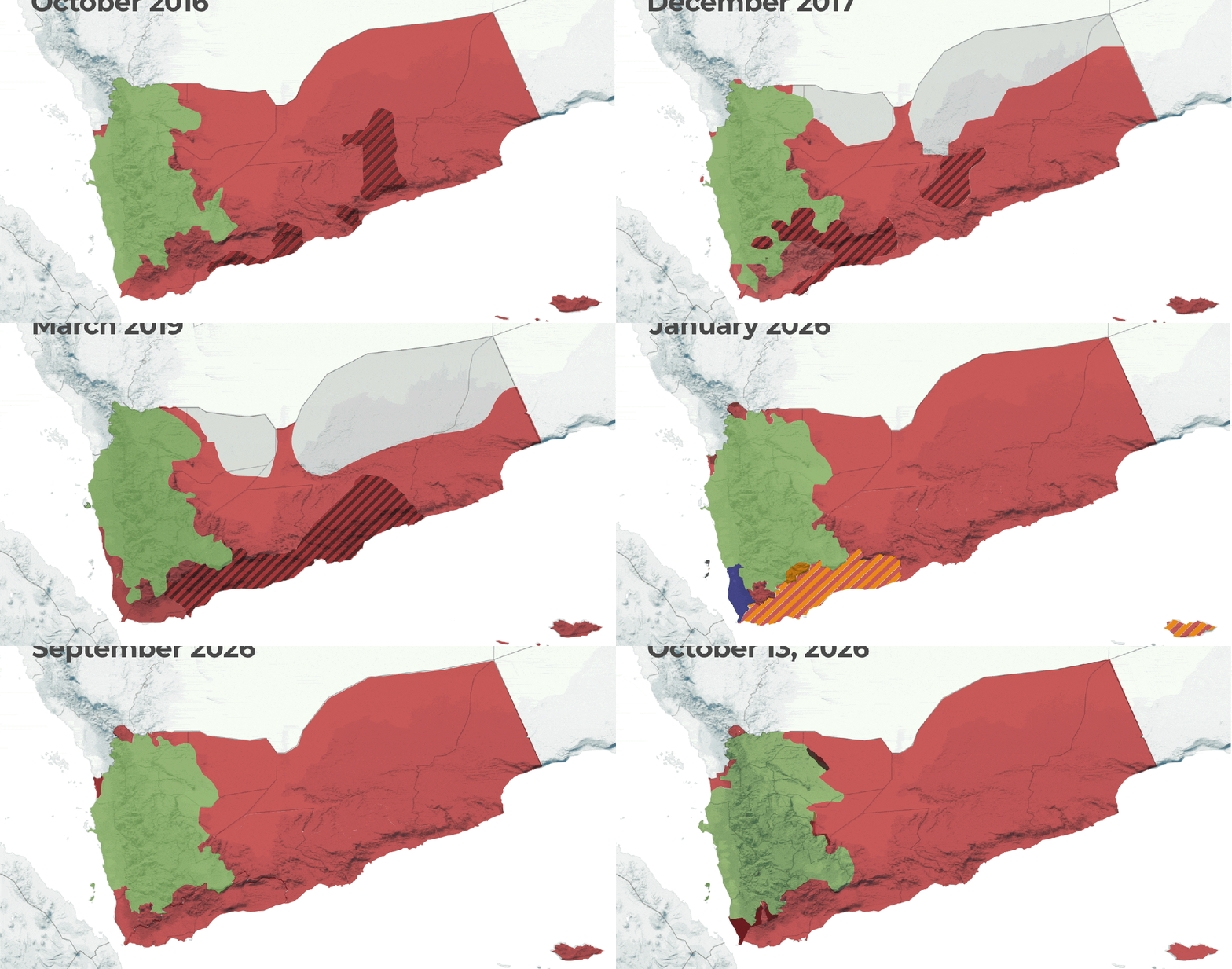

Looking at maps of who controls which areas of Yemen over the past 12 years of war reveals changing alliances and coalitions, all while the country faces poverty and malnutrition.
The Houthi armed group, also known as Ansar Allah (Arabic for Supporters of God), seized the capital, Sanaa, on September 21, 2014, after advancing south from their heartland of Saada in northern Yemen.
- list 1 of 4Saudi-led coalition intercepts Houthi missile launched towards Riyadh
- list 2 of 4Iraq’s PM tells Saudi crown prince Iraqi territory will not be used for attacks
- list 3 of 4Two scenarios for the Yemen war
- list 4 of 4Renewed fighting risks ‘humanitarian catastrophe’ in Yemen, aid groups warn
end of list
The Iran-allied group used antigovernment grievances to gain support after July 2014 fuel subsidy cuts triggered anger.
The Houthis mobilised protests demanding the reversal of the government’s decisions, and subsequently its resignation. They allied with forces loyal to former President Ali Abdullah Saleh, which helped them capture military positions and state institutions.
Then-President Abd-Rabbu Mansour Hadi fled to Aden in February 2015. When forces aligned with the Houthis and Saleh advanced towards the southern port city, Hadi took refuge in the Saudi capital, Riyadh. In March 2015, Saudi Arabia launched a military intervention to restore his internationally recognised government.
Over the next decade, alliances broke and front lines shifted. In this visual explainer, AJLabs uses seven maps to track how Yemen has been fragmented, and how no side has been able to control the whole country.
October 2016

By late 2016, two years after the Houthis seized Sanaa, Yemen was split into rival zones of control.
The Houthi-Saleh alliance controlled Sanaa and much of the northern and western heartlands, home to most of Yemen’s population.
Advertisement
Pro-government forces held territory across the south and the east, supported by Saudi Arabia and the United Arab Emirates.
Al-Qaeda in the Arabian Peninsula (AQAP) also challenged government authority across parts of the south.
December 2017

The antigovernment alliance in Yemen went through its most significant fracture after Saleh appeared close to switching sides in the conflict, leading to a short outbreak of fighting with the Houthis, who then killed Yemen’s former longtime president in Sanaa in December 2017.
This left the Houthis, a primarily Zaidi Shia group, in sole charge of much of northwestern Yemen, including Sanaa and the port city of Hodeidah.
Some pro-Saleh forces switched sides, and pro-government and anti-Houthi forces controlled territory across the south and the east while AQAP retained pockets of influence.
Nearly three years into its intervention and despite a heavy air campaign, the Saudi-led coalition had failed to restore the internationally recognised government of Hadi in Sanaa.
March 2019

The Houthis continued to hold Sanaa and much of the northwestern highlands. Government-aligned forces held extensive territory across the south and the east while AQAP maintained pockets of influence.
The December 2018 Stockholm Agreement halted a pro-government offensive against Houthi-held Hodeidah, a major entry point for food, fuel and aid.
Neither side had been able to achieve a decisive victory. Divisions among the Houthis’ opponents further weakened efforts to establish government authority.
2022
The UAE-backed Southern Transitional Council (STC), which seized Aden in 2019, held territory separately from government forces. Despite officially being part of the anti-Houthi, Saudi-led coalition, the STC fought the government several times.
Hadi was forced to transfer his powers to an eight-member Presidential Leadership Council (PLC), ending his presidency without reclaiming the capital.

April 2023

Saudi-Houthi negotiations raised hopes of a settlement and led to a truce in April 2022, but Yemen remained divided as it had been for years.
While the Houthis retained their control over Yemen’s northwest, the STC continued to undermine Yemen’s internationally recognised government as it tried to increase its own power in the south in the hope that this would eventually lay the foundations for an independent state.
Government forces controlled broad areas of the east, which separatists also wanted to claim for any future state.
Advertisement
The Hadrami Elite Forces, a UAE-backed group, controlled coastal Hadramout. The National Resistance Forces (NRF), led by Saleh’s nephew Tareq Saleh and supported by the UAE, held part of the Red Sea coast.
March 2025
By 2025, the Houthis had held Sanaa and most of Yemen’s northwest continuously for more than a decade.
Government-aligned forces operated across the south and the east.
Houthi attacks on shipping, which the group said were launched in solidarity with Palestinians in Gaza, drew attacks from Israel, the United Kingdom and the United States.
Yemen’s coastline and the Bab al-Mandeb strait became central to a confrontation whose consequences reached far beyond the country.

January 2026

Government forces regained Hadramout and al-Mahra from the STC, which had seized the governorates in December 2025.
Saudi air attacks and a government advance fractured the STC’s leadership. A delegation in Riyadh announced the STC’s dissolution, but coalition officials in Yemen rejected the announcement, and its leader Aidarous al-Zubaidi fled the country.
The map above shows contested authority across parts of southern Yemen and Socotra. Tareq Saleh’s forces remain separately marked along the western coast while the Houthis retained Sanaa and the northwest.
The PLC sought to unify anti-Houthi formations. Regaining territory strengthened its position, but establishing a single command remained unfinished.

September 8, 2026

In early September, Houthi forces attacked west of Taiz in an attempt to cut road access to the Red Sea coast.
Government forces initially claimed gains in Hais and western Taiz, but the port city of Mocha fell on September 10 as Tareq Saleh’s NRF withdrew and repositioned.
By September 11, government sources reported Houthi advances into Dhubab and Mayyun Island, completing their reported takeover of Yemen’s Red Sea coast.
By September 25, nearly 130,000 people, including 71,000 children, had been displaced in three weeks, according to UNICEF.
PLC Chairman Rashad al-Alimi called for a general mobilisation and offered amnesty to Houthi fighters who defected.
Government forces intensified their air and ground operations in Taiz towards the end of the month while Saudi Arabia sought support from Pakistan and Turkiye amid continuing Houthi attacks.
October 13, 2026

After announcing Operation Dawn of Yemen on October 4, the internationally recognised government launched a major offensive on October 5 with the stated aim of retaking areas that included Sanaa. The Southern Giants Brigades fought alongside government troops and former STC-affiliated units.
The same day, the government said its forces had recaptured positions around Dhubab and Bab al-Mandeb, but the full extent of their gains on the coast could not be confirmed. It also said it had seized mountain positions in Haifan, western Taiz and around al-Waziiya.

Fighting also spread to Marib, where government forces claimed heights around the Maas camp and positions north of Harib by October 13.
Advertisement
But while the government claimed these gains, it also lost territory in Taiz governorate, leading to a siege on the city of Taiz, one of the most important government-held areas of the country, with the major road linking it to the south controlled by the Houthis.
The escalation deepened Yemen’s humanitarian crisis, and by October 7, more than 200,000 people had been displaced, including more than 3,700 who fled by sea to Djibouti, according to the International Organization for Migration.
Government and Saudi-led coalition air attacks increased, including on Sanaa. The Houthis, meanwhile, attacked Saudi Arabia repeatedly with ballistic missiles, including an October 10 attack on Riyadh’s airport that killed 13 people.
Related News
Backlash in Kashmir over proposal for uniform Friday sermons across mosques
Christa Pike discharged from hospital and returned to Tennessee prison
EU unlocks humanitarian aid for Africa and other crisis-hit regions