King David Hotel bombing to consulate row: A timeline of UK-Israel tension
 08 October 2026
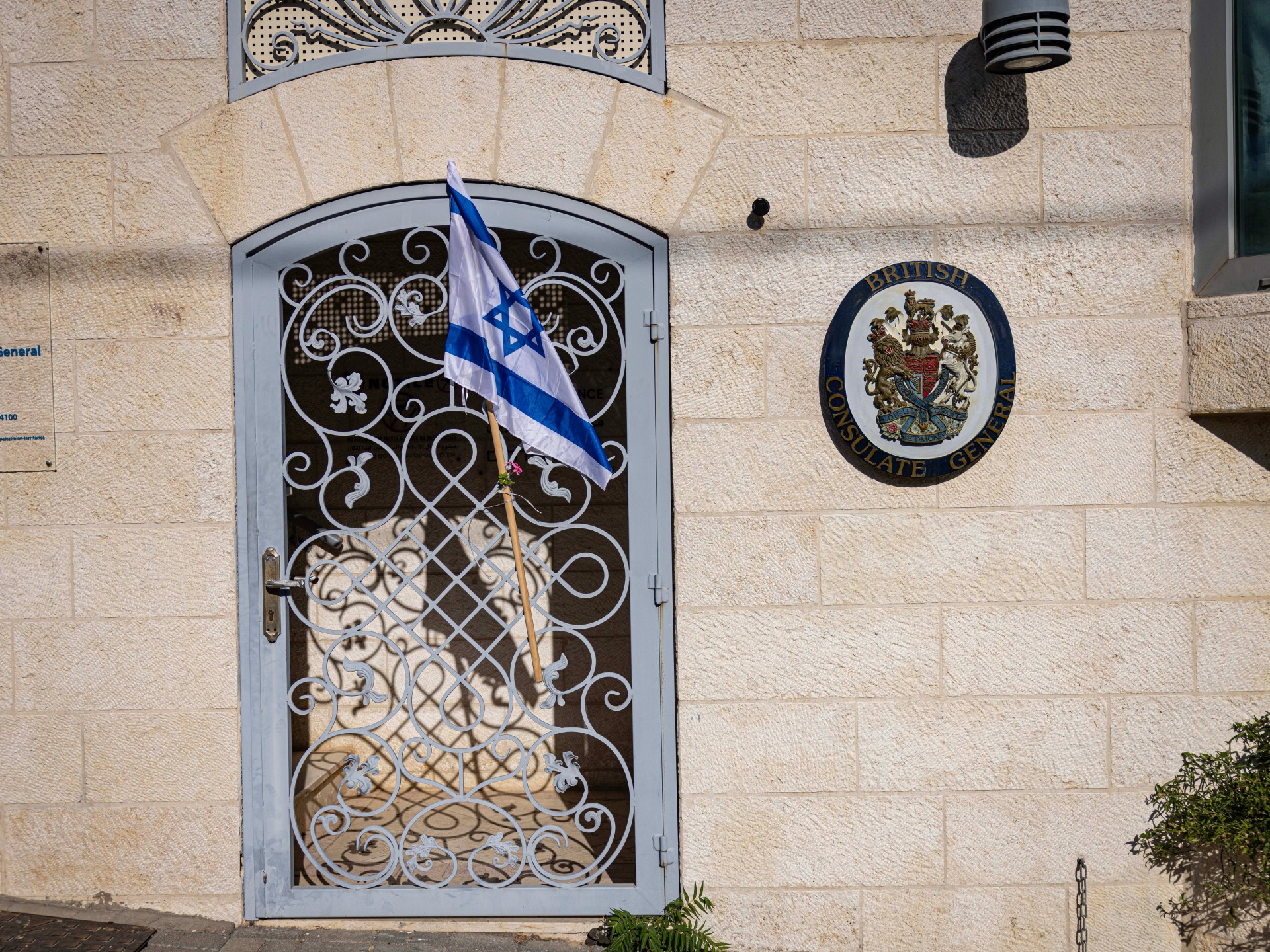

The British Consulate General in occupied East Jerusalem has ceased operating under that name after Israel ordered it to close in retaliation for the United Kingdom’s sanctions on illegal Israeli settlements in the occupied West Bank.
However, UK officials insisted on Thursday that it remains open, albeit under its new title of “UK Mission”.
- list 1 of 3UK ‘threatens to expel 27 Israeli diplomats’ over Jerusalem consulate
- list 2 of 3‘Not the act of a friend’: Israel’s deadline to close UK consulate nears
- list 3 of 3‘Not backing down’: The Britons pushed towards Palestine by Gaza genocide
end of list
This isn’t the first time tensions have arisen between Israel and the UK, however. Here’s more about the times relations have faltered.
Why did Israel order the British consulate to close?
Last month, Israel gave the UK 30 days to close the consulate, after which it said British diplomats working there would lose their diplomatic status.
The order came a day after Foreign Secretary Ed Miliband announced the UK would ban imports of all goods from illegal Israeli settlements in the West Bank and would bar companies from providing them with services, including financing, construction and real estate.
As the deadline expired, the two governments reached a last-minute compromise, however.
Israeli Foreign Minister Gideon Saar said Israel would allow a team of seven British diplomats to work from the building, while 20 diplomats, including the consul general, would leave Israel. The name of the building has also been changed.
Miliband said the building would not close and would now be called the “UK Mission, Jerusalem”, and insisted that the UK does not accept that Israel has the legal right to close a consulate, which the UK owns and which has stood for nearly 200 years.
Advertisement
Besides assisting UK nationals in Palestine, the mission provides support to Palestinians and generally represents the UK in East Jerusalem, the occupied West Bank and Gaza.
Britain and Israel have mostly enjoyed strong and warm relations. But Israel’s move against the consulate is not the first time there has been tension between them.
Here is a timeline of some of those moments of strain:
The King David Hotel bombing
Britain’s role in the founding of Israel dates back to a single letter. On November 2, 1917, Foreign Secretary Arthur Balfour wrote to Lord Rothschild that the British government viewed the establishment of a national home for the Jewish people in Palestine “with favour”, provided nothing was done to prejudice the civil and religious rights of existing non-Jewish communities.
Britain went on to rule Palestine under a League of Nations mandate. By the 1940s, Zionist armed groups had turned their guns on the British administration itself.
The deadliest attack came on July 22, 1946. Members of the Irgun, a Zionist underground group, disguised themselves as hotel staff and carried about 350kg of explosives into the basement of the King David Hotel in Jerusalem. The hotel housed the Secretariat of the Government of Palestine and the headquarters of British forces in Palestine and Transjordan.
Menachem Begin, then head of the Irgun, ordered the bombing. The blast killed 91 people: 41 Arabs, 28 Britons, 17 Jews and five others. Begin later became Israel’s prime minister.
The Irgun claimed it had called in three warnings ahead of the explosion by telephone to the hotel switchboard, the French Consulate and the Palestine Post, giving occupants time to evacuate.
The British authorities did not deny that warnings were sent, but maintained that none reached anyone “in an official position with any power to take action”. The exact sequence of events remains contested: some accounts claim the hotel warning was ignored entirely, while others suggest hotel management did not take the threat seriously. What is not disputed is that the building was not evacuated in time.
The Irgun also claimed that a senior British official, Sir John Shaw, refused to act on its warning, which he strenuously denied.

Close to war during Israel’s formation
Britain withdrew from Palestine in May 1948, and Israel declared itself an independent state. Amid the war that followed with neighbouring Arab states, British and Israeli forces came close to direct confrontation.
Advertisement
In late December 1948, Israeli forces pushed into Egyptian territory in Sinai. A United States Department of State message to its ambassador in Tel Aviv warned that unless Israeli forces withdrew, Britain would be bound to fulfil its obligations under its 1936 treaty with Egypt, so Israel pulled back.
Days later, however, the two sides clashed in the air. On January 7, 1949, Israeli forces shot down four Royal Air Force Spitfires, and a Hawker Tempest later that day. The precise location is unclear, but some sources place it near the Deir el-Balah area of what is now the Gaza Strip, but was then about 25km (15 miles) inside Egyptian territory. Two British pilots were killed, including the Tempest’s pilot, David Tattersfield. Israel said its pilots had mistaken the British aircraft for Egyptian ones.
On January 8, the UK announced it was sending forces to Aqaba, on modern-day Jordan’s Red Sea coast, at Transjordan’s request. In his diary, David Ben-Gurion wrote that he had consulted his top commanders on how to deal with the threat of British intervention. Washington helped calm things down: President Harry Truman criticised the British handling of the crisis.
Historians still debate how close the two sides came to war. Some argue the UK worked to avoid confrontation and never issued a formal ultimatum. Either way, Britain withheld de jure recognition of Israel until April 1950.

UK weapons embargo over invasion of Lebanon
When Israel invaded Lebanon in June 1982, the UK took action. Prime Minister Margaret Thatcher later wrote that Britain restricted defence sales to Israel in June 1982 in direct response to the invasion. The embargo lasted until 1994.
Foreign Secretary Francis Pym publicly condemned the invasion, and government papers declassified years later show London was furious in private as well. The UK even refused to send Israel gas masks during the 1991 Gulf War, when Iraqi missiles struck Tel Aviv.

Falklands tensions
The same year – 1982 – the UK went to war with Argentina over the Falkland Islands, and Israel sent arms to the other side.
According to declassified British files, Israel sold Argentina weapons including Skyhawk jets, which killed dozens of British troops. Foreign Secretary Geoffrey Howe personally asked Israel to stop, but his request was ignored. Israeli arms were also routed through Peru so that the UK would not find out.
Israel denied involvement at first but, by 1984, admitted to supplying Argentina in order to sustain its arms industry. British officials suspected another motive, however. They believed Begin, by then prime minister, still bore a grudge against the UK from the Mandate era.
Gaza genocide: The current crisis
Relations between the UK and Israel have also dipped since the start of Israel’s genocidal war on Gaza in October 2023. More than 74,000 people in Gaza have been killed in Israeli strikes and its siege of the strip, including about 1,400 of those since a supposed US-led “ceasefire” was declared one year ago. Most of the dead are women and children. Thousands more are lost under the rubble and presumed dead.
Advertisement
In September 2024, the UK suspended 30 arms export licences to Israel. In May 2025, it suspended trade talks and sanctioned individuals and companies linked to settler violence. In September 2025, it formally recognised the State of Palestine.
Last September, London went further. Foreign Secretary Ed Miliband, who is himself Jewish, said the UK now regards Israel’s occupation of the West Bank, not just the illegal settlements there, as illegal. He told parliament that Palestinians are being ethnically cleansed by settlers in parts of the West Bank.
Israel’s response was swift. National Security Minister Itamar Ben-Gvir said he had urged Prime Minister Benjamin Netanyahu to close the consulate, accusing it of working on behalf of the Palestinian Authority. Israeli Foreign Minister Saar blamed London: “We did not want it to come to this, but the Labour Government’s actions have led us here.”
The compromise has eased the immediate standoff without resolving it. Saar said the UK had agreed not to retaliate, while Miliband said it would hold off on reciprocal action as long as talks remain credible.
“What’s happening here is that Israel and the UK seem to have found some kind of compromise at the 11th hour, at least for now,” Al Jazeera’s Camille Nedelec said, reporting from London.
“Strictly speaking, the consulate has shut its doors,” she said. “That’s in official language, but practically speaking, there is still a diplomatic presence that is going to be maintained in occupied East Jerusalem by the UK.”
That, she said, “allows both sides to essentially say that they’ve won the argument”.
“We absolutely are at a low point with UK-Israeli relations,” Nedelec said, adding that in a post on X, Saar listed measures including “shuttering that consulate, and he also cited banning some 12 MPs from entering Israel”.
“Gideon Saar also did say, though, that they are allies and that the intelligence sharing continues,” she added.
Israeli anger has been heightened by a resolution passed by the UK’s Green Party at its recent party conference, equating Zionism with “racism”. The party’s leader, Zack Polanski – who is also Jewish – was not present for the vote. However, he liked a post by Green Party member Gill Tavner after the vote, calling on opponents of the motion to “get over yourselves and move on”. “The decision is made. Sometimes they don’t go your way. If you’d prefer to be with genocidal Labour, maybe just go,” she wrote.
Nihad Abu Ghosh, a Palestinian journalist, told Al Jazeera from Ramallah that Israel’s reaction to rising opposition in the UK to its war on Gaza is “driven by the election context, and by its heightened stance towards those it sees as infringing on or undermining Israel’s sovereignty”.
“Britain recognises the Palestinian state, and Israel is trying to resist that by all possible means,” he said, noting that Israel has also punished Spain, Norway and Ireland over the issue.
He compared the move with Washington’s decision to close its own Jerusalem consulate and handle Palestinian affairs through its embassy. “This is what Israel wants: it wants every country in the world to deal with Palestinians as an Israeli matter,” he said.
“Israel’s problem here is that it is punishing itself,” Abu Ghosh said. “If this involved only one country and a limited, partial tension with a country here or there, it could indeed take tough measures. But this is a widening trend.”
He also linked the standoff to history. “Britain in particular bears primary historical responsibility for the creation of the State of Israel, for supporting it, for suppressing the Palestinian people,” he said, citing the Balfour Declaration. “Unless Israel reverses its policies, the situation is likely to escalate further.”
Related News
‘Better deal’: What’s behind Trump’s rejection of Iran’s truce offer?

How Switzerland lost 20 percent of its ice in five years
‘Tool of oppression’: Rising number of UK pro-Palestine voices debanked