

Kosovo’s election of a new president has brought an end to heightened tensions in parliament and possibly on the streets.
On Tuesday, protests against the convictions of former Kosovo Liberation Army leaders coincided with a midnight deadline to elect a president.
- list 1 of 4‘Kosovo’s moves towards Israel are the price of aligning with US policy’
- list 2 of 4Kosovo’s former president guilty of war crimes
- list 3 of 4Police clash with Kosovo protesters over bid to curb Hague war crimes court
- list 4 of 4Amid protests, Kosovo’s political deadlock raises prospect of new elections
end of list
Ultimately, the ruling Vetevendosje Movement (LVV) and opposition Democratic Party of Kosovo (PDK) reached an agreement on her candidacy, clearing the way for a parliamentary vote.
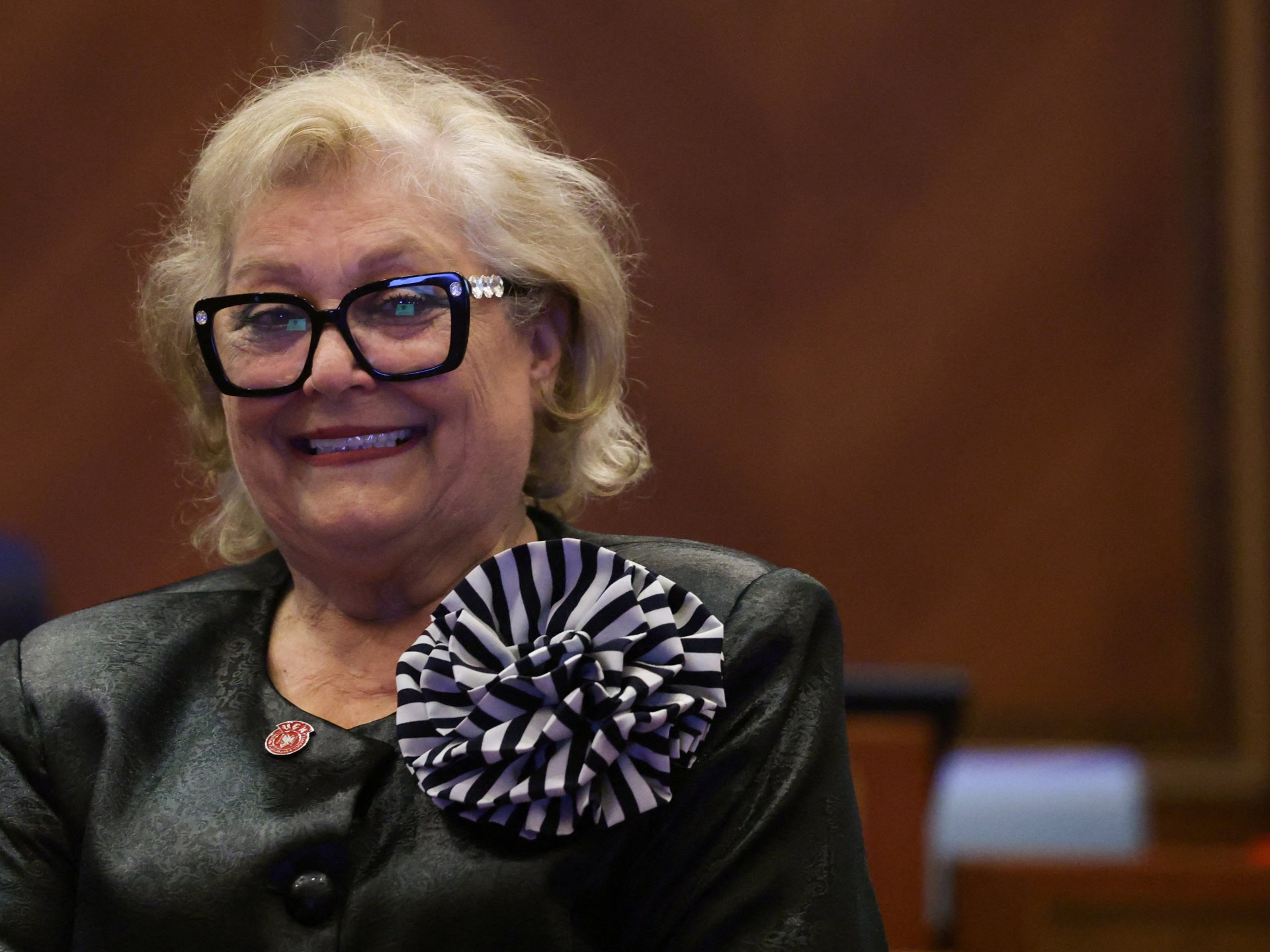
Lawmakers elected Justina Shiroka Pula to the country’s top office in the first minutes of Wednesday, close to the constitutional deadline, averting new early parliamentary elections that could have pushed the country into a deeper crisis.
The 81 votes she secured – one more than the two-thirds, 80-vote threshold required – were the result of a pragmatic compromise.
The parties also agreed to adopt amendments changing the legal framework governing the Kosovo Specialist Chambers, the Hague-based court established to try former Kosovo Liberation Army leaders for alleged war crimes – an issue demonstrators had been urging politicians to address.
After a prolonged period of political deadlock, none of Kosovo’s political parties appeared willing to take responsibility for triggering another election.
“I see the election of Justina Shiroka Pula as a mix of political necessity and the need to stabilise institutions,” Donika Emini, a research fellow at the University of Graz’s Centre for Southeast European Studies, told Al Jazeera.
Kosovo had already been in a prolonged political limbo, she said, with election fatigue and increasing public dissatisfaction with the political elite.
Advertisement
After the Specialist Chambers verdict and 20 days of protests, including violent incidents in Pristina on the night before the presidential vote, “going into yet another election would have carried a high political cost for everyone,” Emini said.
“I see this as more than a temporary fix, but I wouldn’t read it as proof that the underlying polarisation has been resolved.
“It was, above all, a politically necessary compromise to restore institutional functioning.”
Who is Shiroka Pula, Kosovo’s third woman president?
Shiroka Pula’s election extends the run of women leading Kosovo. The 73-year-old is the country’s third female president, after Atifete Jahjaga and Vjosa Osmani.
Born in Pristina in 1953, Shiroka Pula brings to the presidency a career spanning academia, public institutions and politics.
After graduating from the University of Pristina’s economics faculty, she completed postgraduate studies in the theory and policy of economic development at the Faculty of Economics in Zagreb, then in Yugoslavia. She later earned a doctorate, researching the relationship between demographic investment and Kosovo’s economic development.
After a brief period working at the National Bank of Kosovo, Shiroka Pula began a long academic career back at the University of Pristina, rising from assistant lecturer to professor and heading the department of management and informatics.
Last December, she became the first woman to be elected head of the Kosovo Academy of Sciences and Arts, known by its Albanian acronym ASHAK.
Her path to the presidency, however, has not been solely academic.
Shiroka Pula served as Kosovo’s minister of energy and mining from 2008 to 2011. She was then a PDK member of parliament from 2011 to 2014.
That record means she should not be portrayed simply as a non-partisan academic, Emini said.
“She has a substantial political and institutional background,” Emini told Al Jazeera. “She was minister of energy and mining from 2008 to 2011 and a PDK member of the Assembly from 2011 to 2014.
“She has also had a long academic career and has worked extensively with civil society, which in Kosovo had an extensive state-building role for a long period of time,” Emini added.
The combination gives Shiroka Pula a strong understanding of Kosovo’s political and institutional landscape, as well as experience that could allow her to act as a counterbalance between institutions.
Her name was already acceptable to different political actors and was seen as less confrontational than other prospective candidates, according to Emini.
Advertisement
“The outcome was driven by urgency, but it also opens an opportunity to move Kosovo out of a long period of institutional paralysis,” she said.
Unlike the previous presidential arrangement, Shiroka Pula begins her term with backing from the ruling LVV and the PDK, giving her a broad political base from the outset.
But the extent of her political room for manoeuvre will depend on the relationships she develops with the Democratic League of Kosovo (LDK) and other opposition parties, as well as on the team she assembles in her office.
“The question is less whether she has that experience and more whether she will have the political courage and institutional backing to use it independently,” Emini said.
Hopes for a ‘more coordinated’ leadership
Kosovo’s president has limited formal executive powers. Yet the office carries political and diplomatic weight: The president represents the country at home and abroad, helps safeguard institutional continuity, and can mediate when relations between political parties are blocked.
Shiroka Pula’s academic, institutional and international exposure may also make her an appealing figure to Kosovo’s international partners, Emini said. But her influence will depend on how she uses the political and diplomatic space offered by the office, and on her relationship with the government.
Historically, Kosovo’s presidents have at times played a more active foreign policy role than the constitutional division of responsibilities might suggest, depending on the individual and on their relationship with the prime minister.
“I hope this presidency will bring a more coordinated foreign policy among the president, the prime minister and the Ministry of Foreign Affairs,” Emini said. “The tensions between the previous president and the government showed how costly poor inter-institutional coordination can be, including on important processes such as Kosovo’s Council of Europe membership.”
Related News
UK bans goods from Israeli West Bank settlements: What that really means
Arab party leader forced to withdraw from Israeli elections

NHL superstar Ovechkin ‘was asked’ to film Putin ad, team says