

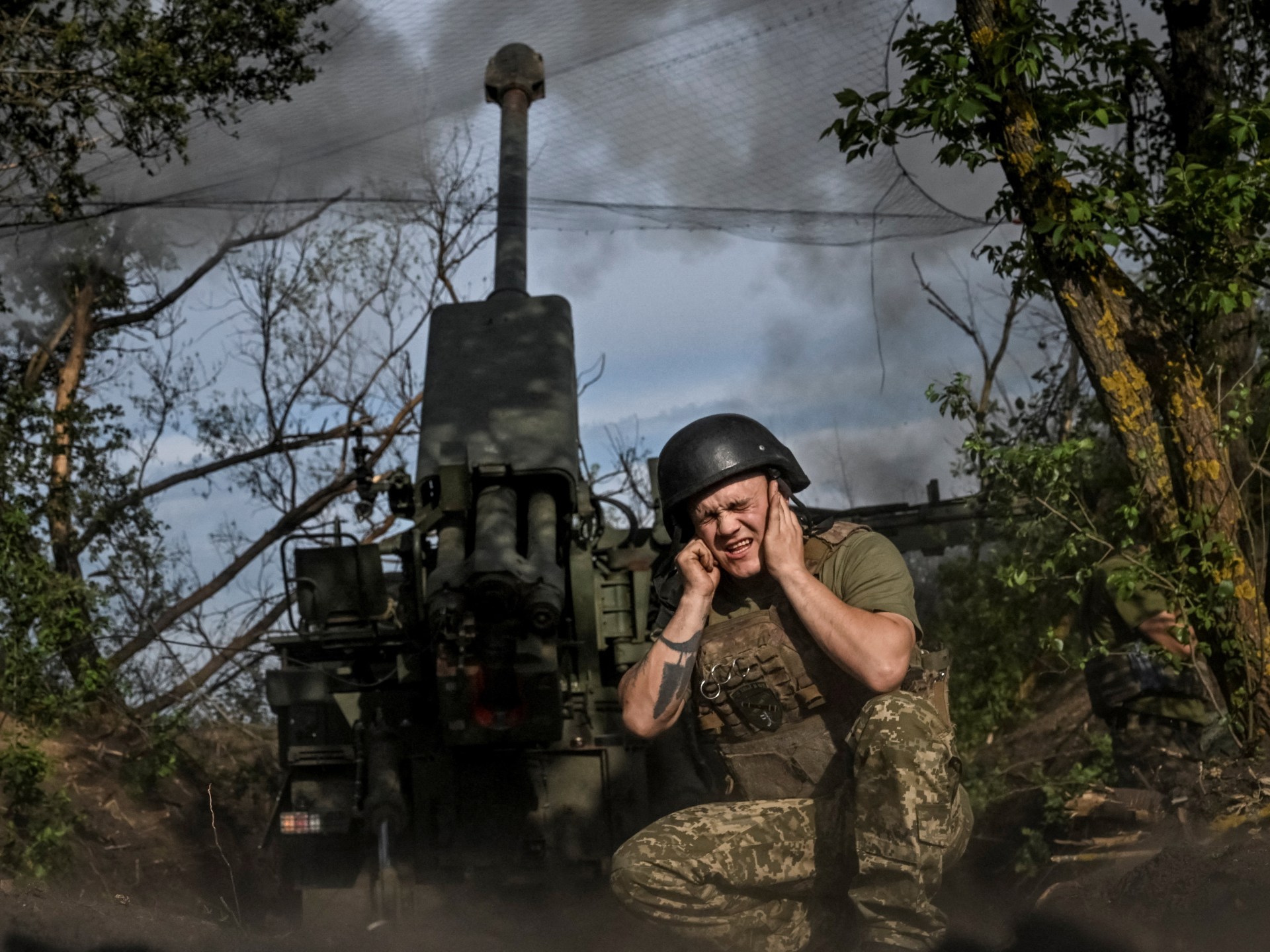

Ukraine’s ability to impede the flow of Russian supplies and personnel to the front lines has grown in recent days, from the southern regions of Zaporizhia and Kherson to the eastern front, and has forced the Russian army to a standstill, according to battlefield analysis.
Meanwhile, Ukraine has continued to strike refineries and munitions factories deep inside Russia, weakening its war effort.
- list 1 of 4Russia kills 12 in Ukraine as Kyiv mourns 707 children killed since 2022
- list 2 of 4Zelenskyy asks Putin for meeting: What’s he offering, could Russia accept?
- list 3 of 4IAEA brokers Ukraine ceasefire to allow nuclear plant repairs
- list 4 of 4Drone explosion in Romanian port spurs Ukraine war spillover fears
end of list
Sensing the growing strength of their position, Ukrainian forces struck the city of St Petersburg as Russian President Vladimir Putin arrived there for a high-profile economic forum, and President Volodymyr Zelenskyy wrote him an open letter telling him he could not win the war.
“Your resources are significantly dwindling,” Zelenskyy wrote. “You won’t have enough money and political power to continue buying the loyalty of Russians, as you’ve been doing for 26 years.”
Zelenskyy invited Putin to face-to-face talks. Russia did not respond directly, nor did it acknowledge its deteriorating battlefield situation.
There is one area where Zelenskyy conceded the Russians had an advantage.
“You hope that ballistics will do for you what everything else has failed to do,” he wrote to Putin.
Russia produces 120 ballistic missiles a month, Zelenskyy told the Ukraine-NATO Council, twice as many as the Patriot interceptors the United States produces.
“Compared to the current challenges, this is nothing,” Zelenskyy told Face the Nation.
The effectiveness of Russia’s ballistics was demonstrated on June 2, when it fired a cocktail of 656 drones and 73 missiles into Ukrainian civilian areas, killing 23 people and injuring at least 130.
Advertisement
Ukraine intercepted 91.7 percent of the drones and 90.6 percent of the cruise missiles, but only 27 percent of the ballistic missiles, according to its Air Force.
Serhiy Beskrestnov, Ukraine’s deputy defence minister, said Russia also keeps a strategic stockpile of 180-250 Iskander ballistic missiles, unlike other types of missiles, which are fired within a few months of manufacture, or drones, which are fired within two weeks of production.
“Ballistics is the last Russian argument in the war,” Zelenskyy wrote, and called for the US to allow it to produce Patriot interceptors under licence.
The US has refused to do so, but Zelenskyy has pledged to produce a Ukrainian version of the Patriot system by the end of 2027.

On May 31, Ukraine’s 3rd Army Corps said it had established fire control over the cities of Luhansk, Starobilsk, Alchevsk, Bryanka, and Kadiivka, all 50 to 90 kilometres (30 to 55 miles) inside occupied Luhansk, and was able to strike armoured vehicles and ammunition depots at the Russian border, 205km (130 miles) away.
It was the first time Ukraine declared it had such interdiction power over the eastern region.
Russian military reporters confirmed Ukraine’s capability to strike queues of Russian trucks lumbering through border checkpoints.
In addition to traffic, Ukraine has also begun striking training centres.
Ukraine’s Unmanned Systems Forces commander, Robert Brovdi, said that on Saturday his forces struck the Tryokhizbenko training ground of the Russian 3rd Army in Luhansk, incurring at least 30 casualties.

Ukraine has been constantly improving the range and performance of its drones, and has reportedly now sent a first-person view drone, normally a short-range weapon, more than 100km (60 miles) into enemy territory.
Ukraine’s Beskrestnov confirmed that Kyiv was also using drones to remotely mine major supply roads in occupied Ukraine, after this was reported on Russian military reporters’ sites.
Russia at a standstill
Ukraine’s tactics seem to be winning. Battlefield analysts have come to the conclusion that Russia is essentially at a standstill.
The Institute for the Study of War, a Washington-based think tank, recently assessed that Russia had made a net gain of just 104 square kilometres (40 square miles) this year.
In the past week, it said it had used new evidence to reassess those gains at 40.64sq km (15sq miles), including December 2025, judging that many of the areas previously thought to be Russian-controlled were merely infiltrated and contested.
Advertisement
Over the same period, the ISW said, Russia lost control of 281.1sq km (108sq miles) it had occupied, as Ukraine contested those lands.

The open source intelligence project DeepState estimated that Russia had gained a total of 14sq km (five square miles) in May, its worst performance since September 2023.
“There are practically no safe roads for the occupier in the south and east of our country,” wrote Zelenskyy on his Telegram messaging channel.
Russian Foreign Minister Sergey Lavrov confirmed that Moscow had heard Zelenskyy loud and clear, describing the Ukrainian leader’s intentions as being “to recapture these lands”.
Russia has insisted on shuttle diplomacy via Washington, but showed disappointment with the fact that United States President Donald Trump’s efforts to reposition the US as a neutral appeared to be failing.
“Right now, they’re saying in the EU: ‘We’re not mediators, we’re firmly on Ukraine’s side’. I was surprised that [Secretary of State] Marco Rubio said the same thing the other day while speaking in Congress,” Lavrov told RT Arabic.
He saw that as a departure from what Trump had promised Putin at their Alaska summit in August 2025.
Ukraine’s deep strikes
Ukraine also kept up its long-range strike campaign against Russian oil and defence infrastructure.
On May 30, it destroyed a ballistic missile launcher and two Tupolev-142 long-range strategic bombers at the Taganrog airbase on the Sea of Azov.
On Sunday, it hit the Saratov and Rostov oil refineries, followed by the Ilsky refinery, one of Russia’s largest, and the Novoshakhtinsky refinery on Tuesday.
On the eve of the St Petersburg International Economic Forum, Ukraine struck the St Petersburg oil terminal and heavily damaged a corvette, the Boykyi, berthed in the city.
There were numerous other strikes on oil storage tanks and pumping stations.
Related News
Iran war day 98: Tehran raises doubts on deal as Lebanon fighting continues

Tulsi Gabbard resigns as Trump’s top US intelligence official
Hilton, Becerra lead California governor race: Key primary election results