

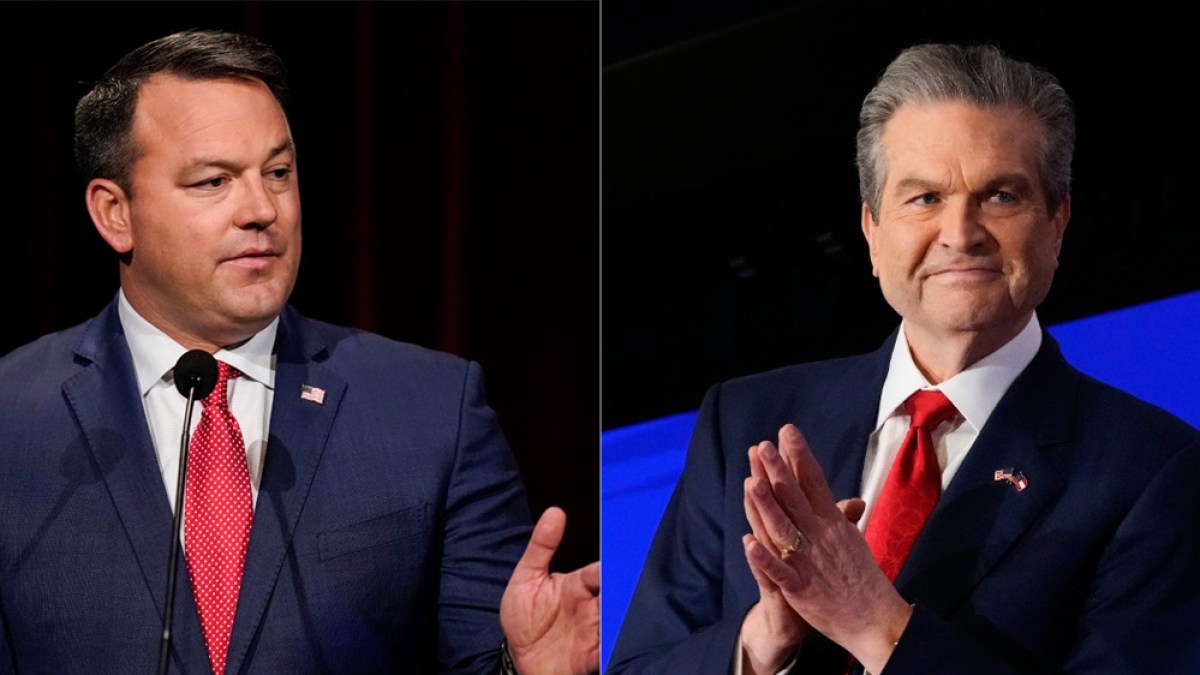

Burt Jones and Rick Jackson have advanced to a run-off in Georgia’s Republican primary for governor, extending a bruising fight over who will represent the party in November’s midterm election.
Jones, Georgia’s lieutenant governor, and Jackson, a healthcare billionaire, will face each other again in the June 16 run-off after neither secured enough support to win the nomination outright following voting on Tuesday.
- list 1 of 4Republican Thomas Massie who stood up to Trump defeated in Kentucky primary
- list 2 of 4What to know about Georgia’s primary as Republicans set sights on Senate
- list 3 of 4Vance: US ‘locked and loaded’ for military action if Iran talks fail
- list 4 of 4US President Trump, family granted immunity from pending tax audits
end of list
The winner will seek to replace Republican Governor Brian Kemp, who is barred by term limits from running again.
US President Donald Trump endorsed Jones last year, and Jones thanked him on Tuesday night. A victory for Jones would strengthen Trump’s influence in Georgia, a key battleground state where his record as a political kingmaker has been mixed.
Democrats are also choosing their nominee as they try to win the governor’s office for the first time since 1998.
The Democratic field includes former Atlanta Mayor Keisha Lance Bottoms, former Republican Lieutenant Governor Geoff Duncan, former state Senator Jason Esteves and former state labour commissioner Mike Thurmond.
Jasmine Clark secures nomination in key Georgia House race
Separately, Democrat Jasmine Clark won her party’s nomination on Tuesday to succeed late Representative David Scott in Georgia’s 13th Congressional District after Scott died in April while seeking another term.
Clark, a state representative, microbiologist and lecturer at Emory University, has pledged to prioritise science policy in Congress. Her campaign was boosted by more than $2m in outside spending from cryptocurrency-linked groups, although Clark said she did not seek their support.
Advertisement
She is expected to be heavily favoured in November’s election, where Jonathan Chavez is set to become the Republican nominee after running unopposed in the primary.
Meanwhile, two-term Representative Mike Collins advanced to the Republican run-off in Georgia’s US Senate race.
Collins, 58, who owns a family trucking business and represents a district east of Atlanta, has closely aligned himself with Trump and describes himself as a “MAGA workhorse”. Immigration enforcement has been a central focus of his campaign.
Georgia Republicans are seeking a challenger to Democratic Senator Jon Ossoff.
Among Collins’s rivals, representative Buddy Carter has highlighted his conservative record in Congress, while former college football coach Derek Dooley has presented himself as a political outsider.

Millions poured into Georgia governor race
More than $125m has been spent on advertising in the Republican primary for Georgia governor, with more than $66m of that spent by Jackson’s campaign, according to the latest figures from advertising-tracking firm AdImpact. By contrast, Democrats running for governor have only spent about $4m.
Jones argues that his conservative record as a state senator and lieutenant governor, combined with Trump’s support, should make him the clear choice for Republican voters.
“I think Georgia just spoke, y’all,” Jones said at his election night party.
“The reason why I know we’re gonna win is because of friends and family members,” he said.
Jackson is betting that his outsider pitch will win over anti-establishment conservatives. On Tuesday night, he called Jones a political insider who is “working inside the system for his own benefit”.
“I cannot be bought, and I will not back down,” Jackson said.
Related News

Turkiye unveils its first intercontinental ballistic missile: What we know

Thousands of protesters demand president’s resignation in Bolivia’s La Paz

Philippines vows to hand fugitive senator to ICC following shootout