

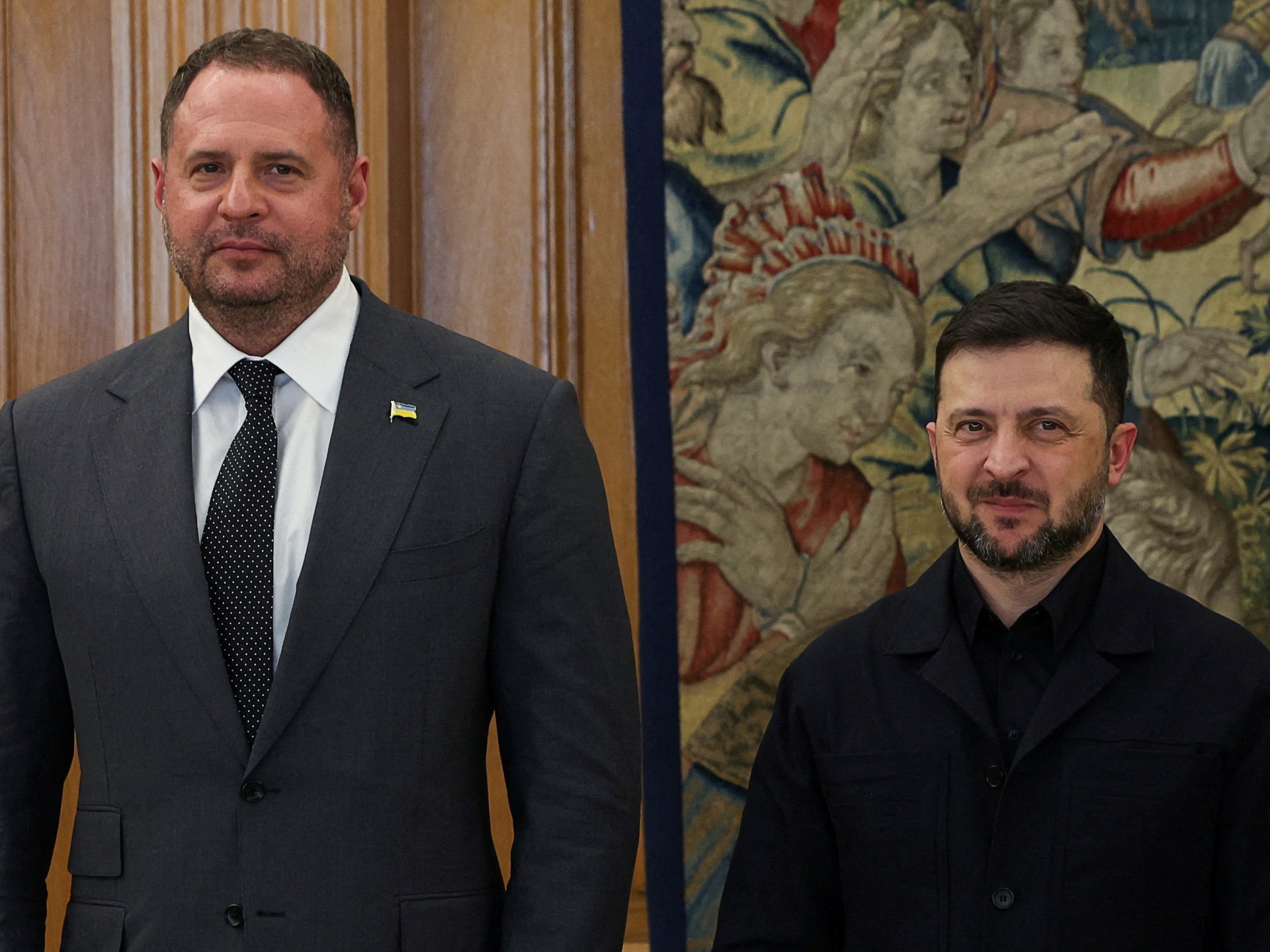

Andriy Yermak, Ukrainian President Volodymyr Zelenskyy’s former chief of staff and close aide, is now at the centre of the country’s biggest corruption investigation since Russia’s full-scale invasion in 2022.
Anticorruption authorities named him an official suspect on Monday in an alleged multimillion-dollar money laundering scheme linked to a luxury housing project outside the capital, Kyiv.
- list 1 of 3Tymoshenko vs Zelenskyy: Political clash over graft rocks wartime Ukraine
- list 2 of 3Watchdog warns against worsening corruption in democracies around the world
- list 3 of 3Once a popular wartime leader among Ukrainians, Zelenskyy’s shine fades
end of list
Yermak appeared at a Kyiv court on Tuesday for a hearing related to the charges, which are part of a widening probe drawing in other senior figures associated with the president, including his national security chief.
While Zelenskyy is not accused of any wrongdoing, the scandal could potentially threaten Ukraine’s aspirations for European Union membership as it seeks to convince the bloc that its anticorruption drive is on track.
So, what are the charges against Yermak? Are other allies of Zelenskyy also under a cloud of suspicion? And what does this mean for Ukraine’s standing with its Western allies?
What are the charges against Yermak?
Ukraine’s National Anti-Corruption Bureau (NABU) and the Specialized Anti-Corruption Prosecutor’s Office (SAPO) say Yermak is suspected of involvement in an organised criminal group that allegedly laundered about 460 million hryvnias ($10.5m) through a luxury real estate project near Kyiv.
Prosecutors are seeking to impose bail of about $5.4m on the 54-year-old while they continue their investigation.
Yermak, who resigned in November, has firmly rejected the claims. In a post on Telegram after a court hearing on Tuesday, he described the accusations as “unfounded”.
Advertisement
“As a lawyer with more than 30 years’ experience, I have always been guided by the law. And now, in the same way, I will defend my rights, my name and my reputation,” he said.

At one point during the hearing, Yermak told reporters that he “owns only one apartment and one car”.
His lawyer, Ihor Fomin, labelled the allegations against his client “groundless” and denied any role by Yermak in laundering funds through the high-end development. Fomin told Ukraine’s public broadcaster Suspilne that “this entire situation has been provoked by public pressure.”
NABU director Semen Kryvonos defended the proceedings, stating that authorities move to issue formal notices only when they believe they possess enough evidence to sustain charges in court. He clarified that Zelenskyy was not subject to any investigation.
But the case has dragged the shadow of corruption closer to the Ukrainian president than ever before. That’s because it isn’t just Yermak who has been caught up in the accusations of fraud.
Have other Zelenskyy allies been implicated, too?
Timur Mindich, a wealthy businessman who was Zelenskyy’s former partner from the entertainment world – the Ukrainian president is a former comedian – has emerged as another leading figure in the scandal. He left for Israel after corruption allegations surfaced last year.
The probe has also brought Rustem Umerov, the head of Ukraine’s National Security and Defence Council, into the crosshairs of the authorities. Umerov, who until last year was Ukraine’s defence minister, is Zelenskyy’s main representative in United States-backed diplomatic efforts to end Russia’s war on Ukraine.
Prosecutors say Umerov has been interviewed as a witness in the luxury real estate development case.
The case is part of a broader anticorruption operation, dubbed “Midas” and led by NABU and SAPO. The operation was first made public in November, when prosecutors accused Mindich of engineering a $100m kickback scheme at Energoatom, charges the businessman has refuted.
Zelenskyy has yet to publicly respond to the allegations involving Yermak. On Monday, a communications aide said it was premature to comment on the case.
Ukraine’s government in July passed a law in an effort to strip the independence of NABU and SAPO, which were established in 2014 after a pro-democracy uprising against the then-government of President Viktor Yanukovych.
Advertisement
Within days, protests broke out against the move, forcing Zelenskyy to reverse course and sign a new law to restore the anticorruption institutions’ independence.
Why does this matter?
The scandal has emerged at a particularly sensitive moment for Ukraine, as Kyiv continues to make the case for military and financial support from its allies in Western Europe and North America.
Last July, US senators Jeanne Shaheen and Lindsey Graham released a strongly worded statement denouncing the attempt by the government to, at the time, curb the anticorruption work of NABU and SAPO.
“One of the most widely used talking points for ending support for Ukraine is that it was awash with corruption,” they said. “We acknowledge that Ukraine continues to make progress on this front and we urge the government to refrain from any actions that undermine that progress.”
Moreover, Ukraine’s bid to join the EU has increased pressure on Zelenskyy’s administration to demonstrate institutional independence and accountability.
German Chancellor Friedrich Merz last month cautioned against a quick accession of Ukraine to the EU, saying Ukraine cannot join the bloc due to several key concerns, including ending the war and fighting corruption.
Ukrainian opposition politician Oleksiy Goncharenko said the allegations had now reached a point that Zelenskyy “personally cannot ignore”.
However, Olena Halushka, a board member at the Anti-Corruption Action Centre in Kyiv, said the case against Yermak and others was a “clear example that the checks and balances system really works”.
Speaking to Al Jazeera, Halushka said it proved that in Ukraine there are “law enforcement institutions functioning independently and professionally, exercising their powers in defence of democracy”.
“These institutions were protected by the Ukrainian society and European partners from the political attack last summer, and now we see the tangible results of their activities,” she added.
In a survey conducted on May 6 by the Kyiv International Institute of Sociology, 54 percent of Ukrainians said corruption was a bigger threat to the country than the war with Russia.
Related News
Turkiye unveils its first intercontinental ballistic missile: What we know
Myanmar’s blanket prison term reduction trims Aung San Suu Kyi’s sentence
At least nine people killed in explosion at Pakistan market