

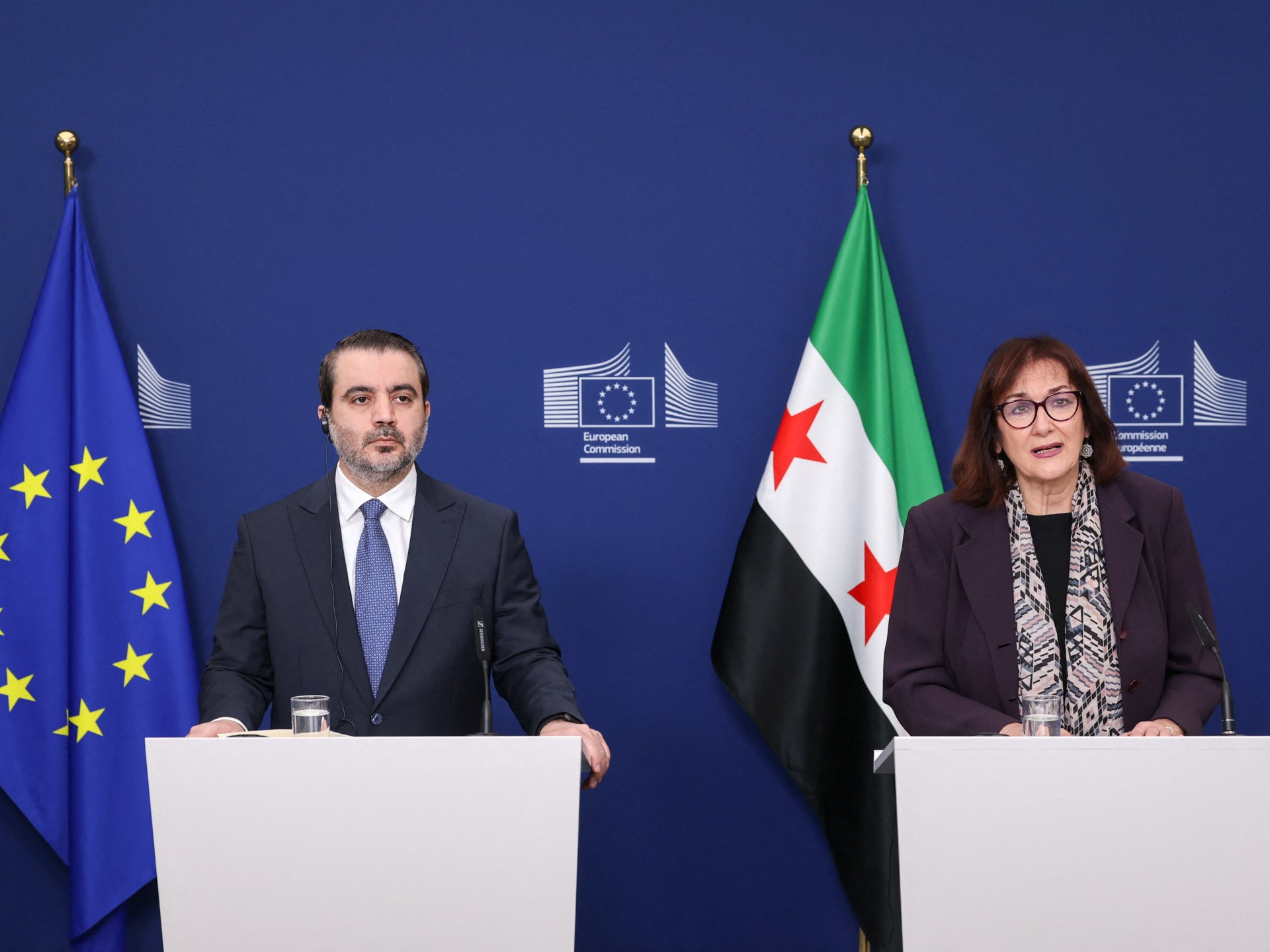

The European Council has terminated the partial suspension of a cooperation agreement with Syria, thereby restoring fuller trade ties with the country as it seeks to emerge from nearly 14 years of war.
The council said on Monday the move marked an important step towards strengthening relations between the European Union and Syria.
- list 1 of 4Syria sees first government reshuffle since al-Assad’s ouster
- list 2 of 4Syria becomes alternative energy corridor for oil as Hormuz effectively blo
- list 3 of 4Syria says it dismantled Hezbollah-linked cell plotting assassinations
- list 4 of 4From exile to judge: Symbolism in Syria’s trial of Assad, former officials
end of list
The decision “sends a clear political signal of the EU’s commitment to re-engage with Syria and support its economic recovery”, the European Council added in a statement.
At the same time, the EU’s foreign ministers met in Brussels with top Syrian diplomat Asaad al-Shaibani, kicking off a high-level political dialogue 18 months after the removal of Syrian strongman Bashar al-Assad.
The 27-nation bloc has launched a new chapter with Syria after al-Assad was swept from power in December 2024.
European Commission chief Ursula von der Leyen promised after meeting interim Syrian President Ahmed al-Sharaa in Damascus in January that Europe would “do everything it can” to support Syria’s recovery.
The commission proposed that EU states fully reactivate the bloc’s cooperation agreement with Syria last month.
The deal, which abolished duties on imports of most industrial products from Syria, was partially suspended in 2011 when al-Assad’s regime cracked down on antigovernment protests at the start of a civil war.
Syria-EU trade had peaked in 2010 at more than 7 billion euros ($9.1bn at the 2010 exchange rate).
By 2023, EU imports from the country had dwindled to 103 million euros ($120m) while European exports to Syria stood at 265 million euros ($310m).
Advertisement
On the sensitive matter of Syrian refugee returns, Germany, home to the EU’s largest Syrian community at more than a million people, is on the front line.
Chancellor Friedrich Merz has embraced tougher migration policies as he seeks to counter the far right, and he triggered a backlash by declaring during a visit by Syria’s president last month that he hoped 80 percent of Syrian refugees would return home within three years.
He later clarified this was a figure put forward by al-Sharaa himself.
Related News

Israel to release two detained Gaza flotilla activists
Japan’s Takaichi pledges deeper energy cooperation with Vietnam
Is Egypt threatening Israel through its military exercises on the border?