
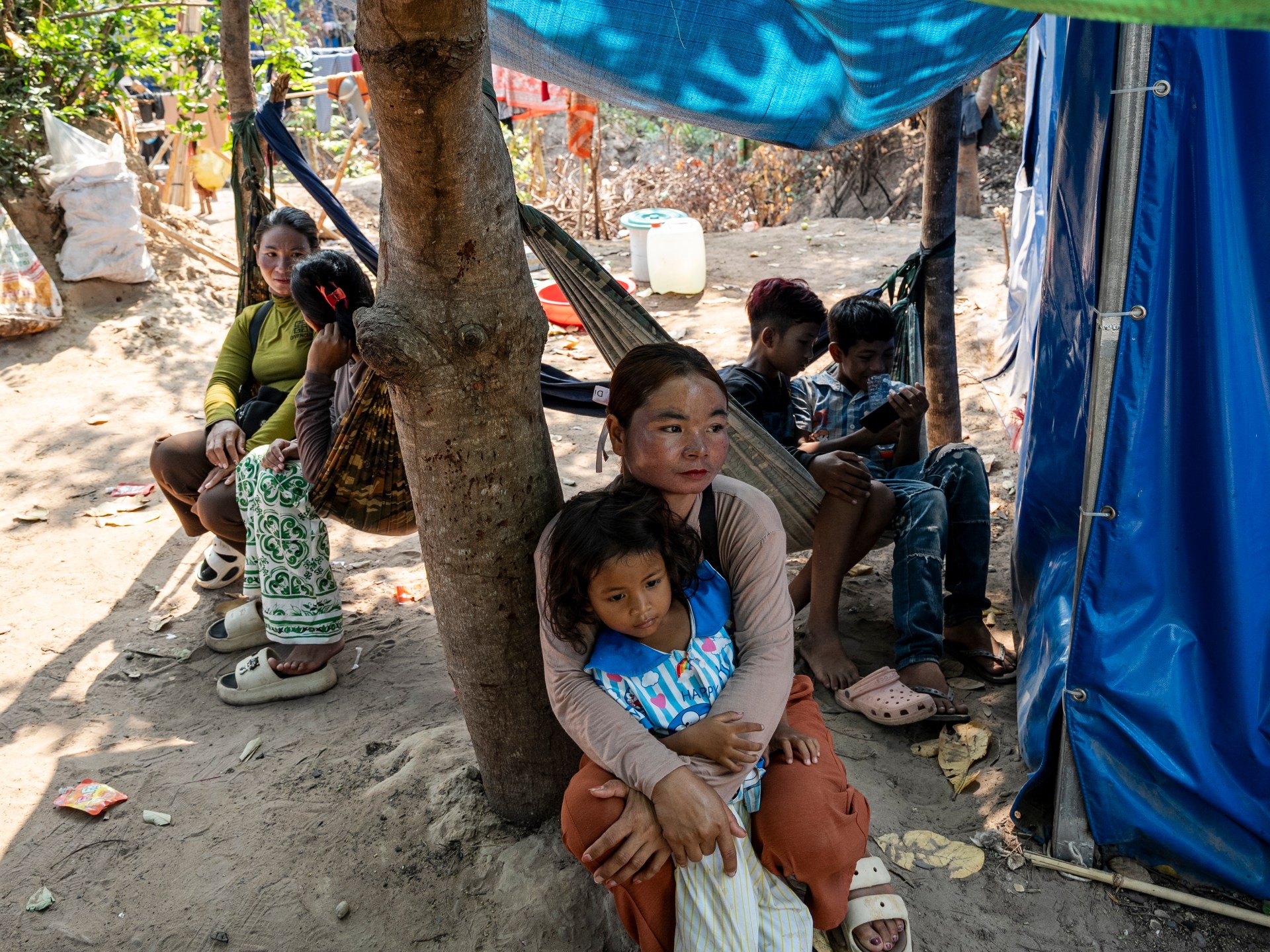

Preah Vihear/Siem Reap provinces – When asked how she spends her day, 11-year-old Sokna rattled off a list of chores.
She first fetches water, then washes dishes and sweeps the leaves and dust from around the blue tarpaulin tent her family now calls home, in the grounds of a Buddhist pagoda in northwestern Cambodia.
- list 1 of 4Cambodian PM says Thailand occupying ‘deep’ territory after ceasefire
- list 2 of 4Southeast Asia shuts offices, limits travel as oil crisis deepens
- list 3 of 4Cambodia parliament approves law to combat cybercrime scam rings
- list 4 of 4US sanctions Cambodian senator over purported scam network links
end of list
Sokna and her sister have stopped attending school, their mother Puth Reen said, since moving to this camp for people displaced by the recent rounds of fighting between Thailand and Cambodia.
The two sisters are among more than 34,440 people who remain in displacement camps in Cambodia – 11,355 of whom are children – as of this month, according to the country’s Ministry of Interior.
“I tried to tell them to go to school, but they don’t go,” Puth Reen told Al Jazeera, explaining how precarious life had become since returning to live in Cambodia after fleeing neighbouring Thailand, where she had worked for many years, as the fighting started.
Like Puth Reen and her family, the future looks murky for the tens of thousands of Cambodians – including many schoolchildren – who are still in displacement camps, and their lives remain disrupted months after the last outbreak of fighting between Thailand and Cambodia.
Forced to flee their homes in areas where local troops are now stationed and on high alert, or in areas occupied by opposing Thai forces, Cambodia’s internally displaced say they are surviving off aid donations, while those more fortunate are transitioning from emergency tents into wooden stilted houses provided by the Cambodian government.
But with tension still evident between the leadership in Bangkok and Phnom Penh, the tenuous ceasefire along the Thai-Cambodia border means life cannot yet return to normality.
Advertisement
Some areas on the Cambodian border, such as the villages of Chouk Chey and Prey Chan in Banteay Meanchey province, have become rallying points for nationalists who post on social media about the Thai occupation of Cambodian territory. Their anger is directed at the large shipping containers and barbed wire that Thai forces have used to block access to villages once inhabited by Cambodians and occupied during fighting.
The Thai military-installed containers now form a sort of new frontier between the two countries.
The Cambodian military has also prevented people, such as local farmer Sun Reth, 67, from returning to their homes in front-line areas, which are still highly militarised zones, with troops ready at any moment for a new round of fighting.
“Now the Cambodian military base is just next to [my house],” Sun Reth said, adding that she was not allowed by authorities to sleep in her modest home or pick cashew nuts from her farm to sell for a little income.
Cambodian children more focused on ‘rumours’ of war
The long-held border dispute between Thailand and Cambodia erupted into two rounds of conflict last year, over five days in July and almost three weeks in December.
Dozens were reported killed on both sides, and hundreds of thousands of civilians fled their homes as both countries’ armed forces fired artillery, rockets, and, in the case of Thailand, conducted air strikes deep into Cambodian territory. Thailand has a modern air force, a military capability not possessed by its smaller neighbour.
Cambodian and Thai officials reached a ceasefire on December 27, but the situation remains tense five months on.
For families who fled the fighting, school continues for most children in the displacement camps, but parents say education is fragmented while their lives are still so unsettled.
Mothers at the Wat Bak Kam camp for the displaced in Preah Vihear province told Al Jazeera that primary school students can join classes at a local school, but high school students need to travel daily to the provincial capital, about 15km (9 miles) away.

Now the rising cost of petrol, due to the US-Israel war on Iran, has made it even harder for teenaged students, who have access to motorcycles, to make the journey to school.
Kinmai Phum, technical lead for WorldVision’s education programme, which is providing support to the camps, said school dropout rates and children skipping classes have increased substantially among students from the displaced border regions.
Advertisement
Kinmai Phum said the situation is a perfect storm of problems: Displaced families have been forced to move around for shelters, schools and temporary learning spaces lack facilities, and some students have psychological trauma due to the conflict.
“Local authorities [are] concerned that many children may not return to school at all if displacement and economic hardship persist,” Kinmai Phum said.

Yuon Phally, a mother of two, said she had noticed the impact of the war on her daughter and son, who are in their first and third years in primary school.
When they return from school, Yuon Phally said, they tell her about rumours they had heard about Cambodia and Thailand resuming fighting.
“Their feeling is not fully focused on school; they focus more on these rumours,” she said.
Her children’s world was more impacted by the conflict because their father is a soldier stationed in the Mom Bei area of the border.
During the fighting in December, Yuon Phally said she could not convince her children to go to school because they all waited to see if their father would call on a mobile phone from the front line.
“I couldn’t hold back my tears, and that added more pressure onto my kids,” she said.
“They would ask about their dad and how he is doing now. Then they told me to eat rice. They understood my feelings.”
She said her children’s focus on their studies only improved after their father returned from fighting to the camp where they are staying, to rest and recover from sickness and injuries sustained in battle.

‘Who doesn’t want to have peace?’
Soeum Sokhem, a deputy village chief, told Al Jazeera how his home is located in the militarised “danger zone” along the border, but he feels compelled to return every few days to check on his house, tend crops, sleep an occasional night, and check in with other neighbours doing the same.
“I can’t just stay here”, he said of camp life.
“I have to go back.”
When asked how he felt about the border war, Soeum Sokhem said he had experienced so much war in Cambodia that he did not know how to describe his “inner feeling like I really want to”.
He then listed off all the conflicts he had lived through in Cambodia since the 1960s: The spill over into Cambodia from the US war in neighbouring Vietnam; the US bombing campaign in Cambodia; the genocidal Khmer Rouge regime, and the civil war that followed after Vietnam’s intervention to topple the regime’s leader Pol Pot in 1979, and which lasted until the mid-1990s.
Then in the 2000s, sporadic border fights with Thailand began, he said.

Cambodia’s contemporary history has been anything but peaceful, a fact which might explain why the current Cambodian government so often speaks of peace. Government buildings and billboards proclaim the government’s unofficial motto: “Thanks for peace.”
Advertisement
“But who doesn’t want to have peace?” Soeum Sokhem said, after charting his life and the many conflicts he had lived through.
Now the 67-year-old said he once again hears gunfire occasionally when he returns to check on his home on the front line.
“Before, when I walked there, it was normal,” he said.
“But nowadays, I walk with fear when going back there.”
Related News
Virginia Supreme Court strikes down Democrats’ redistricting plan in US
Spain’s Canary Islands brace for incoming hantavirus-stricken cruise ship
Australian women with alleged ISIL ties returning from Syria, minister says