
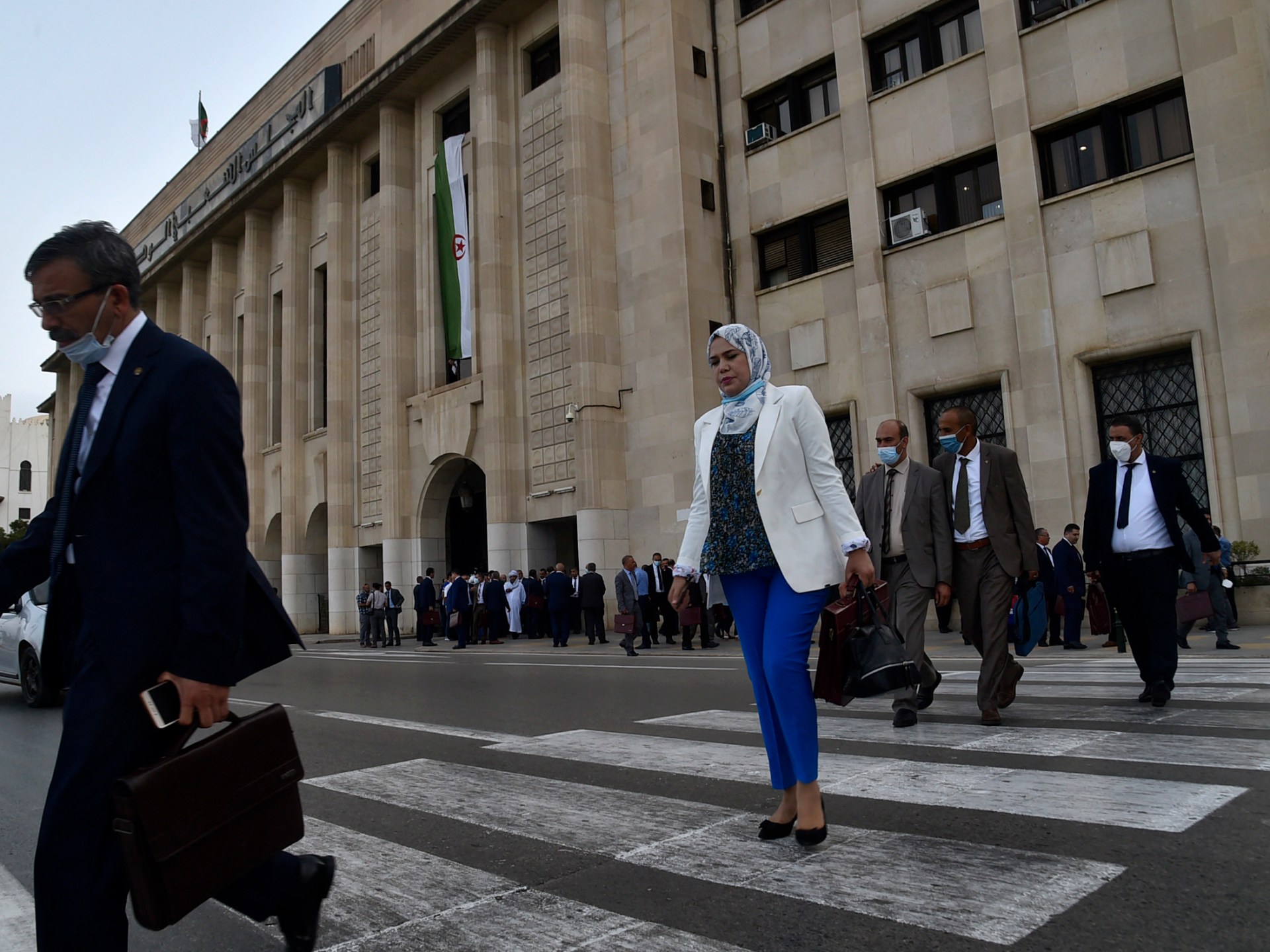

Lawmakers in Algeria have begun debating a draft law that would criminalise France’s colonisation of the North African country amid a period of tense ties between the two countries, according to the People’s National Assembly.
French colonial rule in Algeria lasted for more than 130 years, which was marked by torture, enforced disappearances, massacres, economic exploitation and marginalisation of the Indigenous Muslim population.
Algeria gained independence from France in 1962, but it came at a high human cost: up to 1.5 million people are believed to have been killed, thousands disappeared and millions displaced.
Here is what we know about the draft legislation.
The draft law, which seeks to criminalise France’s colonial rule in Algeria between 1830 and 1962, was introduced in the People’s National Assembly, Algeria’s lower house of parliament, on Saturday.
The bill will go up for a vote on Wednesday, according to reports.
Public broadcaster AL24 News reported that the draft, which contains five chapters comprising 27 articles, is based on “the principles of international law that affirm peoples’ right to legal redress” and “the achievement of historical justice”.
It aims to “establish responsibility, secure recognition and an apology for crimes of colonialism as a foundation for reconciliation with history and the protection of national memory,” the channel reported.
What has the speaker said?
Introducing the bill, Speaker Ibrahim Boughali said it was not just a legal text, but a “defining milestone in the course of modern Algeria”.
Advertisement
“It is a supreme act of sovereignty, a clear moral stance, and an unambiguous political message, expressing Algeria’s commitment to its inalienable rights and its loyalty to the sacrifices of its people,” Boughali said, according to the Anadolu news agency.
He noted that France’s colonisation of the country was “not limited to the plundering of wealth”.
“It also extended to policies of systematic impoverishment, starvation, and exclusion aimed at breaking the will of the Algerian people, erasing their identity, and severing their ties to their … roots,” he said.
How has France responded?
The French government has not yet responded to the debate.
But French President Emmanuel Macron has previously said he would not apologise for the colonisation of the country.
He told Le Point magazine in 2023 that he would not ask forgiveness from Algeria but intended to work towards reconciliation with Algerian President Abdelmadjid Tebboune.
“It’s not up to me to ask forgiveness,” he said in the interview, the AFP news agency reported.
“The worst thing would be to decide: ‘we apologise and each go our own way’,” Macron said. “Work on memory and history isn’t a settling of all accounts.”
France ruled Algeria from 1830 until being driven out as a colonial power in a brutal war of independence that raged from 1954 to 1962.
Some 1.5 million Algerians were killed in the war, with French forces accused of gross human rights violations and war crimes, including systematic torture, summary executions and enforced disappearances. The French colonial forces also destroyed thousands of villages, forcibly displacing some two million Algerians.
In 2018, France acknowledged it was responsible for systematic torture during the war.
How are relations between France and Algeria?
Algeria and France maintain enduring ties through immigration in particular, but the parliamentary debate comes amid friction in the relationship.
Tensions have been high for months since Paris recognised Morocco’s autonomy plan for resolving the Western Sahara conflict in July 2024. Western Sahara has witnessed armed rebellion since it was annexed by Morocco after the colonial power, Spain, left the territory in 1975.
Algeria supports the Sahrawi people’s right to self-determination in Western Sahara and backs the Polisario Front, which rejects Morocco’s autonomy proposal.
In April, the tensions escalated into a crisis after an Algerian diplomat was arrested along with two Algerian nationals in Paris. The diplomatic crisis came barely a week after Macron and Tebboune expressed their commitment to revive dialogue.
Advertisement
Related News
Far-right candidate Jose Antonio Kast wins Chile’s presidential election
Why is Trump demanding travellers’ social media handles; how will it work?
Russia-Ukraine war: List of key events, day 1,387